
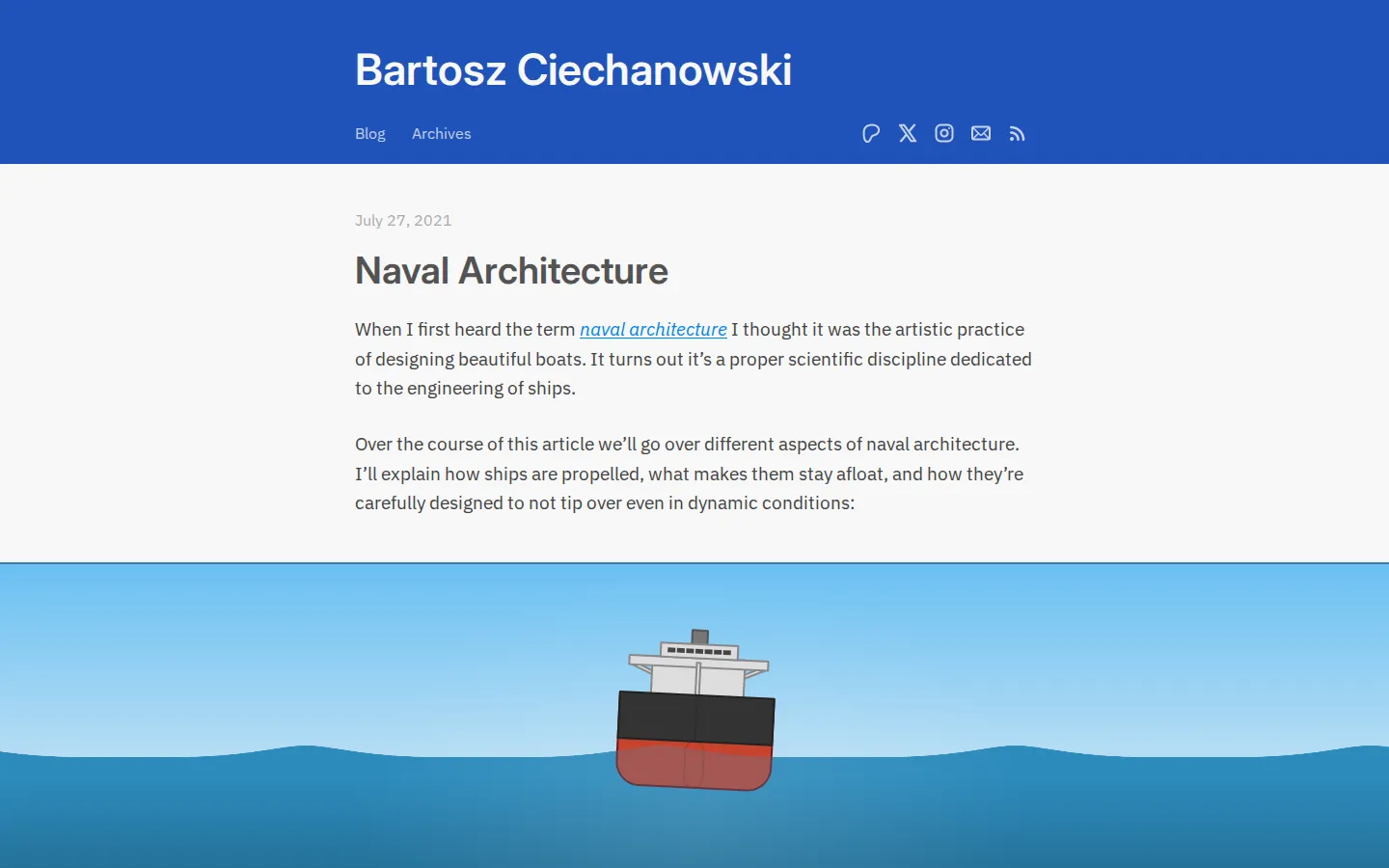
Naval Architecture turns ship physics into a patient chain of visual demonstrations. It begins with water pressure, builds toward buoyancy and hull stability, then loads the deck, sloshes the tanks, and twists the propeller blades. The result is a substantial engineering lesson that lets intuition arrive before the jargon does.
What is Naval Architecture?
The article starts with syringes, gauges, and submerged blocks, so the forces holding up a steel ship never appear by magic. From there, the examples grow into hull cross-sections, righting arms, cargo stacks, partly filled tanks, and screw propellers. Controls described throughout the page let readers change forces, proportions, loads, and viewing angles while nearby plots and arrows explain the consequences. Equations remain part of the voyage, but each one is tied to a concrete picture rather than dropped onto the deck without warning.
What you can do there
- Read a visual explanation of how ships float and stay stable
- Adjust demonstrations of pressure, hulls, cargo, and propulsion
Why we picked it
Few explainers make a container ship feel like a laboratory instrument. This one connects small changes in hull shape or cargo position to visible changes in balance, then carries that same cause-and-effect approach into propulsion. It is unusually good at turning an intimidating discipline into a sequence of questions worth poking.
How to get the most from it
Give the early pressure and buoyancy sections time to establish the vocabulary. When a control appears, change one variable at a time and watch the force arrows or stability plot before moving on. The cargo and free-surface sections are especially rewarding once center of gravity and center of buoyancy feel familiar.
Good to know
This is a long, equation-friendly read rather than a five-minute toy. Many demonstrations are described as animated, draggable, or slider-controlled, so a larger screen should make the diagrams easier to study. The author explicitly presents the propeller discussion as a simplified introduction, not a substitute for professional naval-engineering guidance.
Who made it, and when?
Bartosz Ciechanowski is the credited creator or organization.
Creator’s official page Open Naval ArchitectureMore like this
Stellarium Web

Turn the browser into a planetarium matched to the sky above your location.
The Scale of the Universe 2

Slide from the smallest known scales to the largest structures in the observable universe.
100,000 Stars
Fly from the Sun into a 3D neighborhood of one hundred thousand nearby stars.
WorldWide Telescope

A sky atlas with a time machine tucked into its controls