
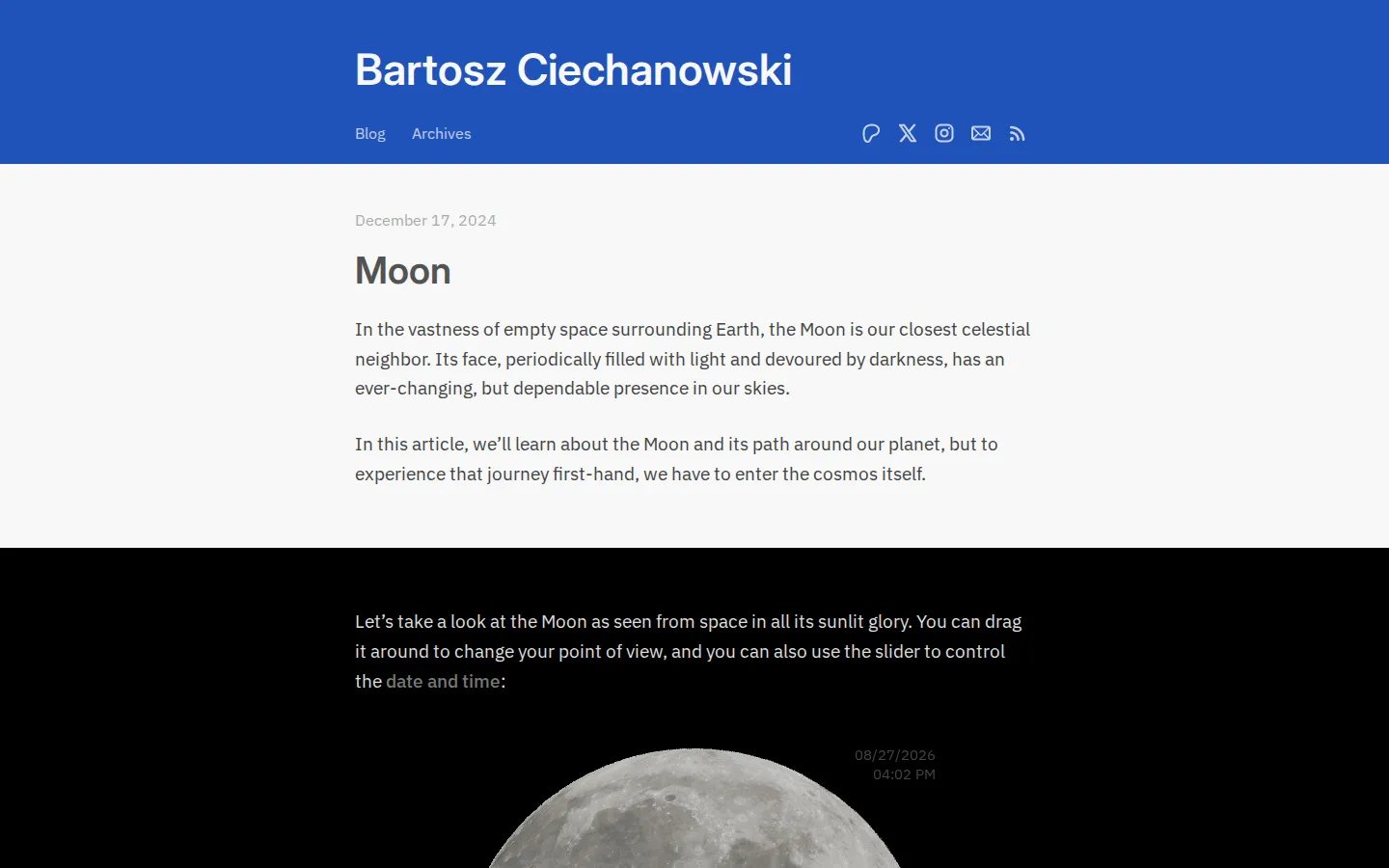
Moon is Bartosz Ciechanowski's expansive visual explanation of our nearest celestial neighbor. It works outward from scale and orbit into what the Moon looks like from Earth, then keeps going through gravity, phases, eclipses, tides, surface detail, and reflected light. This is a sit-down-and-stay-awhile article, not a quick diagram with a paragraph attached.
What is Moon?
The page builds its argument a piece at a time. Early comparisons establish how small, massive, and distant the Earth and Moon are relative to one another; later sections shift between viewpoints in space and on the ground so apparent motion stops feeling like a flat textbook sketch. The article describes draggable models, time scrubbers, changing viewpoints, speed controls, and size toggles as working parts of the explanation. That patient accumulation is the trick: phases, eclipses, libration, tides, and lunar brightness arrive after the geometry needed to make them click.
What you can do there
- Read a visual explanation of lunar motion
- Manipulate the article's described models and time controls
Why we picked it
Few explainers are willing to spend this much visual attention on a single familiar object. Moon earns its length by repeatedly changing scale and perspective, letting the same Earth-Moon-Sun system answer different questions instead of throwing isolated diagrams at the reader. It feels less like scrolling through a lesson and more like unpacking a compact observatory one instrument at a time.
How to get the most from it
Give it a proper reading session rather than a two-minute skim. Move through the sections in order, pause at each model, and use one control at a time before combining viewpoint and time changes. The metric and imperial options are useful if an unfamiliar unit starts getting between you and the scale of the scene.
Good to know
The article was published on December 17, 2024, is written in English, and its reading layer is openly accessible. It is exceptionally long and visually ambitious, so readers looking for one fast answer may prefer to stop after the relevant section. Live interaction, device support, accessibility, motion preferences, audio, and runtime privacy behavior have not been independently verified.
Who made it, and when?
Bartosz Ciechanowski is the credited creator or organization. The earliest supported launch date we found is December 17, 2024.
Creator’s official page Open MoonMore like this
Stellarium Web

Turn the browser into a planetarium matched to the sky above your location.
The Scale of the Universe 2

Slide from the smallest known scales to the largest structures in the observable universe.
100,000 Stars
Fly from the Sun into a 3D neighborhood of one hundred thousand nearby stars.
WorldWide Telescope

A sky atlas with a time machine tucked into its controls