
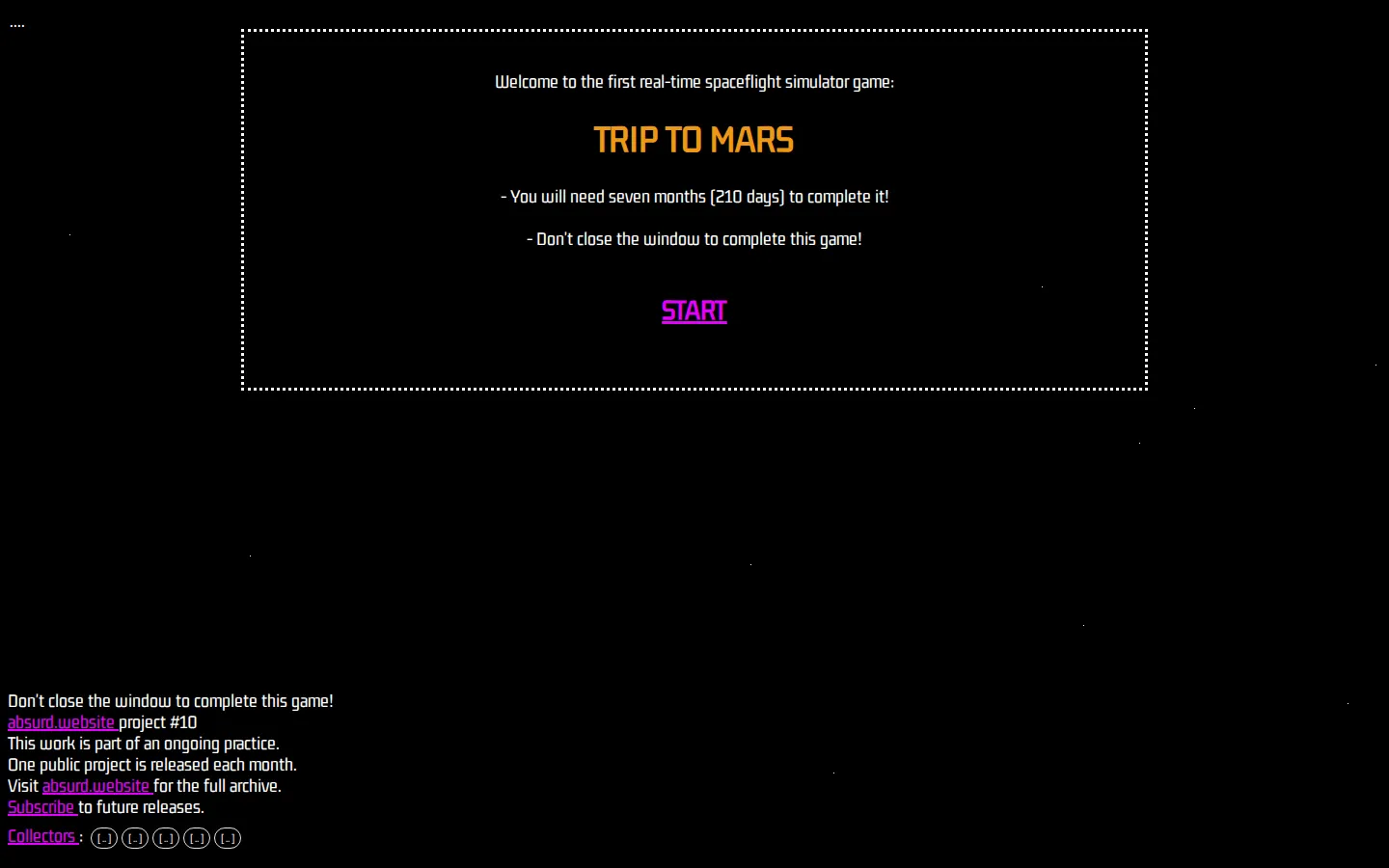
Trip to Mars turns one click into a 210-day commitment: start a real-time flight and keep the window open for seven months. The joke is immediate; the finish line is intentionally unreasonable.
What is Mission to Mars?
The page is admirably blunt: one Start control, a Mars-bound premise, and two rules—allow 210 days and do not close the window. That turns an ordinary browser tab into a comically fragile spacecraft. Trip to Mars is project number 10 in Absurd.website's archive, where startup-shaped web experiments are treated as conceptual artworks. You can understand the gag in seconds, but completing it demands the kind of patience normally reserved for actual mission control.
What you can do there
- Start a simulated trip to Mars
- Keep the page open for 210 days
Why we picked it
Its entire punch line depends on refusing the browser's usual promise of instant payoff. The 210-day rule makes a tiny Start button feel absurdly consequential, which is exactly the sort of clear, committed internet idea worth preserving.
How to get the most from it
Read the rules before pressing Start. Treat the 210-day finish as conceptual unless you are willing to keep the window open continuously; the destination itself warns that closing it prevents completion.
Good to know
Plan on a continuously open window: the page says closing it prevents completion. Timer persistence, mobile behavior, and audio are not documented there. Viewing is public; collectible ownership is a separate option.
Who made it, and when?
Janis Kauss is the credited creator or organization. The earliest supported launch date we found is September 2021.
Creator’s official page Open Mission to MarsMore like this
DevLids

A little museum of the laptop backs that attended every meetup before the stickers started peeling.
The Nicest Place on the Internet

A live find from internet culture.
Tamaweb

A browser Tamagotchi with chores, evolution branches, and a surprisingly busy little social calendar.
Webkay

A candid browser-data mirror with a few cobwebs in the corners