
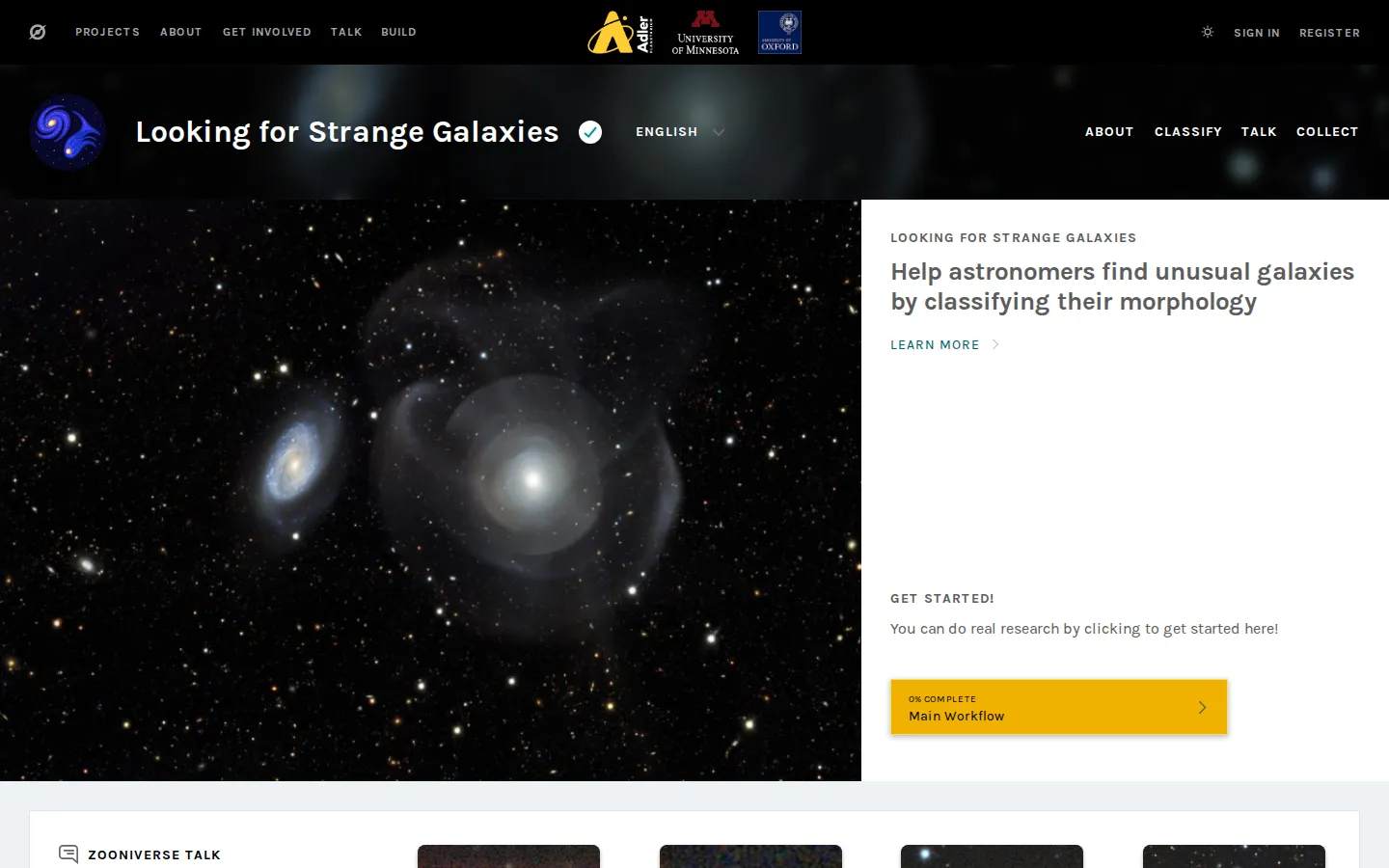
Looking for Strange Galaxies turns telescope cutouts into quick citizen-science decisions. You inspect a galaxy, answer morphology questions, and help a Chile-centered research team flag mergers, tidal tails, lopsided disks, and jellyfish-like systems for deeper study.
What is Looking for Strange Galaxies?
The appeal is wonderfully specific: instead of admiring a polished space picture and moving on, you are asked to notice what looks structurally strange. The project draws from DECam imagery in DESI Legacy Imaging Surveys DR10 and focuses on galaxies connected to the CHANCES spectroscopy program. Its questions are meant to turn human pattern recognition into useful morphology labels, especially for rare or borderline shapes that are awkward to catch with simple rules. A tutorial and field guide provide examples, while Talk offers a place to bring genuinely puzzling cases to other classifiers and the research team.
What you can do there
- Inspect telescope-image cutouts and answer morphology questions
- Flag unusual galaxy features for scientific follow-up
- Consult the tutorial, field guide, or discussion area when a case is unclear
Why we picked it
It makes the scientific value of looking closely feel immediate. One odd double core or one-sided trail is not merely space wallpaper; it can be a clue to a merger, tidal encounter, or gas stripping. The project also keeps the task bite-sized, so a spare minute can become a small piece of a much larger catalog rather than another scroll through cosmic glamour shots.
How to get the most from it
Read the tutorial before your first batch, then compare each target with the field-guide examples instead of chasing a dramatic answer. Mark an image unclear when the target is obscured, and use Talk for the cases where a nearby object or edge-on view makes the morphology ambiguous. A few careful classifications beat a speed run through fuzzy galaxies.
Good to know
No astronomy background is expected, and the project says an individual task usually takes about 10 to 30 seconds. Personal statistics are tied to sign-in, but the actual classification, saving, and account flows were not executed for this field note. The landing and detailed statistics views also showed conflicting live totals, so treat progress counters as changeable interface data rather than a settled measure of participation.
Who made it, and when?
Looking for Strange Galaxies research team is the credited creator or organization. The earliest supported launch date we found is June 25, 2026.
Creator’s official page Open Looking for Strange GalaxiesMore like this
Stellarium Web

Turn the browser into a planetarium matched to the sky above your location.
The Scale of the Universe 2

Slide from the smallest known scales to the largest structures in the observable universe.
100,000 Stars
Fly from the Sun into a 3D neighborhood of one hundred thousand nearby stars.
WorldWide Telescope

A sky atlas with a time machine tucked into its controls