
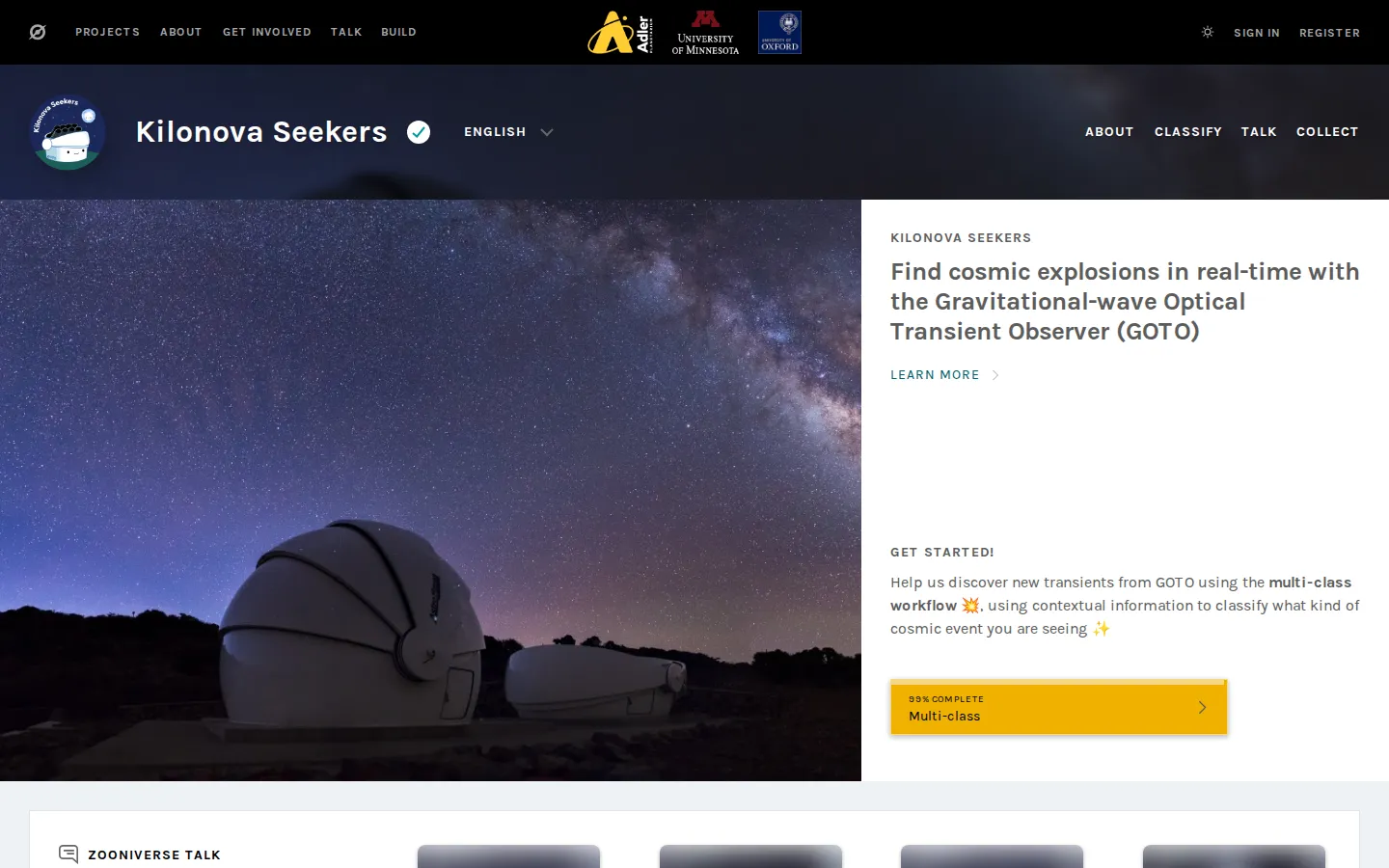
Kilonova Seekers turns fresh telescope detections into a careful visual sorting task. Compare a recent sky image with an older reference and a difference view, then help decide whether the bright speck in the crosshairs is a real cosmic transient or a camera-shaped red herring.
What is Kilonova Seekers?
The core idea is pleasingly concrete: three views of the same patch of sky, one question about what changed, and a second pass to name the likely kind of transient or image artefact. The pictures come from GOTO, a two-site optical survey built to chase the visible afterglows of gravitational-wave events and to catch other short-lived phenomena. Kilonova Seekers routes uncertain detections to volunteers because those awkward edge cases are exactly where automated classifiers can stumble. Many judgments are combined before a promising candidate reaches the research team, so a single click is a vote rather than a discovery certificate. This is not merely busywork dressed in starlight: the project's first six months produced more than 600,000 classifications, 20 first discoveries, and a sizeable labelled dataset for better machine-learning tools. Its 2026 Generation 3 workflow adds contextual imagery and more specific labels, giving each tiny cosmic blot a little more scientific texture.
What you can do there
- Compare science, reference, and difference images
- Classify a candidate as a transient or imaging artefact
Why we picked it
It compresses active time-domain astronomy into a task you can understand in a minute without pretending the science is simple. The difference-image format makes uncertainty visible, while the public results ledger shows how volunteer consensus can travel onward into reports and follow-up. There is a lovely tension here: you are looking for a pinprick, but the pinprick may be the loudest thing happening in its galaxy.
How to get the most from it
Start with the tutorial and field guide, then compare the science image against the older reference before studying the difference view. A genuine candidate should sit near the crosshairs and appear in the recent image without a matching source in the reference. Use the more specific second-stage labels only when the shape supports them; uncertainty is more useful than an enthusiastic guess.
Good to know
Work arrives in telescope-driven batches. During this check the landing page showed a fresh upload time but also 100 percent completion and zero active subjects, so an empty queue may simply mean the sky or pipeline is between deliveries. Many people inspect each subject, and promising consensus goes to the GOTO team for follow-up. You can classify without treating every bright dot as a kilonova; known supernovae, variable stars, and imaging artefacts are all part of the hunt. Log in if you want the project to identify and credit you for a discovery.
Who made it, and when?
GOTO collaboration is the credited creator or organization. The earliest supported launch date we found is July 11, 2023. A documented update was recorded February 20, 2026.
Creator’s official page Open Kilonova SeekersMore like this
Stellarium Web

Turn the browser into a planetarium matched to the sky above your location.
The Scale of the Universe 2

Slide from the smallest known scales to the largest structures in the observable universe.
100,000 Stars
Fly from the Sun into a 3D neighborhood of one hundred thousand nearby stars.
WorldWide Telescope

A sky atlas with a time machine tucked into its controls