
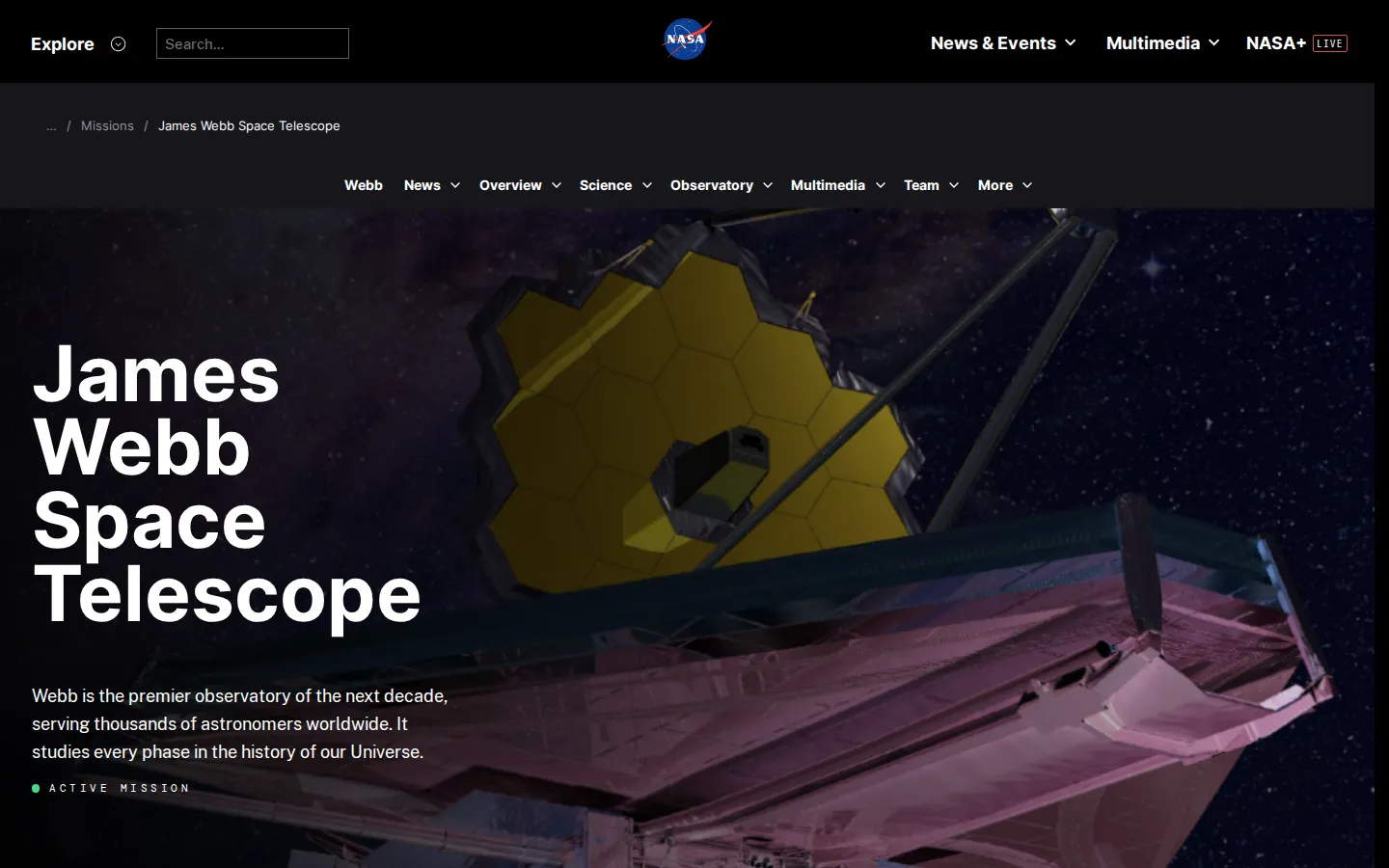
NASA’s Webb mission portal is a doorway into the work of the James Webb Space Telescope: why it is kept cold, what its instruments are built to see, and how its observations connect the early universe, galaxies, stars, planets, and our own cosmic neighborhood.
What is James Webb Telescope?
The James Webb Space Telescope is often encountered as a spectacular image, but NASA’s mission site gives the machinery and purpose behind the glow. It frames Webb as an observatory serving astronomers around the world and studying the universe across its long history. The result is a useful home base for understanding not only what Webb has seen, but what kind of questions its design makes possible. Infrared is the key. NASA’s telescope overview describes a huge light-gathering mirror, a sunshield, and four science instruments, while Space.com explains the practical reason for all that thermal care: faint infrared signals are easily drowned out by the telescope’s own heat. That is a wonderfully physical constraint. To see farther into cold, dust-shrouded, or very distant parts of the cosmos, the observatory first has to avoid becoming the loudest thing in its own view. The portal is most rewarding when treated as a map rather than a headline feed. Start with the explainers, then move into a science theme or mission update that catches your attention. Webb’s discoveries are ongoing and specialized, but the underlying story remains easy to feel: a carefully cooled instrument is gathering old light and helping people turn it into new questions.
What you can do there
- Browse mission explainers
- Follow science themes and updates
- Learn how infrared observations reveal the universe
Why we picked it
This site earns a place here because it makes an enormous, international science mission approachable without stripping away what makes it strange. It links big public images to the physical realities of infrared astronomy, the telescope’s hardware, and the questions researchers are still pursuing.
How to get the most from it
Begin with the telescope and science explainers before jumping into a specific discovery. Pick one theme, such as early galaxies, stellar evolution, exoplanets, or the solar system, and follow the links from there. When you encounter a striking image, read its supporting context before drawing conclusions from the colors alone.
Good to know
Webb is a scientific observatory, not a live-view camera, and individual releases can be complex research products. Its mission site is updated over time, so a single page will not capture every result or the final word on an active scientific question. This profile did not test the site’s live media or filtering tools.
Who made it, and when?
NASA is the credited creator or organization.
Creator’s official page Open James Webb TelescopeMore like this
Stellarium Web

Turn the browser into a planetarium matched to the sky above your location.
The Scale of the Universe 2

Slide from the smallest known scales to the largest structures in the observable universe.
100,000 Stars
Fly from the Sun into a 3D neighborhood of one hundred thousand nearby stars.
WorldWide Telescope

A sky atlas with a time machine tucked into its controls