
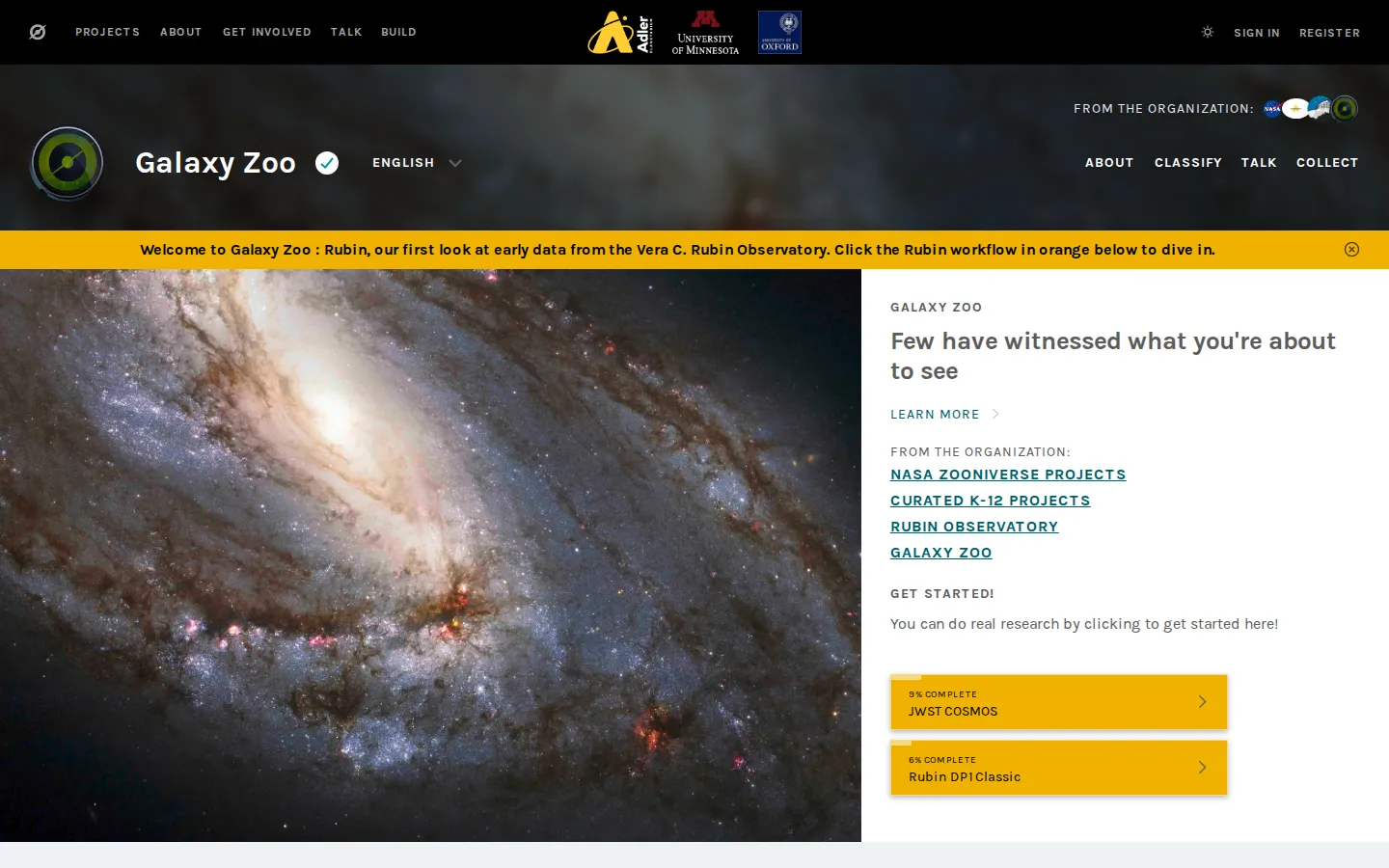
Galaxy Zoo turns telescope surveys into approachable citizen science. You inspect one galaxy at a time and classify its visible structure; repeated judgments from many volunteers are combined into research data. The current project highlights early imagery from the Vera C. Rubin Observatory.
What is Galaxy Zoo?
A Galaxy Zoo session begins with a picture that may be crisp, faint, lopsided, or gloriously swirled. Instead of asking for a grand theory, the project breaks morphology into visual decisions: smooth or structured, edge-on or face-on, barred or unbarred, spiral or disturbed. Your answer joins other independent classifications rather than standing alone. That modest ritual has scaled from Sloan survey images in 2007 to newer sets from Hubble, JWST, Euclid, and now the Rubin Observatory, producing public data, peer-reviewed work, and occasional cosmic oddities that nobody thought to put on the questionnaire.
What you can do there
- Inspect telescope images of galaxies
- Classify visible shapes and structures
- Contribute judgments to astronomical research
Why we picked it
The contribution is real but the entry cost is wonderfully small: attention, pattern recognition, and a willingness to make a careful call. Its long publication record shows what repeated volunteer judgments can become, while discoveries such as Hanny's Voorwerp preserve the thrill of finding something the decision tree did not anticipate.
How to get the most from it
Take the tutorial and keep the field guide nearby for the first few images. Judge only what is visibly present, use the examples when a feature is faint, and do not freeze over a borderline answer; the project deliberately combines several people's classifications for each subject.
Good to know
The project is free and designed for non-specialists, but a submitted classification cannot be edited. The active image sets and completion levels change over time. The live workflow, account options, discussion tools, mobile behavior, accessibility, and current data-processing details were not tested here, and no screenshot was captured.
Who made it, and when?
Galaxy Zoo team is the credited creator or organization. The earliest supported launch date we found is July 2007.
Creator’s official page Open Galaxy ZooMore like this
Zooniverse

Help real research by classifying galaxies, wildlife, weather records, manuscripts, and more.
StopotS

A fast little word scramble where your friends become the jury
Mandalagaba

A symmetry sketchpad where one stroke recruits a whole geometry crew
Kick the Ball Back

A tiny football emergency, one dragging foot, and several children who have no time for excuses.