
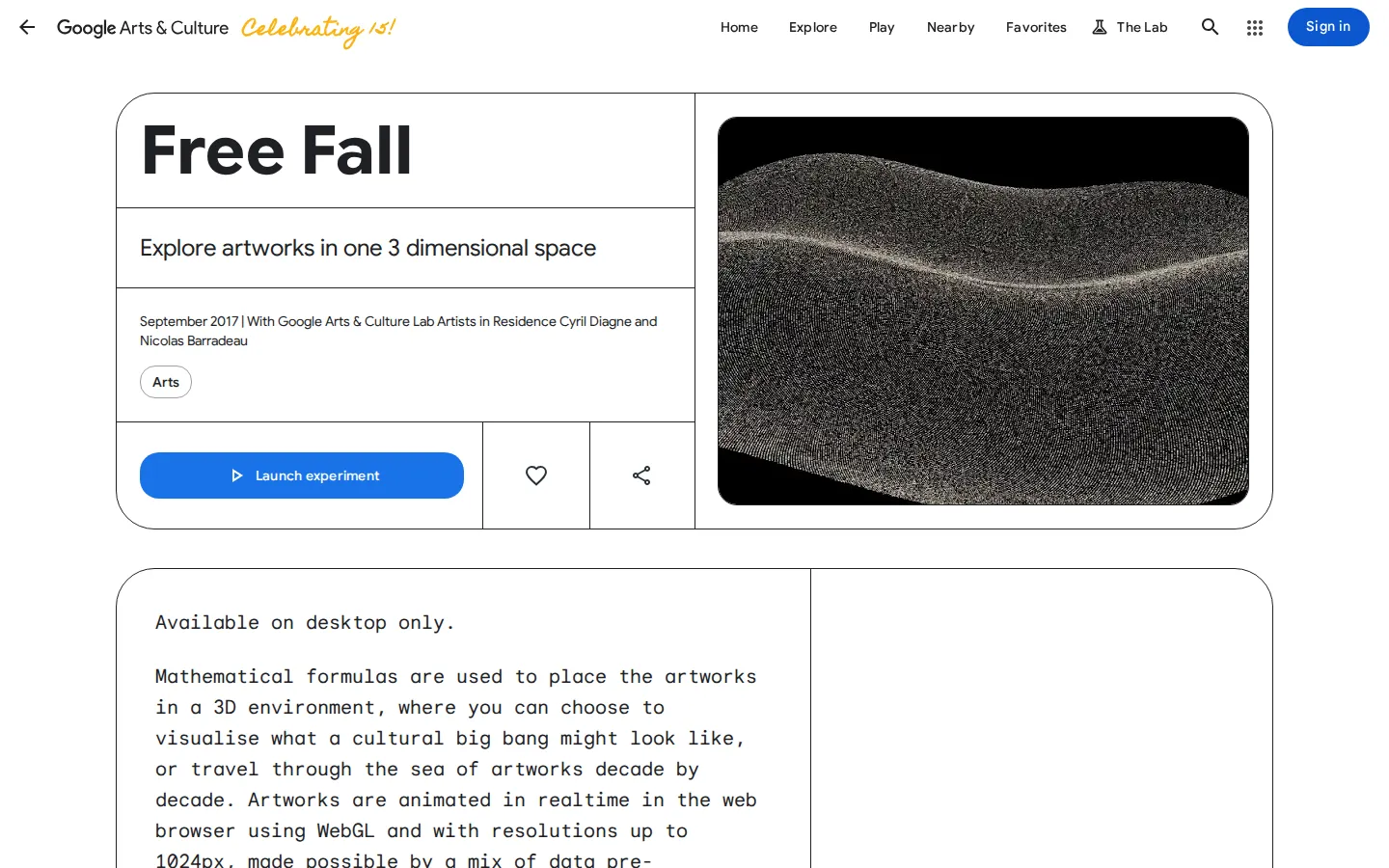
Free Fall flings thousands of museum objects into navigable 3D formations instead of filing them behind a search box. Four views turn the same collection into a cultural Big Bang, a golden-ratio sphere, a moving wave, or a chronological river, with individual artworks waiting beneath the swarm.
What is Free Fall?
The delight is in changing the shape of the archive. Big Bang makes the collection feel cosmic; Sphere gives it a deliberate geometric shell; Waves treats the database like a restless surface; Timeline restores dates when the cloud becomes too unruly. Dragging and wheel-zooming are the documented way through, and a focused thumbnail can lead back to its full Google Arts & Culture record. That scale is also the catch. With hundreds of partner collections represented, orientation can evaporate quickly, and an independent Goethe-Institut review reached for the Timeline when the spectacle became overwhelming. This is less a precise research instrument than a machine for bumping into an artwork you did not know to request.
What you can do there
- Navigate a 3D field of artworks
- Switch among Big Bang, Sphere, Waves, and Timeline arrangements
- Zoom and focus individual artworks
- Open artwork records on Google Arts & Culture
Why we picked it
Most collection sites ask for a name, period, or keyword before they show their hand. Free Fall starts with abundance and lets spatial curiosity do the filtering. The four arrangements are meaningfully different, and the ability to open a surprising object in its proper catalog keeps the experiment connected to useful context.
How to get the most from it
Start in Big Bang for the full meteor shower, then switch to Timeline when you want your bearings back. Drag in short movements, zoom slowly, and click one thumbnail before the field becomes visual wallpaper. A large desktop screen and a fast connection suit the experience best.
Good to know
The project is officially desktop-only and depends on WebGL. Google recommends a fast connection, while independent coverage warns that slower links can be frustrating. The moving 3D field may be uncomfortable for motion-sensitive visitors, and keyboard or screen-reader support was not verified.
Who made it, and when?
Cyril Diagne and Nicolas Barradeau is the credited creator or organization. The earliest supported launch date we found is September 2017.
Creator’s official page Open Free FallMore like this
Zoomquilt
An endlessly falling illustrated world nested inside itself.
Thisissand

Pour tiny grains of color into layered landscapes, patterns, and patient accidents.
Click Click Click

A green button that turns browser habits into a tiny surveillance drama.
Beige balls

Twelve colorful-looking spheres, one beige reality, and a tidy lesson in how nearby stripes boss your eyes around.