
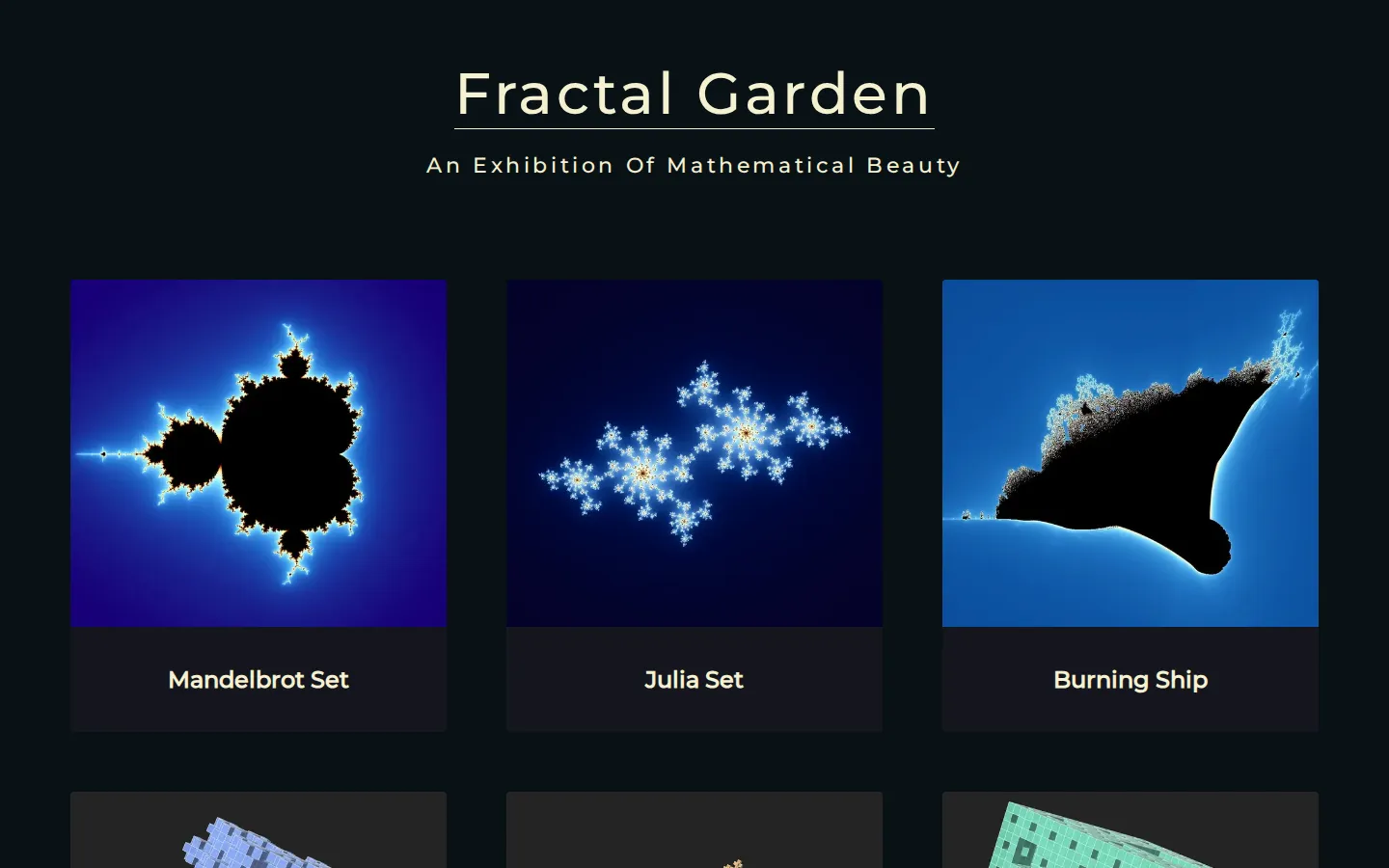
Fractal Garden turns a broad collection of recursive patterns into a browsable exhibition. Pick a classic set, curve, fern, sponge, or chaos diagram, then use the entry's own controls to inspect how a small mathematical rule keeps producing more detail.
What is Fractal Garden?
The front page works like a specimen wall: 34 named fractals sit side by side, ranging from the Mandelbrot and Julia sets to L-system ferns, space-filling curves, a Menger sponge, a Mandelbulb, and the logistic map. Individual entries pair a visual experiment with a compact explanation, and some expose the formula or rendering code behind the picture. The controls change with the specimen. A two-dimensional set may invite panning and deep zooming, while a three-dimensional form adds orbit, camera, detail, color, growth, or wireframe settings. That variety keeps the garden from becoming a stack of pretty thumbnails; each stop offers a different way to see recursion doing its strange little gardening job.
What you can do there
- Browse a gallery of named fractals
- Pan and zoom through two-dimensional sets
- Orbit and tune three-dimensional recursive forms
- Read concise explanations and implementation notes
Why we picked it
The site makes mathematical structure feel tangible without turning the visit into homework. Its best trick is the pairing of immediate visual play with just enough explanation to connect the shape on screen to the rule underneath it. The collection is also broad enough to reward wandering instead of funneling everyone toward one famous spiral-edged set.
How to get the most from it
Start with the Mandelbrot set to learn the basic pan-and-zoom rhythm, then jump to the Menger sponge or Mandelbulb for a change of dimension. Open each entry's explanation after moving around the visual, and adjust one studio control at a time so the effect of iteration, density, detail, or camera position stays legible.
Good to know
The exhibition is free to open and its public code is MIT-licensed. Some entries rely on WebGL-style graphics or offer animation and auto-rotation, so performance and motion will vary by device. Browser compatibility, audio, accessibility, privacy behavior, and the controls themselves were not verified in a rendered session; no screenshot was captured.
Who made it, and when?
Rico Trebeljahr is the credited creator or organization. The earliest supported launch date we found is 2022.
Creator’s official page Open Fractal GardenMore like this
Zoomquilt
An endlessly falling illustrated world nested inside itself.
Thisissand

Pour tiny grains of color into layered landscapes, patterns, and patient accidents.
Click Click Click

A green button that turns browser habits into a tiny surveillance drama.
Beige balls

Twelve colorful-looking spheres, one beige reality, and a tidy lesson in how nearby stripes boss your eyes around.