
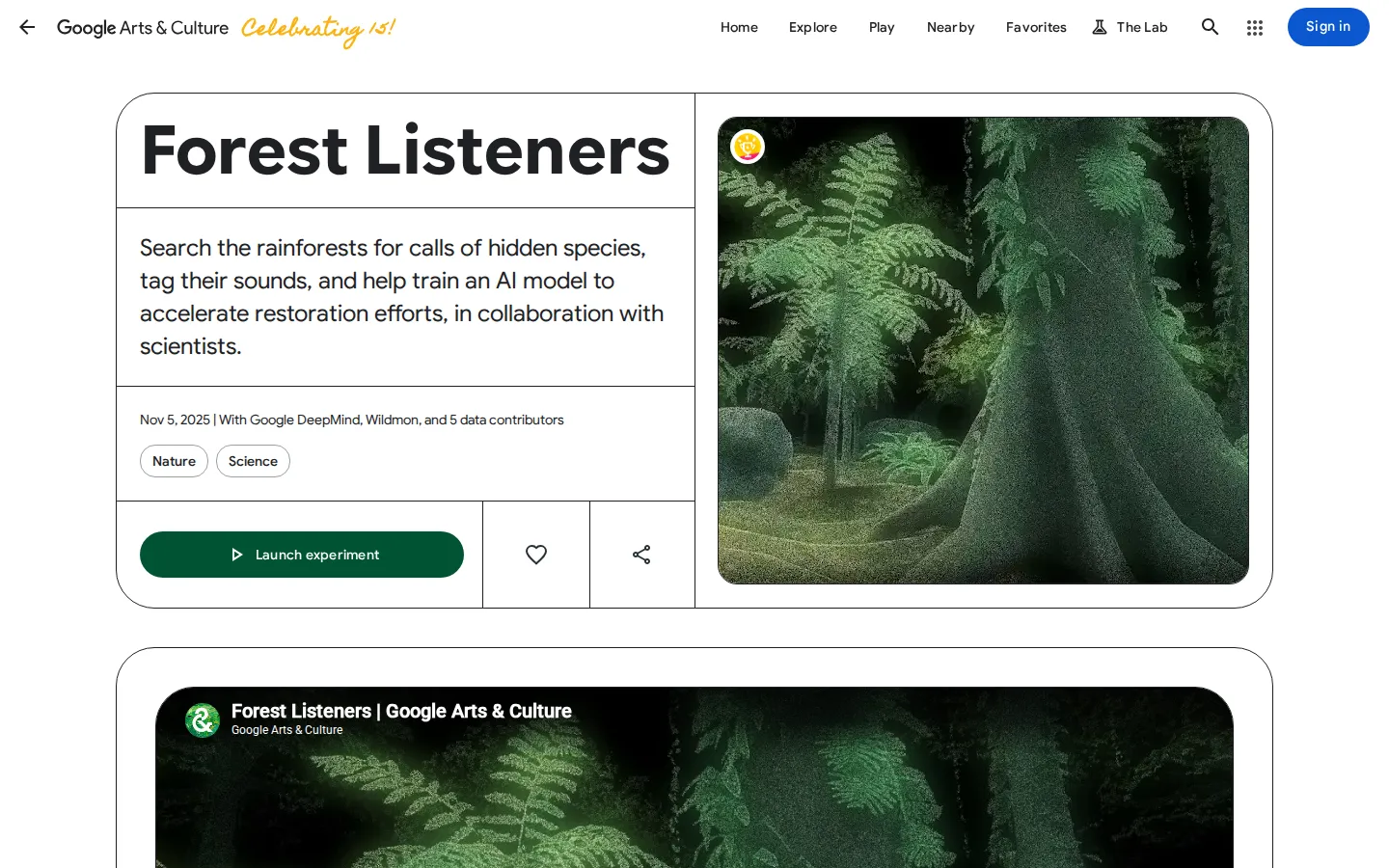
Forest Listeners turns Brazilian field recordings into a compact citizen-science task. You hunt for an animal in a virtual forest, learn its call, then judge short clips with a simple Yes or No. The quiet reward is hearing a habitat as data while adding a human check to a much larger machine-listening project.
What is Forest Listeners?
The experience begins with a hidden voice rather than a visible animal. Pick through a stylized Amazon or Atlantic forest, learn the sound attached to a target species, and then listen closely to recordings gathered by acoustic monitors in Brazil. Each decision is deliberately small, but the project says those labels are aggregated to help refine Perch, Google DeepMind's bioacoustics model. That gives the exercise two tempos at once: a quick spot-the-call challenge on the surface and, underneath, a reminder of how much conservation evidence arrives as hours of messy, overlapping sound.
What you can do there
- Search a virtual rainforest for a target species
- Learn the species' call
- Classify short field recordings with Yes or No
Why we picked it
It makes citizen science feel concrete without sanding away the uncertainty. A call may be faint, buried under insects, or absent altogether, so careful listening matters more than fast clicking. The result is part field guide, part data-labeling desk, and a pleasing excuse to hear a forest before trying to measure it.
How to get the most from it
Wear headphones if you have them and learn the reference call before rushing into the clips. Replay difficult samples when the controls allow it, and use Yes only when the target sound is actually present; uncertain ears are more useful than confident guessing.
Good to know
Sound is central, so this is a poor fit for silent browsing. The project describes more than 1.2 million recordings and a model-training purpose, but its public material leaves current label counts, consensus rules, privacy details, accessibility behavior, and measured conservation outcomes unresolved.
Who made it, and when?
Google Arts & Culture, Google DeepMind, and WildMon is the credited creator or organization. The earliest supported launch date we found is November 5, 2025.
Creator’s official page Open Forest ListenersMore like this
Zooniverse

Help real research by classifying galaxies, wildlife, weather records, manuscripts, and more.
StopotS

A fast little word scramble where your friends become the jury
Mandalagaba

A symmetry sketchpad where one stroke recruits a whole geometry crew
Kick the Ball Back

A tiny football emergency, one dragging foot, and several children who have no time for excuses.