
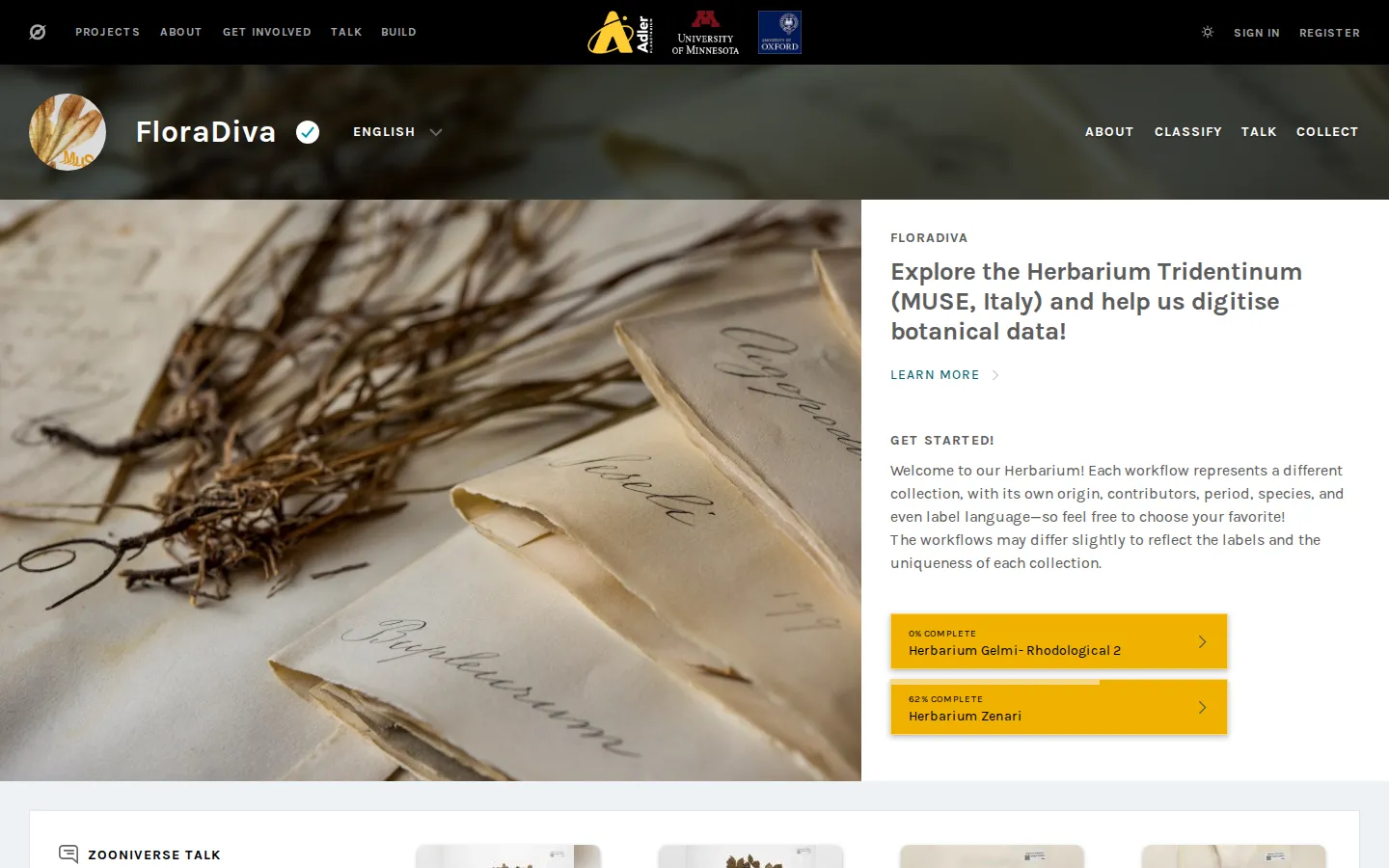
FloraDiva opens the drawers of Trento's Herbarium Tridentinum by asking volunteers to transcribe the names, dates, and places written on scanned specimen labels. Its charm is equal parts plant history and handwriting detective work, with separate workflows that range across mosses, roses, fungi, lichens, and vascular plants.
What is FloraDiva?
A pressed plant is only half a record; the cramped label beside it holds the who, where, and when. FloraDiva turns those small scraps of paper into the main event. Pick a collection, study a scanned herbarium sheet, and copy the requested field without translating or tidying away its original language. Different workflows isolate scientific names, collection dates, or localities, which makes each visit feel more like a stack of bite-size archival puzzles than one endless data-entry form. The age of the material supplies the friction and the personality. Nineteenth-century cursive can buckle, Latin names bring their own punctuation, and months may appear as Roman numerals. Help text and worked examples are available, while an unclear option gives genuinely unreadable locality text somewhere honest to go.
What you can do there
- Choose a botanical collection workflow
- Transcribe names, dates, and localities from specimen labels
- Ask the project team about difficult handwriting
Why we picked it
The museum scale makes every modest transcription matter. Herbarium Tridentinum holds more than 150,000 plants, mosses, lichens, and fungi gathered over two centuries, and FloraDiva is part of a larger effort to turn those physical sheets into searchable biodiversity records. The best moments come when a faded collector's note stops looking like decoration and becomes a usable place or date again.
How to get the most from it
Choose a workflow whose subject appeals to you, then read its field guide before tackling the first sheet. Zoom in on the label, match each fragment to the requested field, preserve the spelling and language you see, and use the date legend when Roman numerals appear. Treat the unclear button as a last resort, and take stubborn handwriting to Talk when another pair of eyes could help.
Good to know
Collections rotate and several listed workflows are already complete, so the live choice can change. Labels are often Italian or Latin and may also be German or English; the project asks for transcription, not translation. A login is recommended for asking questions in Talk. The detailed workflow figures and the page's overall counters do not agree, so completion percentages are best treated as moving estimates. Device, accessibility, correction, autosave, privacy, advertising, popup, and audio behavior were not tested.
Who made it, and when?
MUSE - Museo delle Scienze di Trento is the credited creator or organization. The earliest supported launch date we found is April 22, 2026.
Creator’s official page Open FloraDivaMore like this
OneZoom Tree of Life

Zoom through the evolutionary tree connecting millions of living species.
WindowSwap

Borrow someone else's window for a quiet view of another life and place.
OCEARCH Shark Tracker

A map where each dot has teeth and a travel itinerary
Is it dark outside?

A one-word verdict for a question your window could answer