
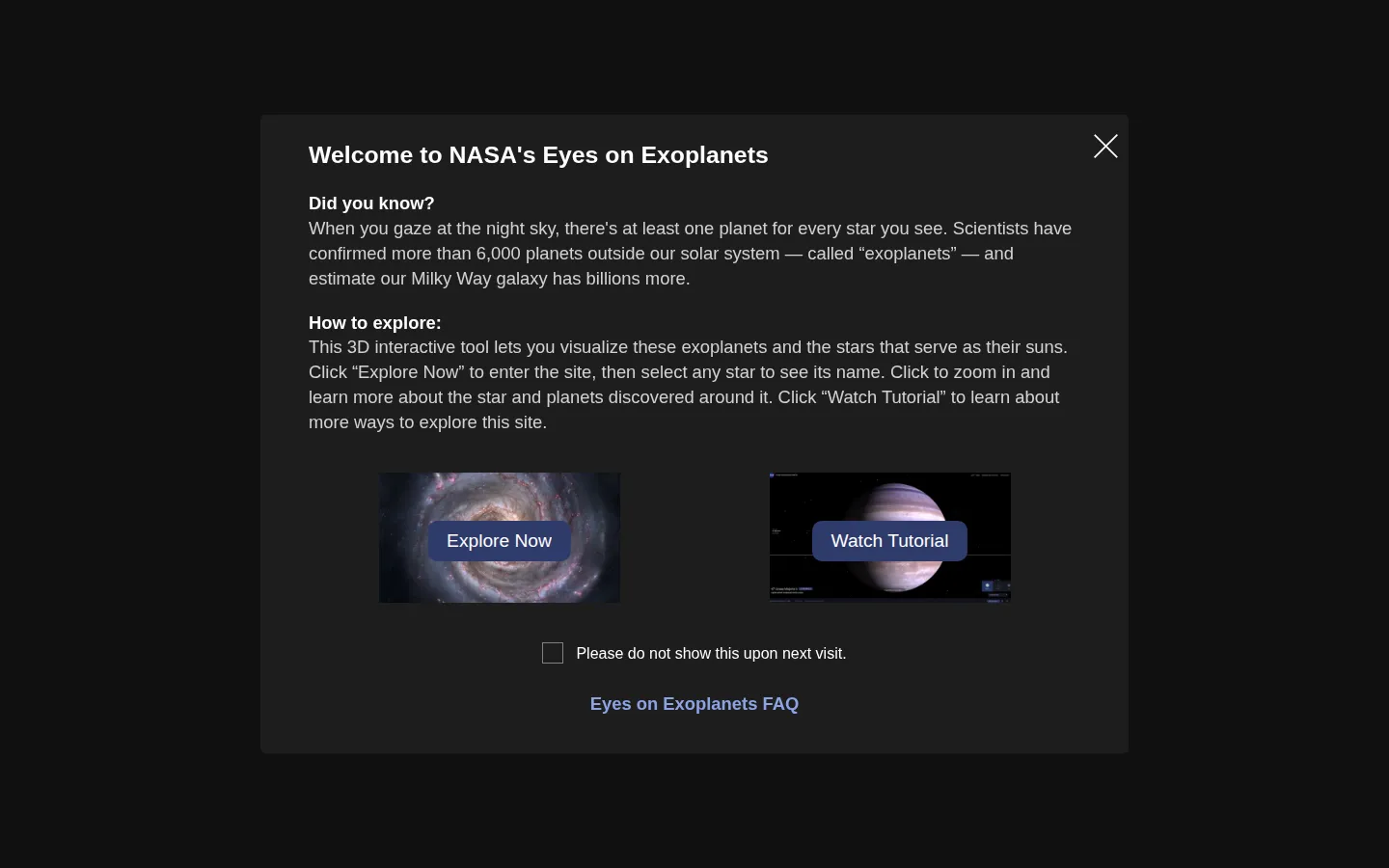
Eyes on Exoplanets maps confirmed worlds beyond our solar system into a browser-based 3D explorer. Search for a planet, open its star system, compare its scale and orbit with familiar neighbors, or trace how telescopes found it. NASA's current tutorial places more than 6,000 confirmed exoplanets within reach of the controls.
What is Eyes on Exoplanets?
A table can tell you that a planet is hundreds of light-years away; this tool tries to make the distance feel navigable. The app arranges discovered systems in a three-dimensional galactic view, then lets a chosen star unfold into orbital layouts, planet concepts, habitable-zone context, and comparisons with Earth, Jupiter, or the solar system. Discovery methods and observatories stay attached to the worlds they revealed, so the map doubles as a record of how exoplanet science sees at all. A View from Earth mode, mission filters, constellations, future target stars, and curated weird worlds offer several useful starting points when a blank galaxy feels a little too roomy.
What you can do there
- Search for a star or confirmed exoplanet
- Inspect a planetary system and compare it with our solar system
- Filter discoveries by planet type, method, observatory, or mission
- View habitable zones, travel estimates, and discovery context
Why we picked it
The scale is the hook, but the layered context gives the trip substance. NASA Exoplanet Archive data becomes approachable without losing the links between a planet, its star, its discovery technique, and the instrument behind the find. NASA educators, the Smithsonian, science-center professionals, and a recent astronomy-education paper have all put the tool to work with learners, which is a good sign that the spectacle can carry an actual lesson.
How to get the most from it
Search for a familiar system such as TRAPPIST-1, switch into system view, and compare the orbit layout with our solar system before opening individual planets. Next, turn on the habitable-zone layer and check the discovery method and observatory. For a broader tour, browse the weird-world lists or filter by Kepler, TESS, planet type, or detection method instead of pinballing among random stars.
Good to know
Planet surfaces are artist concepts, while the system records come from NASA data; treat the pictures as informed visualization rather than vacation photography. NASA describes desktop, tablet, and smartphone support, but the live 3D controls, location permission, graphics load, accessibility, mobile performance, advertising, consent, and storage behavior were not tested in this review. Catalog totals may differ across NASA pages because some count planets and others count systems.
Who made it, and when?
NASA Jet Propulsion Laboratory is the credited creator or organization.
Creator’s official page Open Eyes on ExoplanetsMore like this
Stellarium Web

Turn the browser into a planetarium matched to the sky above your location.
The Scale of the Universe 2

Slide from the smallest known scales to the largest structures in the observable universe.
100,000 Stars
Fly from the Sun into a 3D neighborhood of one hundred thousand nearby stars.
WorldWide Telescope

A sky atlas with a time machine tucked into its controls