
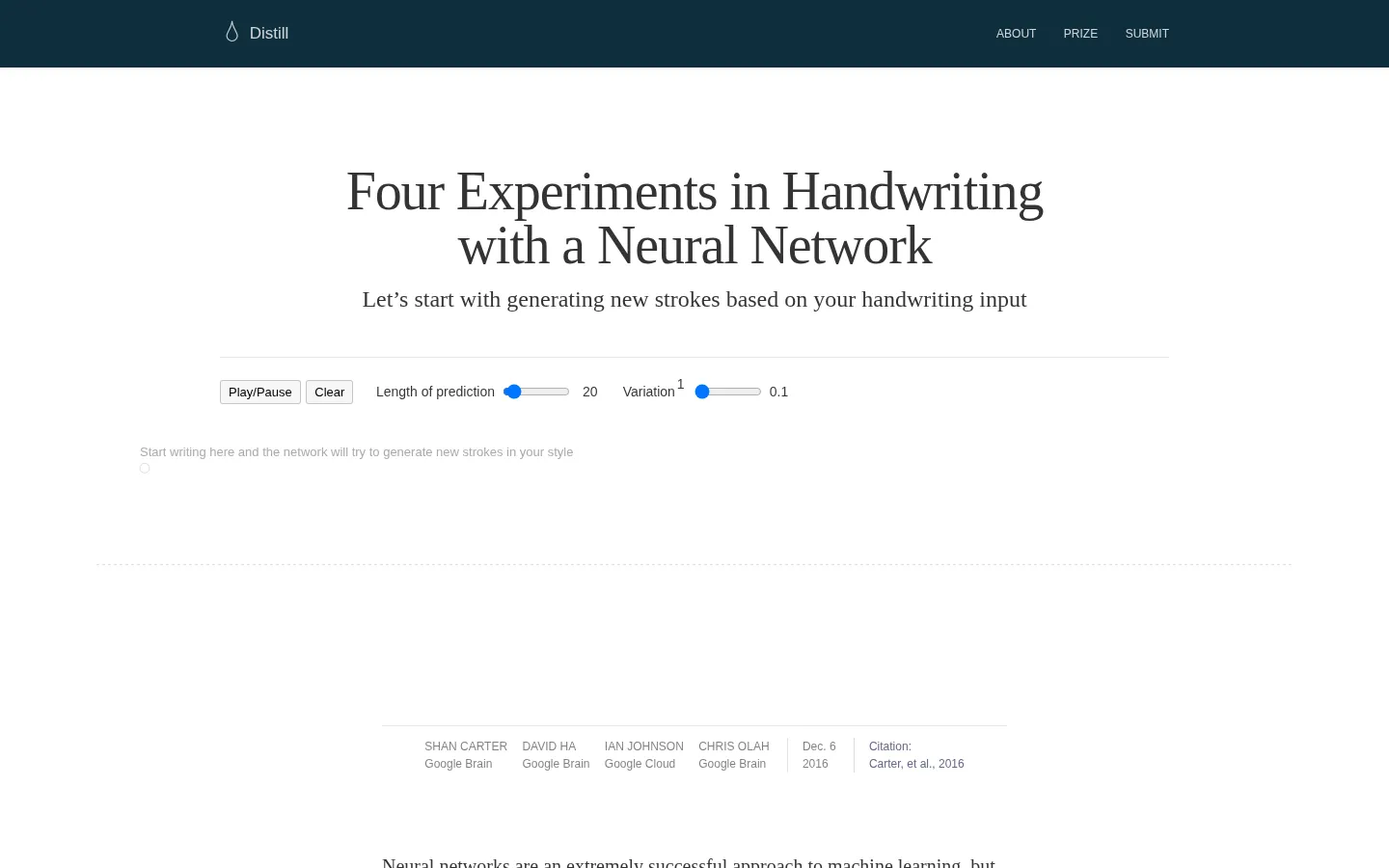
This Distill article turns a small handwriting-generating network into a set of drawing experiments. Seed a stroke, vary the model's nerve, compare many possible continuations, and descend from the visible squiggle into a heatmap of the memory cells helping to choose it.
What is Experiments in Handwriting with a Neural Network?
The opening canvas invites a human mark and answers with machine-made continuations, complete with controls for prediction length and variation. The article then refuses to treat one sample as the whole story. It fans out dozens of possible next strokes, showing where the model might fork left or right before settling on a path. From there, the tour moves under the nib: a heatmap maps line segments against 500 memory cells, while another drawing area is designed to reveal those activations as a sample unfolds. The authors are candid that the browser-sized model mostly produces convincing-looking gibberish. That limitation is part of the charm and the lesson. This is not a handwriting service wearing a lab coat; it is a compact window into probability, memory, and the awkward business of asking what a neural network has actually learned.
What you can do there
- Draw seed strokes and inspect generated continuations
- Adjust prediction length and variation
- Compare many possible next stroke paths
- Inspect cell activations in a handwriting heatmap
Why we picked it
Few model explainers make the jump from playful input to internal state this cleanly. A doodle leads to alternate futures, alternate futures lead to uncertainty, and uncertainty leads to the cells behind the pen. Columbia's data-visualization course also used the piece as a visualizing-algorithms reading, which fits its real strength.
How to get the most from it
Begin with a short, simple stroke and change only one control at a time. Compare low and high variation, pause on a fork where several paths disagree, then carry that curiosity into the activation heatmap. The gibberish is useful evidence here: watch for style, direction, pen lifts, and uncertainty instead of grading the model on spelling.
Good to know
The authors explicitly say the generated letters and words are mostly gibberish, so this is an interpretability experiment rather than a writing tool. Drawing, playback, and animated paths may be awkward with assistive technology or reduced-motion needs. The article and its public repository also state different Creative Commons versions for article content, so verify the exact terms before reuse.
Who made it, and when?
Shan Carter, David Ha, Ian Johnson, and Chris Olah is the credited creator or organization. The earliest supported launch date we found is December 6, 2016.
Creator’s official page Open Experiments in Handwriting with a Neural NetworkMore like this
Zoomquilt
An endlessly falling illustrated world nested inside itself.
Thisissand

Pour tiny grains of color into layered landscapes, patterns, and patient accidents.
Click Click Click

A green button that turns browser habits into a tiny surveillance drama.
Beige balls

Twelve colorful-looking spheres, one beige reality, and a tidy lesson in how nearby stripes boss your eyes around.