
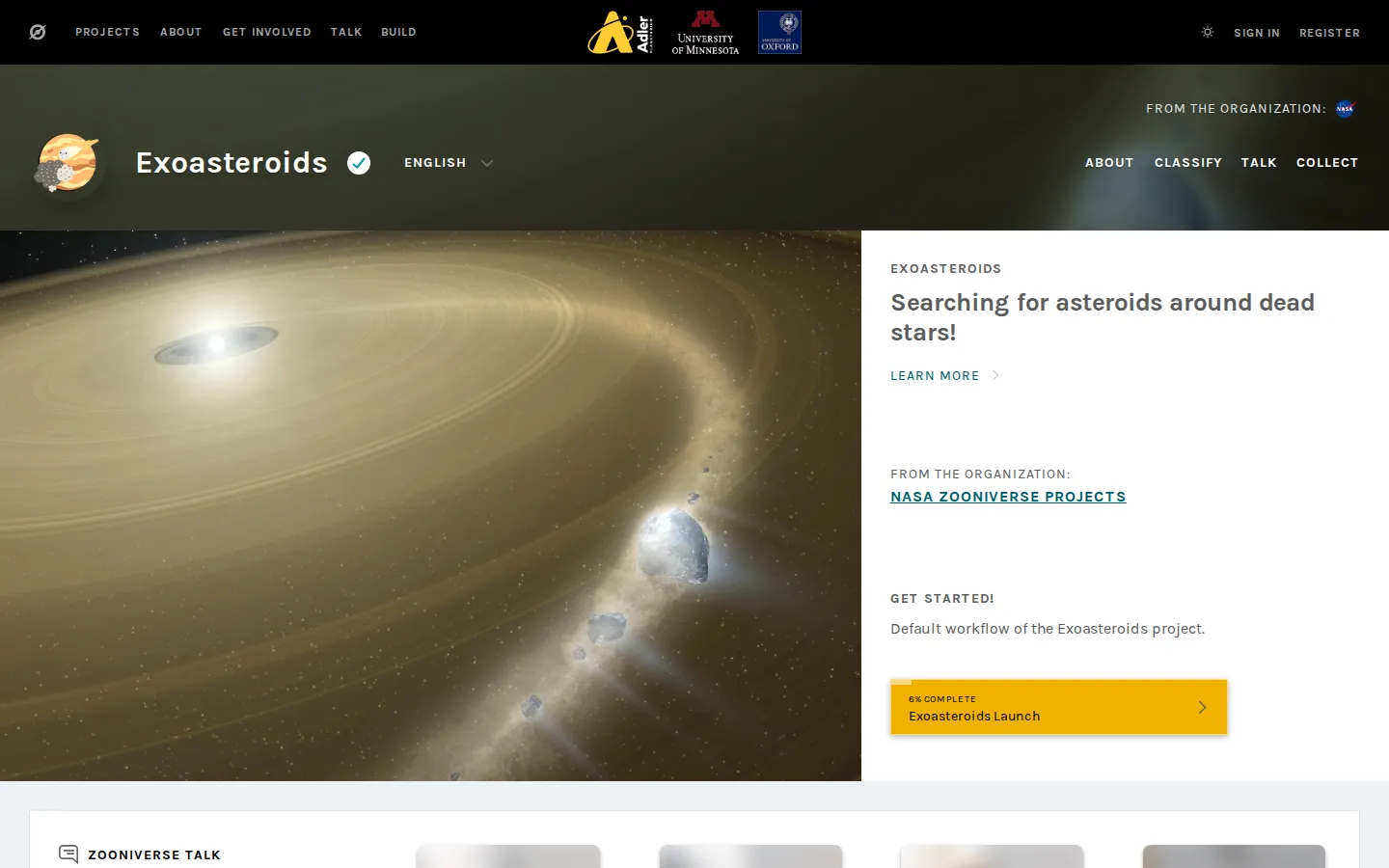
Exoasteroids turns decade-long WISE observations into compact flipbooks centered on white dwarfs. Your job is to spot genuine brightness changes without being fooled by spikes, ghosts, crowded fields, or ordinary image noise.
What is Exoasteroids?
Each subject compresses years of infrared sky surveys into a visual comparison task: watch the centered white dwarf, compare the standard view with the difference imagery, and decide whether its brightness truly changes. That simple question carries a useful scientific wrinkle. Dust from disrupted rocky bodies may produce real variability, while telescope artifacts can perform convincing impersonations. The project therefore feels less like naming a celestial object and more like quality control at cosmic scale. Extra links can lead from a subject into SIMBAD or WiseView when you want to investigate beyond the basic classification.
What you can do there
- Inspect white-dwarf time-lapse flipbooks
- Flag changes in infrared brightness
- Discuss unusual subjects with the project community
Why we picked it
The premise is immediately legible, but the artifact-spotting gives it teeth. Exoasteroids asks for patient human pattern recognition where automated measurements can be swamped by false positives, making each careful classification feel modest, specific, and connected to an actual research question.
How to get the most from it
Take the tutorial before judging your first flipbook, then watch the center of both views rather than chasing every flicker around the frame. Learn the signatures of diffraction spikes and orange optical ghosts, and use the subject-information links or Talk when a case seems especially odd.
Good to know
NASA says no astronomy background is required and estimates five to fifteen minutes for the tutorial. A brightness change is a candidate signal, not a confirmed exoasteroid, and the project's live progress counters were inconsistent during this check, so available work may change.
Who made it, and when?
The earliest supported launch date we found is September 17, 2024.
Open ExoasteroidsMore like this
Stellarium Web

Turn the browser into a planetarium matched to the sky above your location.
The Scale of the Universe 2

Slide from the smallest known scales to the largest structures in the observable universe.
100,000 Stars
Fly from the Sun into a 3D neighborhood of one hundred thousand nearby stars.
WorldWide Telescope

A sky atlas with a time machine tucked into its controls