
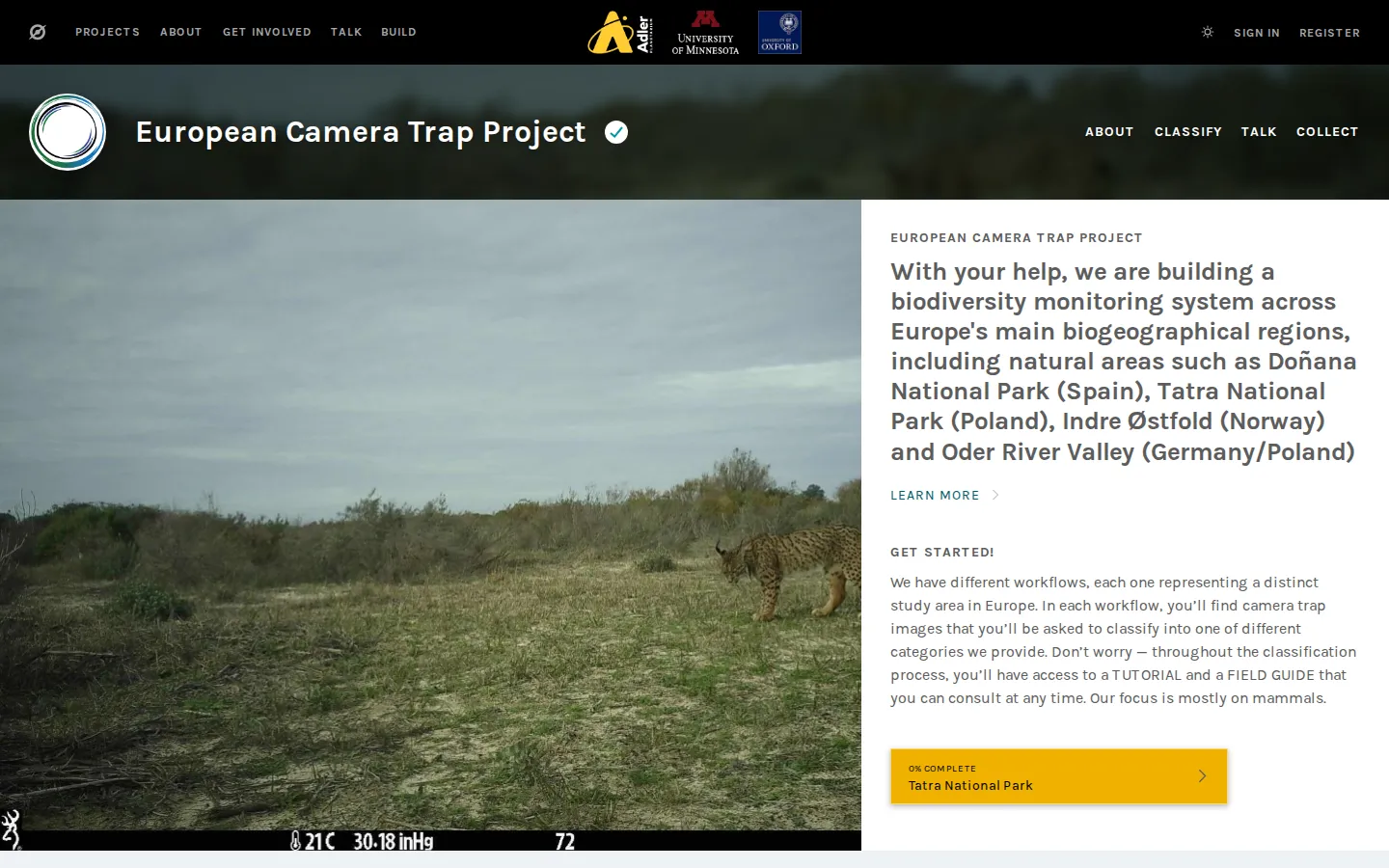
European Camera Trap Project turns trail-camera photographs from four European study areas into a public species-identification job. Its best moment is the small detective work of separating a deer from a dark, partial silhouette, though the classification queue was empty during this check.
What is European Camera Trap Project?
Each workflow corresponds to a study area, with cameras spanning Doñana, the Tatra mountains, the Oder Delta, and Indre Østfold. When photographs are available, volunteers identify species, count animals, and handle awkward frames where the subject is distant, partly hidden, nocturnal, or absent. A tutorial and field guide provide the identification scaffolding, while Talk gives uncertain sightings somewhere useful to go. The labels are intended to help a wider WildINTEL effort combine citizen science, camera traps, and automated recognition into more coordinated wildlife monitoring. At present, the Tatra workflow displays a finished, out-of-data notice, so the About pages are the main attraction until another batch appears.
What you can do there
- Identify animals in European camera-trap photographs
- Count animals and flag uncertain or notable images
Why we picked it
The geographic spread gives familiar camera-trap classification a satisfying continental scale: one project connects boreal forest, alpine habitat, Mediterranean wetlands, and a cross-border river delta. It also treats difficult images honestly instead of pretending every night blur is an easy fox. That mix of patient observation and practical conservation makes the work feel consequential without requiring specialist credentials.
How to get the most from it
Check the Classify tab first. If a batch is live, choose a study-area workflow, skim the tutorial and field guide, then classify only what the photograph supports; use broader categories or Unrecognizable when details are weak. Count multiple species separately, and send stubborn cases to Talk. If the queue is empty, the Research and FAQ pages still make a compact tour of the habitats and identification method.
Good to know
The workflow was out of data during this visit, so participation may be intermittent. Zooniverse says an account is not required for ordinary classification, but signing in is necessary if you want personal statistics or a volunteer certificate. Night images, partial animals, and empty frames are normal parts of the task. The project's own tags also anticipate predation and unhealthy animals, so the photo stream may occasionally be rougher than a woodland postcard. Device, accessibility, audio, and privacy behavior were not tested in a rendered session.
Who made it, and when?
WildINTEL is the credited creator or organization. The earliest supported launch date we found is March 10, 2026.
Creator’s official page Open European Camera Trap ProjectMore like this
Zooniverse

Help real research by classifying galaxies, wildlife, weather records, manuscripts, and more.
StopotS

A fast little word scramble where your friends become the jury
Mandalagaba

A symmetry sketchpad where one stroke recruits a whole geometry crew
Kick the Ball Back

A tiny football emergency, one dragging foot, and several children who have no time for excuses.