
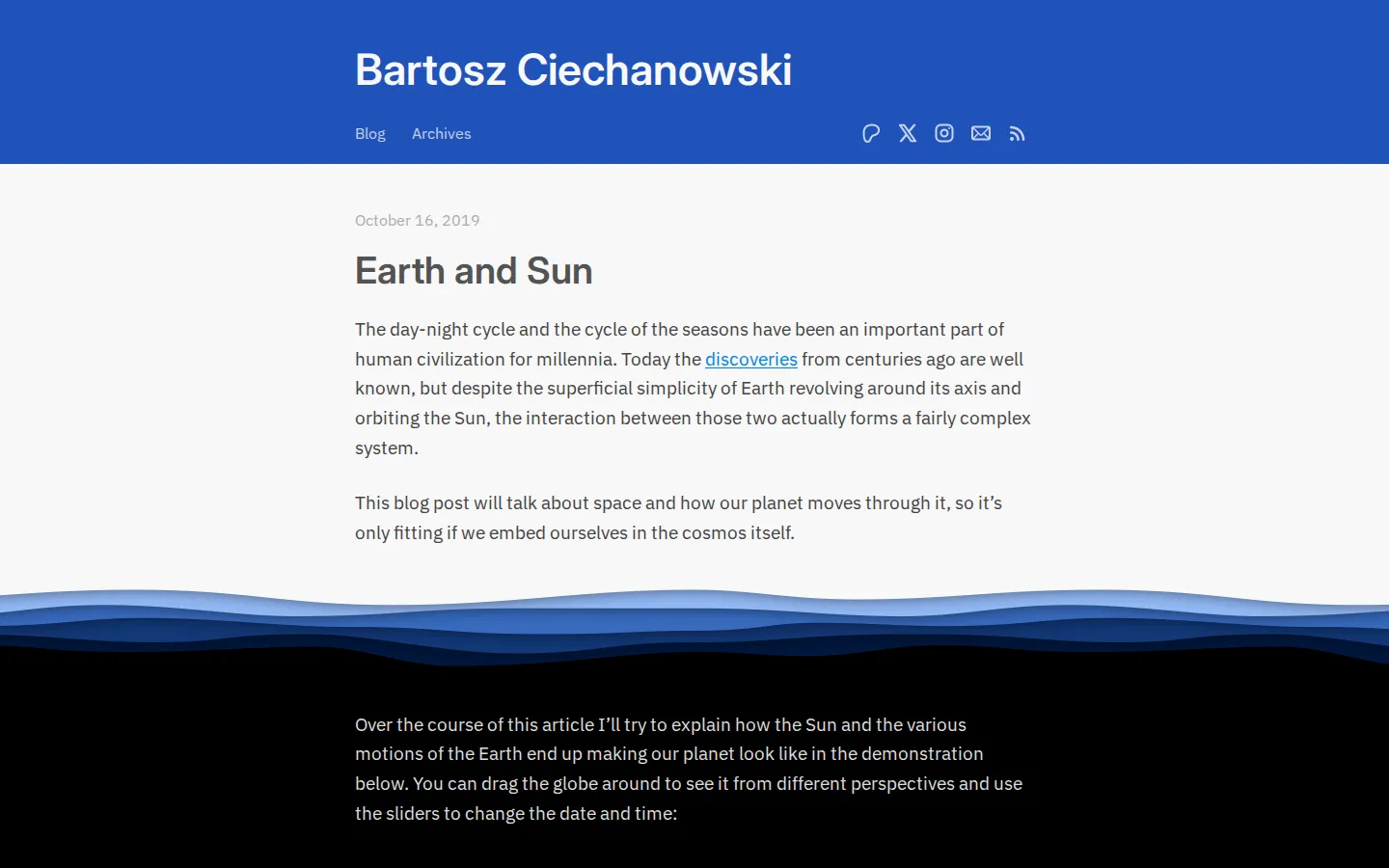
Earth and Sun turns a familiar schoolbook diagram into a patient, interactive tour of orbit, rotation, seasons, solar time, and the analemma. Bartosz Ciechanowski's models let dates, hours, viewpoints, and scale move while the surrounding prose explains what each change means.
What is Earth and Sun?
The article begins with the size mismatch between Earth and Sun, builds an ellipse from its focal points, and only then sets the planet moving. From there it layers rotation onto revolution, tips the axis, follows sunlight across both hemispheres, and traces the Sun's annual figure eight in the sky. The structure is the trick: every new piece of celestial machinery arrives beside a model designed to isolate it. By the time precession and the equation of time appear, they feel like consequences of parts you have already met rather than facts dropped from orbit.
What you can do there
- Rotate three-dimensional astronomy diagrams
- Scrub through dates and times
- Switch units and date formats
Why we picked it
This is scientific explanation with excellent stagecraft. Scale, viewpoint, date, and time become knobs instead of obstacles, allowing several motions that are usually flattened into one diagram to be separated and recombined in a way that rewards curiosity.
How to get the most from it
Do not rush the first orbit. Drag each model to a side view as well as a top view, then move one slider at a time. Keep the time fixed while changing the date when you reach seasons and the analemma; the pattern becomes much easier to read.
Good to know
The demonstrations use UTC and can show metric or imperial measurements plus American or international dates. This is a substantial, equation-friendly read, so budget at least half an hour if you want to follow the argument rather than skim the planets.
Who made it, and when?
Bartosz Ciechanowski is the credited creator or organization. The earliest supported launch date we found is October 16, 2019.
Creator’s official page Open Earth and SunMore like this
Stellarium Web

Turn the browser into a planetarium matched to the sky above your location.
The Scale of the Universe 2

Slide from the smallest known scales to the largest structures in the observable universe.
100,000 Stars
Fly from the Sun into a 3D neighborhood of one hundred thousand nearby stars.
WorldWide Telescope

A sky atlas with a time machine tucked into its controls