
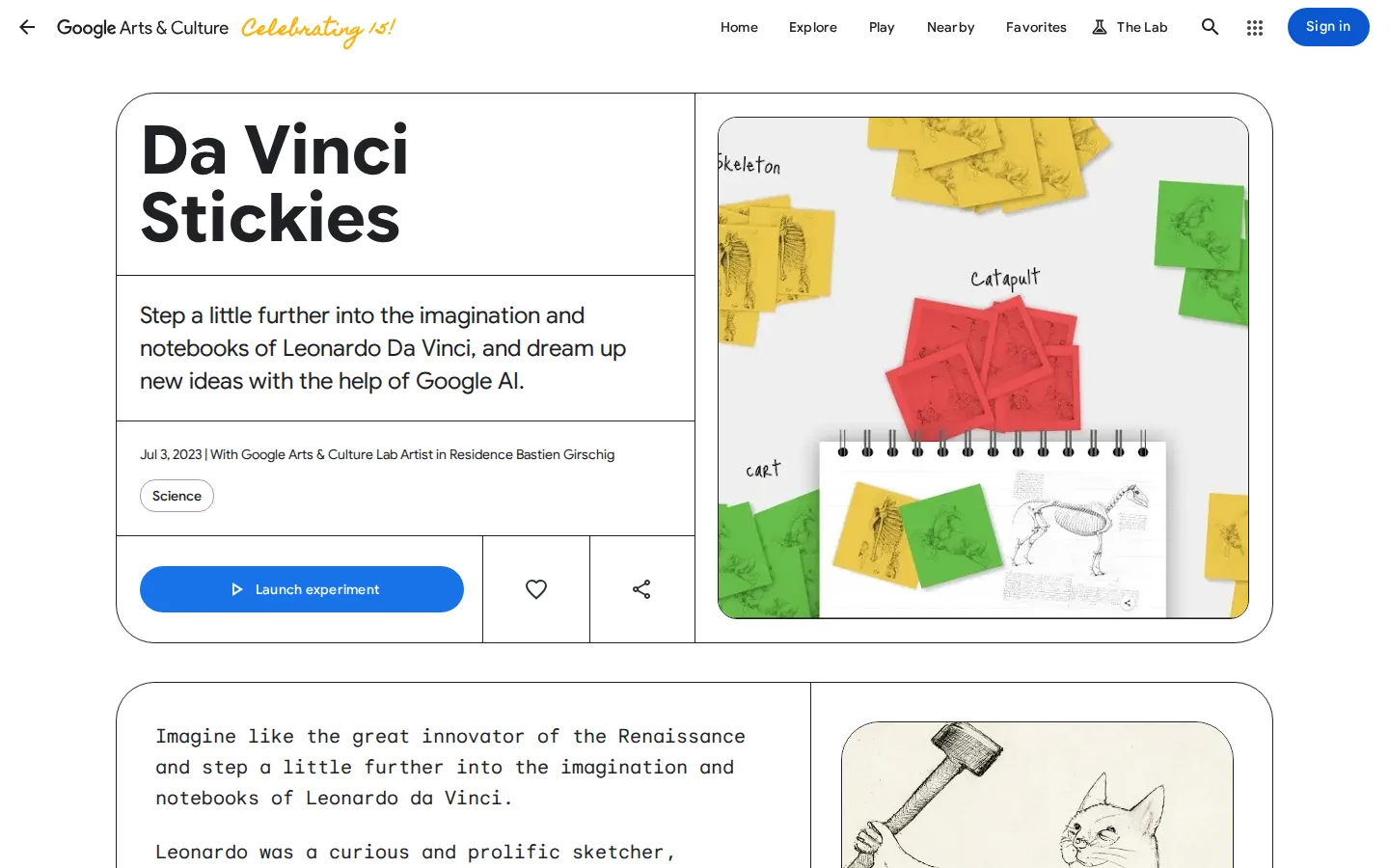
Da Vinci Stickies scatters drawings from Leonardo's notebooks across a digital board, then asks you to combine two into a fresh AI-made contraption. It is part archive doorway, part brainstorming game: the old lines remain the spark, while the result belongs firmly to the twenty-first century.
What is Da Vinci Stickies?
The premise borrows the cheerful logic of a workshop wall. Browse the codex sketches, pick two fragments that seem as though they ought to meet, and drag them onto the whiteboard. The selected drawings become ingredients for a newly generated image, turning Leonardo's studies of nature, mechanisms, anatomy, and motion into odd speculative hybrids. That simple pairing rule gives the enormous notebook collection a manageable entry point. You do not need to understand every annotation or know which codex supplied each line before curiosity takes over; a wing beside a gear is enough to start a theory. The generated result is not a recovered Leonardo invention, and that distinction matters. Think of it as a visual prompt produced from historical parts, with the pleasure coming from the collision rather than any claim of authenticity.
What you can do there
- Browse digitized Leonardo sketches
- Drag two sketches onto a digital whiteboard
- Generate a new image inspired by the pair
Why we picked it
Archival interfaces can make a mountain of pages feel like homework. This one reduces the first move to choosing two sketches, preserving enough of the source material to invite questions while adding a playful payoff. The strongest moments happen before generation, when an unlikely pair starts suggesting a machine in your own head.
How to get the most from it
Scroll around before choosing the first two obvious drawings. Pair sketches that share a motion, shape, or problem, then try a deliberately mismatched combination. Treat the generated image as a conversation starter, and follow intriguing source sketches into the wider Inside a Genius Mind collection for historical context.
Good to know
The source drawings come from Leonardo's codices, but the combined result is generated by Google AI and should not be mistaken for a historical design. Google says images from this experiment are watermarked. The visual drag-and-drop interaction may be a poor fit for some assistive-input setups, and its current keyboard behavior is undocumented.
Who made it, and when?
Bastien Girschig is the credited creator or organization. The earliest supported launch date we found is July 3, 2023.
Creator’s official page Open Da Vinci StickiesMore like this
AutoDraw

Sketch badly on purpose and let machine-assisted suggestions turn it into a crisp icon.
Calligrapher.ai
A browser scribble machine that gives typed words a wobblier set of shoes.
Sketch Toy: Draw sketches and share replays with friends!

A doodle pad that remembers every stroke and turns the making into the show.
Wombo Dream AI

A prompt-powered sketchbook for images and video.