
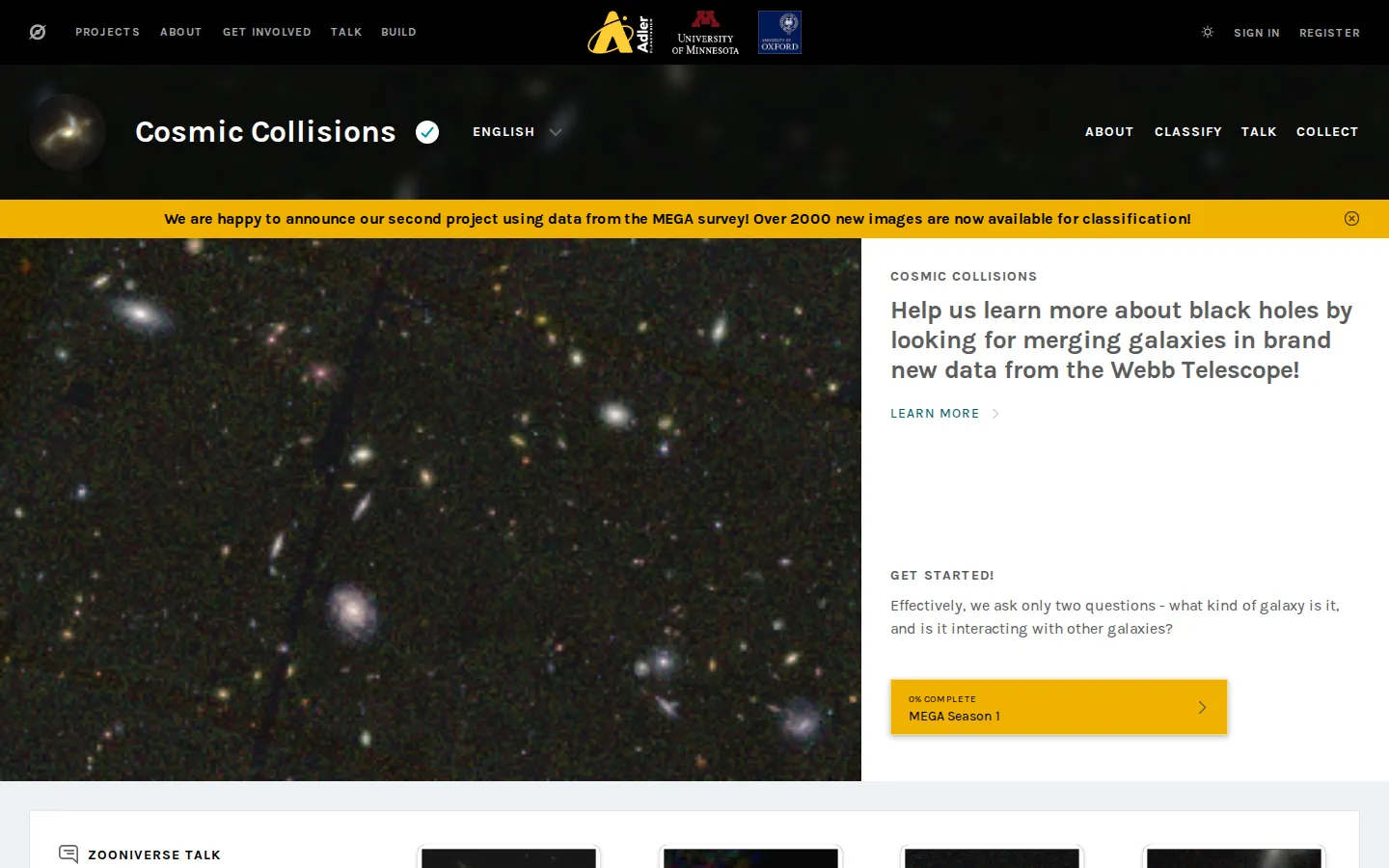
Cosmic Collisions turns fresh James Webb galaxy images into a focused citizen-science job: identify each galaxy's form, then decide whether gravity appears to be pulling it into a merger. The pictures can be tiny and ambiguous, but the project's field guidance makes that uncertainty part of the work instead of hiding it.
What is Cosmic Collisions?
The project asks two compact questions with an unusually large idea behind them. First, volunteers sort a Webb image by visible galaxy type. Then they look for signs of interaction: doubled nuclei, stretched tidal features, or neighboring galaxies that seem to be warping one another. Those human labels are meant to sit beside infrared measurements of active black holes, giving the research team a way to test whether mergers and black-hole growth reliably travel together. The current campaign draws on the MEGA survey and announces more than 2,000 new images, so this is closer to an astronomical sorting bench than a polished space-photo gallery. Some subjects will look crisp; others are a handful of stubborn pixels wearing a galaxy costume.
What you can do there
- Classify a galaxy by its visible shape
- Judge whether it is interacting with another galaxy
- Discuss unusual examples with the research community
Why we picked it
Cosmic Collisions gives a small visual judgment real scientific weight without asking visitors to master a telescope pipeline. The two-question structure is easy to understand, while the borderline cases reward patience and close looking. It is a neat reminder that human pattern recognition still has useful work to do beside sophisticated infrared analysis.
How to get the most from it
Read the short research explanation and FAQ before classifying. Learn the difference between a compact point source, a smooth spheroid, and a face-on disk, then watch for multiple nuclei, tidal tails, or visibly distorted companions. When a subject refuses to fit neatly, choose the closest example and flag the oddball in Talk instead of forcing certainty.
Good to know
The project recently changed from a three-panel subject view to a simpler single-image format, and some supporting copy is still catching up. Low-resolution galaxies can be genuinely ambiguous; the workflow expects many people to inspect the same subjects so one uncertain answer does not steer the final result by itself. Audio behavior and current account requirements are not clearly stated on the public project pages.
Who made it, and when?
Gregory Troiani is the credited creator or organization. The earliest supported launch date we found is March 25, 2025.
Creator’s official page Open Cosmic CollisionsMore like this
Stellarium Web

Turn the browser into a planetarium matched to the sky above your location.
The Scale of the Universe 2

Slide from the smallest known scales to the largest structures in the observable universe.
100,000 Stars
Fly from the Sun into a 3D neighborhood of one hundred thousand nearby stars.
WorldWide Telescope

A sky atlas with a time machine tucked into its controls