
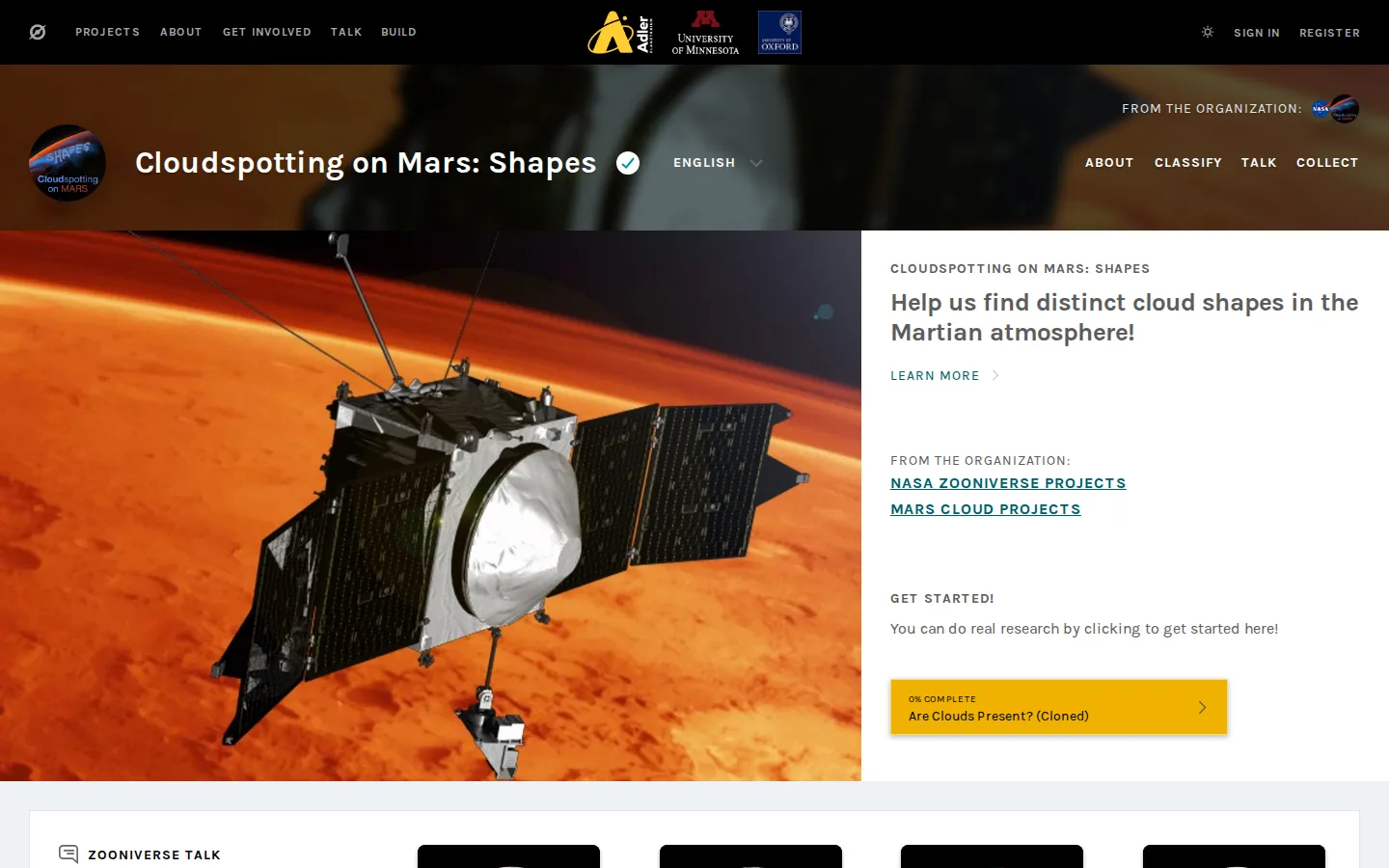
Cloudspotting on Mars: Shapes turns MAVEN's ultraviolet views of the Red Planet into a careful pattern-spotting job. Learn the cloud families, separate bright atmosphere from bright ground, and help build a map of when and where Martian clouds form.
What is Cloudspotting on Mars: Shapes?
Mars looks less like a dusty postcard here and more like a weather map assembled by a very patient scanner. The project uses ultraviolet observations from MAVEN, where reflective clouds show up as pale structures against the darker planet. Your job is to decide which recognizable cloud type appears and mark it, while watching for look-alikes such as ice patches and volcanoes. Those small decisions are meant to feed a database for studying seasonal patterns, winds, and cloud formation. The landing page also keeps the science close at hand through research, FAQ, discussion, and collection sections, so a classification can lead naturally into a deeper atmospheric rabbit hole.
What you can do there
- Tag cloud shapes in ultraviolet images of Mars
- Learn to distinguish clouds from surface features
Why we picked it
The hook is wonderfully concrete: cloud-gazing, except the sky is on another planet and the image is ultraviolet. It gives casual pattern recognition a legitimate scientific destination, while the false-positive checks make the task more thoughtful than simply clicking every bright smudge.
How to get the most from it
Budget roughly fifteen minutes for the tutorial and field guide before classifying. Learn the example shapes first, then compare every bright feature with the surface landmarks shown in the guidance. Use the image information control when Mars-year or seasonal context helps, and take unusual cases to Talk rather than forcing a confident label.
Good to know
The current landing page displayed zero active subjects and classifications even though the team's repository described a twilight dataset as active, so a usable batch is not guaranteed on every visit. The hands-on workflow, device support, accessibility, account behavior, and audio were not tested, and the project cannot be embedded outside its own origin.
Who made it, and when?
The earliest supported launch date we found is October 29, 2024.
Open Cloudspotting on Mars: ShapesMore like this
Stellarium Web

Turn the browser into a planetarium matched to the sky above your location.
The Scale of the Universe 2

Slide from the smallest known scales to the largest structures in the observable universe.
100,000 Stars
Fly from the Sun into a 3D neighborhood of one hundred thousand nearby stars.
WorldWide Telescope

A sky atlas with a time machine tucked into its controls