
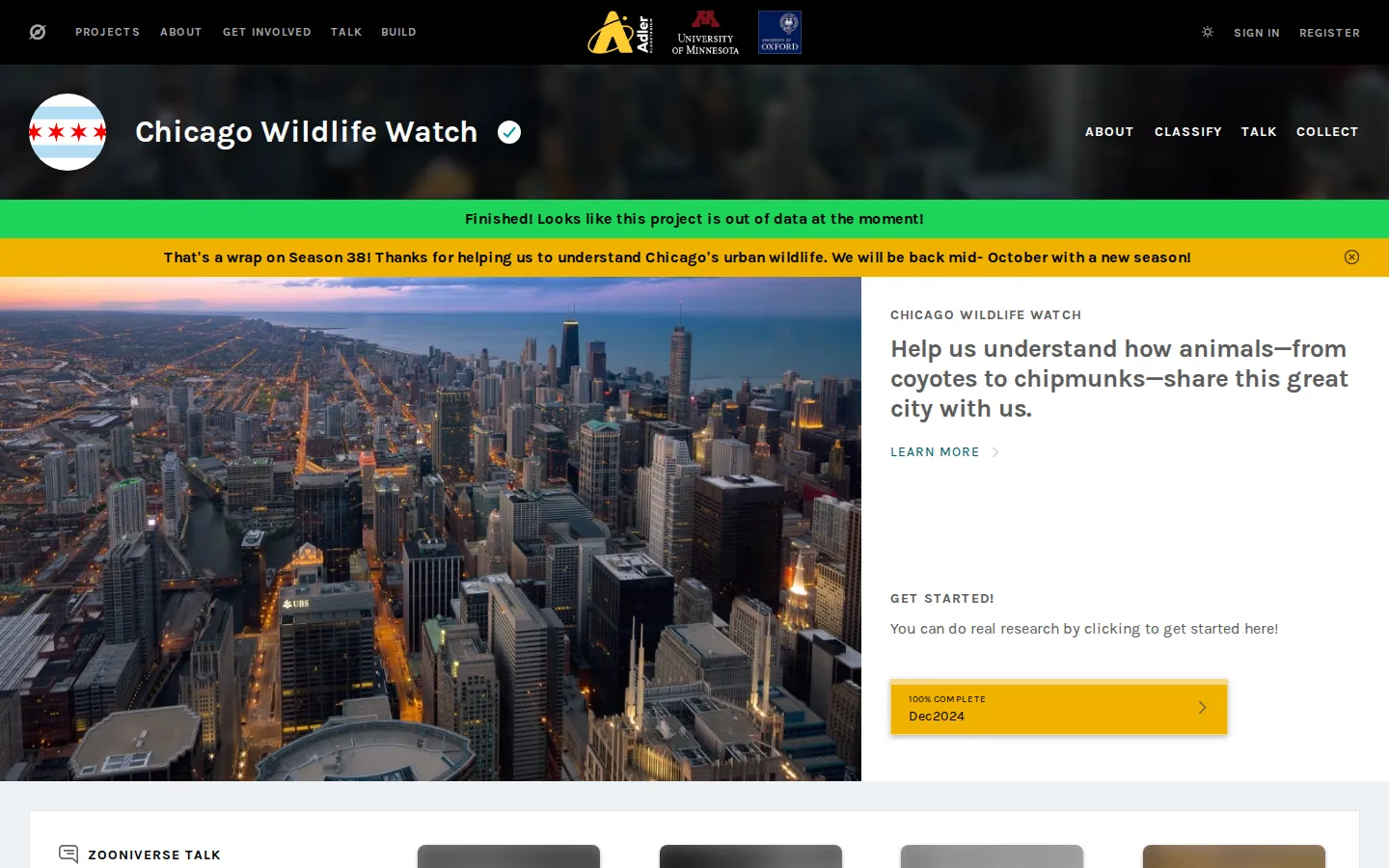
Chicago Wildlife Watch turns seasonal camera-trap photos from parks, cemeteries, golf courses, and forest preserves into bite-size identification work. The payoff is real urban-ecology data, but timing matters: Season 38 had finished when checked, leaving the classifier temporarily empty.
What is Chicago Wildlife Watch?
A fox at the edge of a frame, a deer crowding the lens, or apparently nothing but leaves: Chicago Wildlife Watch asks volunteers to sort the evidence left by more than 100 motion-triggered cameras across the city and suburbs. When a photo batch is active, visitors identify the animal they see, and repeated judgments help researchers settle on a classification. The project's FAQ is unusually useful, explaining why empty frames count, how to judge scale, and when a riding mower is scientifically relevant. Those small decisions feed a long-running effort to understand how wildlife uses human-shaped green space. The current pause is the catch. The live page says Season 38 is complete and promises another season in mid-October, so today it works better as a field-guide stop than an active queue of mystery animals.
What you can do there
- Identify animals in Chicago-area camera-trap photos
- Discuss difficult images with volunteers and researchers
Why we picked it
The project makes ordinary camera-trap oddities useful without sanding away their charm. A blurry flank or suspicious patch of grass becomes a tiny act of ecological bookkeeping, and published research shows why agreement between many careful eyes matters.
How to get the most from it
Check the status notice before settling in. During an active season, read the short field guidance, inspect the corners before choosing nothing here, and use Talk when an animal refuses to introduce itself. Between seasons, the FAQ and team pages explain the method while you wait for fresh photos.
Good to know
Classification is seasonal rather than continuously available; at this check, the active batch was 100 percent complete. The live workflow, signup behavior, device support, accessibility, and audio were not testable without active subjects. Human-containing images are handled under a stated removal policy, but that process was not independently audited.
Who made it, and when?
Lincoln Park Zoo and Adler Planetarium is the credited creator or organization.
Creator’s official page Open Chicago Wildlife WatchMore like this
Zooniverse

Help real research by classifying galaxies, wildlife, weather records, manuscripts, and more.
StopotS

A fast little word scramble where your friends become the jury
Mandalagaba

A symmetry sketchpad where one stroke recruits a whole geometry crew
Kick the Ball Back

A tiny football emergency, one dragging foot, and several children who have no time for excuses.