
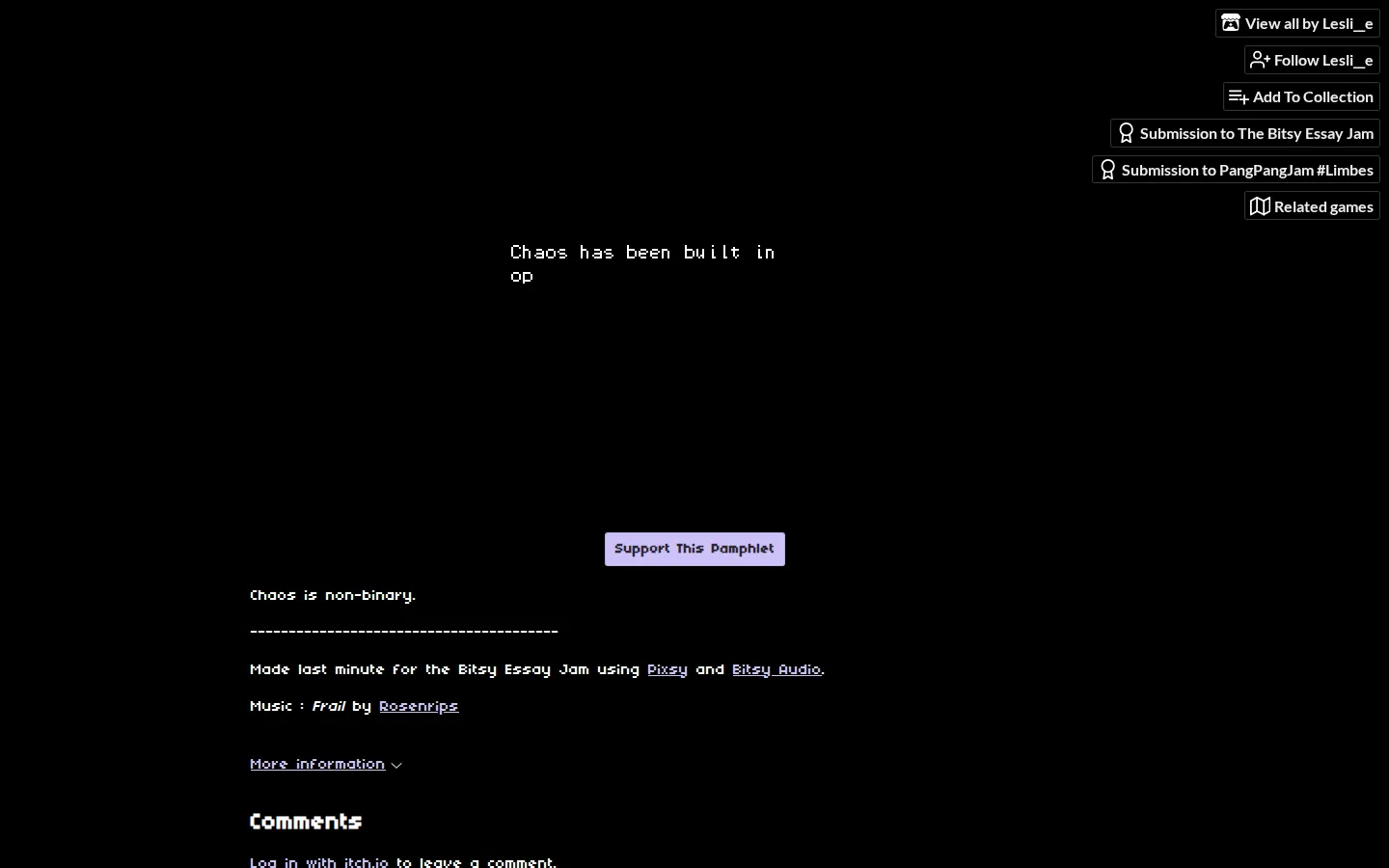
Chaotic Thinking compresses an argument about chaos and non-binary thought into a tiny Bitsy pamphlet. Arrow presses move through text and abstract monochrome images while Lucas Friche's music supplies the pulse, turning a few seconds of input into a brisk philosophical flicker.
What is Chaotic Thinking?
This is less a world to roam than a sequence to tap awake. Leslie Astier arranges words and stark pixel images as a predetermined procession, with no visible avatar and no maze pretending to be a place. The right-arrow rhythm becomes the interaction: each press swaps in another statement or shape while Lucas Friche's track Frail keeps the piece from feeling like a static slide deck. The subject is chaos, especially the way non-binary thought can resist tidy either-or boxes, and the format wisely stays small enough to feel like a bright shard rather than a lecture.
What you can do there
- Advance a sequence of text and abstract images
- Listen to the accompanying music
Why we picked it
Chaotic Thinking makes its constraint do real work. One button sounds almost comically slight, yet the repeated press gives the essay cadence and lets image, text, and music argue together. It is a useful reminder that interaction can be punctuation, not just navigation.
How to get the most from it
Open the embedded pamphlet, keep the sound available, and use the keyboard arrow control to advance. There is no branching route to optimize; let the short sequence set its own tempo and replay it if a line slips past too quickly.
Good to know
The listing calls it a one-button English experience lasting only a few seconds, although the exact runtime was not measured here. The sequence is linear and audio is part of the presentation. Touch, mobile, screen-reader, and reduced-motion behavior remain unverified.
Who made it, and when?
Leslie Astier and Lucas Friche is the credited creator or organization. The earliest supported launch date we found is 2020.
Creator’s official page Open Chaotic ThinkingMore like this
DevLids

A little museum of the laptop backs that attended every meetup before the stickers started peeling.
The Nicest Place on the Internet

A live find from internet culture.
Tamaweb

A browser Tamagotchi with chores, evolution branches, and a surprisingly busy little social calendar.
Webkay

A candid browser-data mirror with a few cobwebs in the corners