
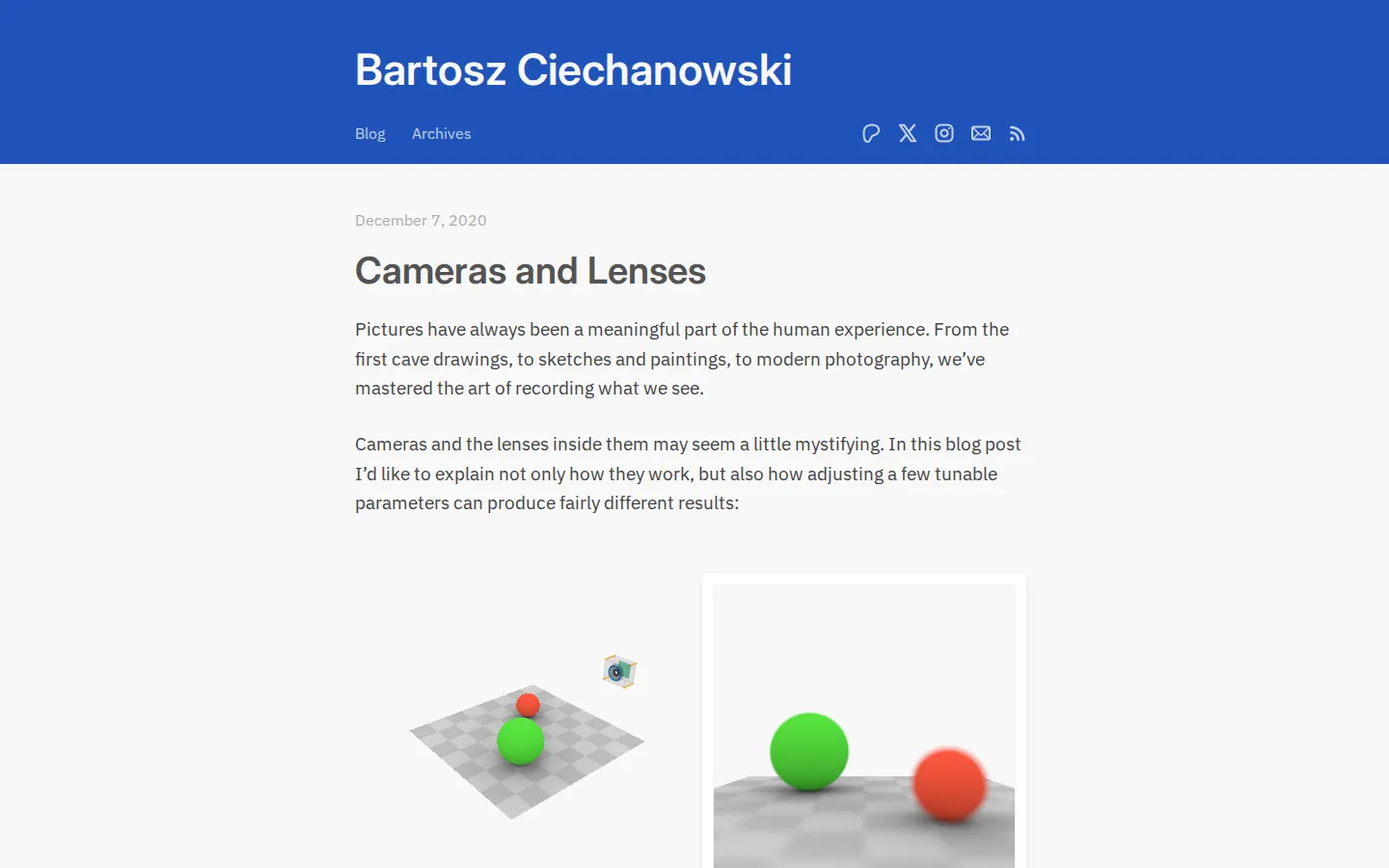
Cameras and Lenses turns a long optics lesson into a patient construction project. It begins with light landing on a digital sensor, adds a pinhole and glass, then works toward focus, aperture, depth of field, and lens aberrations. The article is substantial, but its diagrams keep the equations attached to something visible.
What is Cameras and Lenses?
The clever move here is refusing to start with a finished camera. The article first asks what a bare image sensor can record, then gives it a dark box and a pinhole, and only later recruits refracting glass to gather more light and control focus. That progression makes familiar photography terms feel earned instead of memorized. Along the way, the page connects exposure and sensor color filters to pinhole sharpness, wave propagation, Snell's law, focal length, bokeh, aperture blades, f-numbers, and the aberrations that complicate real lenses. The document describes sliders, draggable views, animated wave models, and play-pause controls throughout, although those live behaviors were not exercised during this check.
What you can do there
- Read a camera system into existence from sensor to lens
- Adjust diagrams that connect optical variables with visible results
Why we picked it
It treats the camera as a chain of solvable optical problems rather than a sealed black box. Each new component answers a weakness in the previous one, so the long route from stray photons to a multi-element lens has a satisfying narrative spine. Independent photography and web-design coverage also singled out the depth of the explanation and the way the page layers readable prose with richer interactive material.
How to get the most from it
Give it a proper reading session and follow the sequence instead of jumping straight to aperture or bokeh. When a diagram appears, change one documented control at a time and compare the pictured result with the paragraph beside it. If the wave animations become distracting, use the article's pause controls before continuing into refraction and lens geometry.
Good to know
This is closer to a compact illustrated course than a five-minute tip sheet, and it assumes some patience for equations. The article is publicly readable, while the wider site offers optional Patreon support. Animated wave demonstrations are described as on by default with pause controls; live interaction, device behavior, accessibility, audio, privacy, and performance were not tested, and no screenshot was captured.
Who made it, and when?
Bartosz Ciechanowski is the credited creator or organization. The earliest supported launch date we found is December 7, 2020.
Creator’s official page Open Cameras and LensesMore like this
Stellarium Web

Turn the browser into a planetarium matched to the sky above your location.
The Scale of the Universe 2

Slide from the smallest known scales to the largest structures in the observable universe.
100,000 Stars
Fly from the Sun into a 3D neighborhood of one hundred thousand nearby stars.
WorldWide Telescope

A sky atlas with a time machine tucked into its controls