
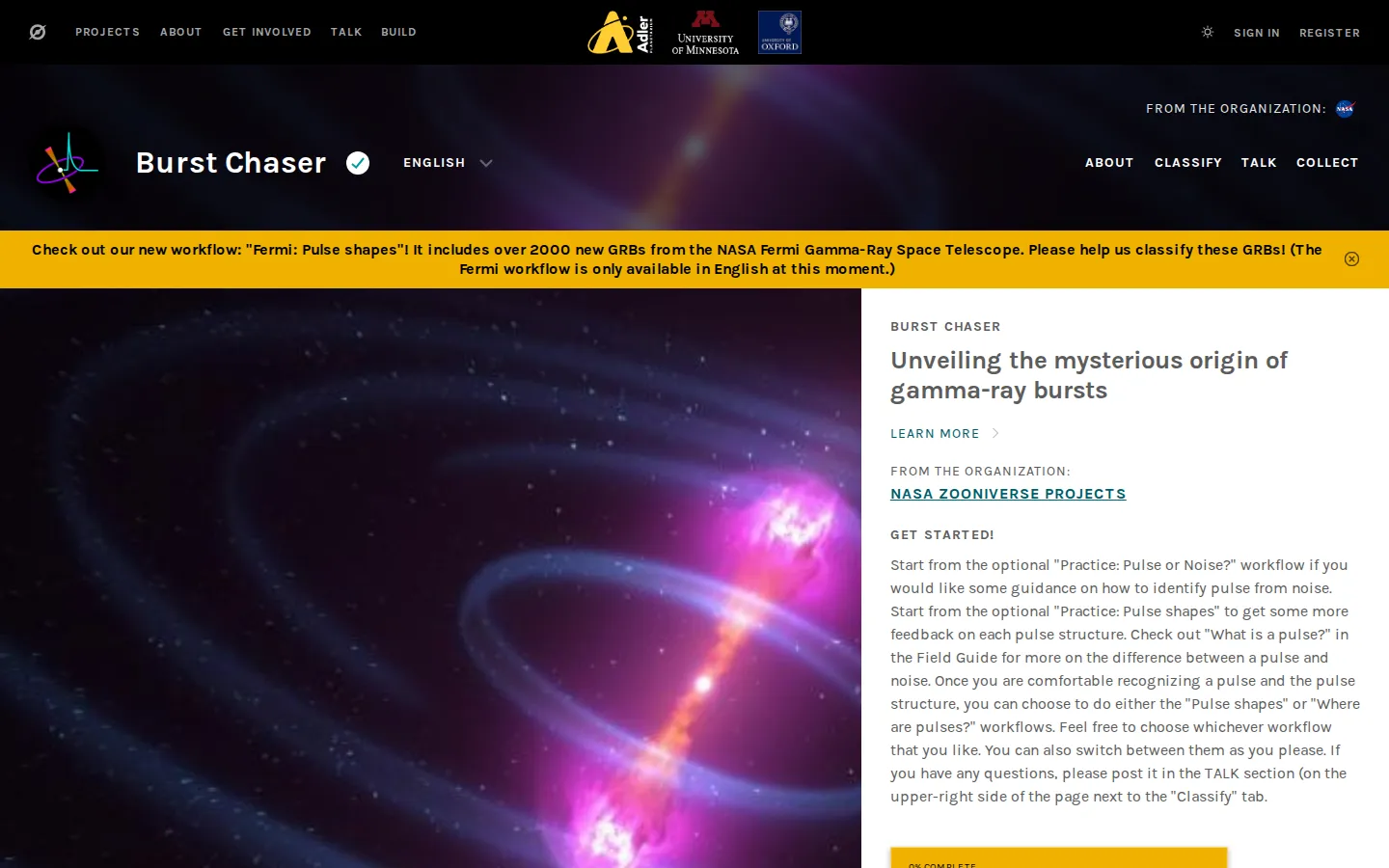
Burst Chaser gives you gamma-ray light curves from NASA's Swift and Fermi observatories and asks a deceptively human question: which peaks are real, and what shape do they make? Practice rounds teach pulse from noise before the project hands your judgments to a wider effort to understand violent stellar deaths and compact-object mergers.
What is Burst Chaser?
The raw material here is not a cinematic explosion but a line graph with a brief fit of the jitters. One workflow asks whether a candidate signal rises above background noise; another asks you to box individual pulses; the shape route sorts bursts into recurring structures. A computer shades the likely burst region blue, yet the project's own guide warns that short events can slip past that first pass. That is the point of the human layer. Burst duration and pulse shape can hint at a collapsing massive star, a neutron-star merger, or a neutron-star and black-hole collision, while awkward cases challenge those tidy categories. The original Swift pulse-location set covered 1,487 bursts, and a newer English-only workflow adds thousands of Fermi detections to the sorting table.
What you can do there
- Distinguish gamma-ray-burst pulses from noise
- Classify pulse shapes
- Mark individual pulses on light curves
Why we picked it
Burst Chaser turns a fearsome corner of astrophysics into focused visual detective work without pretending the answers are obvious. Its practice routes make room for beginners, while the documented retirement rule—more than ten classifications and more than 90 percent agreement—shows that one uncertain click does not become cosmic doctrine.
How to get the most from it
Start with Pulse or Noise, then try the pulse-shape practice until the examples stop looking like random mountain ranges. In a live light curve, concentrate on the blue region but do not treat it as infallible: a very short pulse may sit outside the algorithm's highlight. Use the field guide, keep your categories consistent, and let ambiguous cases stay honestly ambiguous.
Good to know
The project is free, online, and designed for people without astronomy training; NASA puts the tutorial at roughly five to fifteen minutes. French, Spanish, Italian, and Hindi versions are listed, but the newer Fermi workflow is currently English-only. Public progress figures conflict with zero visible platform counters, so treat headline totals as unsettled. The classifier itself was not exercised here, leaving account, device, accessibility, audio, and submission behavior unverified.
Who made it, and when?
Amy Lien and the Burst Chaser team is the credited creator or organization.
Creator’s official page Open Burst ChaserMore like this
Stellarium Web

Turn the browser into a planetarium matched to the sky above your location.
The Scale of the Universe 2

Slide from the smallest known scales to the largest structures in the observable universe.
100,000 Stars
Fly from the Sun into a 3D neighborhood of one hundred thousand nearby stars.
WorldWide Telescope

A sky atlas with a time machine tucked into its controls