
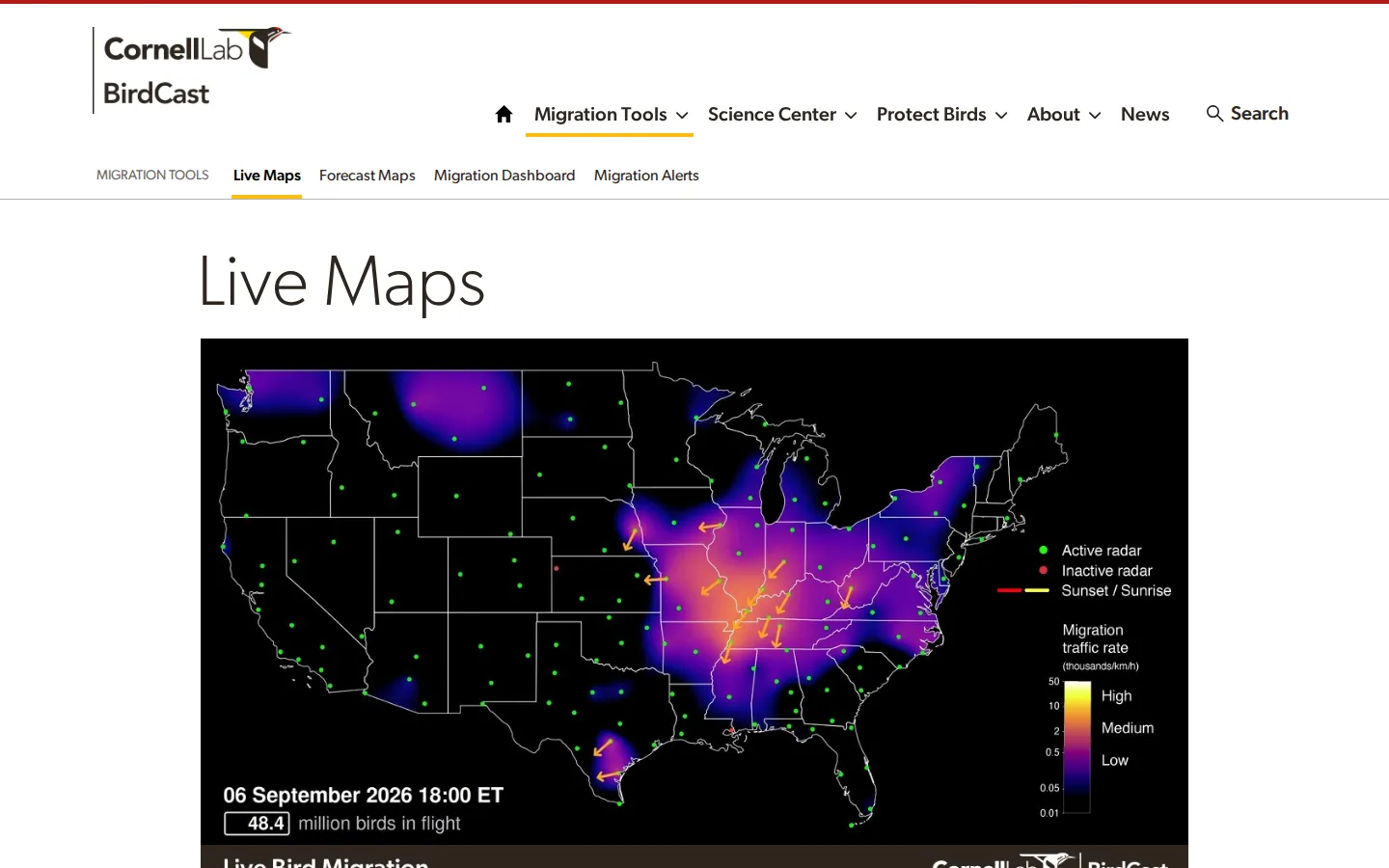
BirdCast turns weather-radar returns into a moving national picture of nocturnal migration. Colors show traffic intensity, arrows show flight direction, and sunrise and sunset lines frame the nightly pulse, making an otherwise invisible journey unusually legible.
What is BirdCast Live Migration Maps?
The live map reads like weather coverage from a parallel atmosphere. Bright patches swell where migration traffic is strongest, orange arrows trace the prevailing direction, and the sweep from sunset toward sunrise gives the animation a natural clock. Radar-status dots are part of the story too: a blank patch can mean a quiet sky, but it can also mean a station is offline or poorly positioned in mountainous terrain. That honesty about the instrument keeps the spectacle useful without pretending it is a literal census. It is a compact way to see a continental event that mostly passes above us while we sleep.
What you can do there
- Watch nighttime migration intensity move across the United States
- Read flight direction and radar availability from the map legend
Why we picked it
The map makes an enormous natural movement readable in seconds while keeping its measuring stick visible. Its best trick is not simply showing where birds are busy; it gives the viewer enough legend and caveat to understand what the glowing currents can and cannot say.
How to get the most from it
Open it after local sunset during spring or fall migration, then follow the brighter bands and orange arrows through the night. Check the radar-status dots before interpreting a dark area, and use the sunrise line to see the nightly movement wind down.
Good to know
Coverage is limited to the contiguous United States, and radar cannot name the species in flight. Traffic values are estimates, while mountains, weather filtering, and station maintenance can leave gaps. The maps are most informative during seasonal nighttime movement.
Who made it, and when?
Cornell Lab of Ornithology is the credited creator or organization. The earliest supported launch date we found is 2018.
Creator’s official page Open BirdCast Live Migration MapsMore like this
OneZoom Tree of Life

Zoom through the evolutionary tree connecting millions of living species.
WindowSwap

Borrow someone else's window for a quiet view of another life and place.
OCEARCH Shark Tracker

A map where each dot has teeth and a travel itinerary
Is it dark outside?

A one-word verdict for a question your window could answer