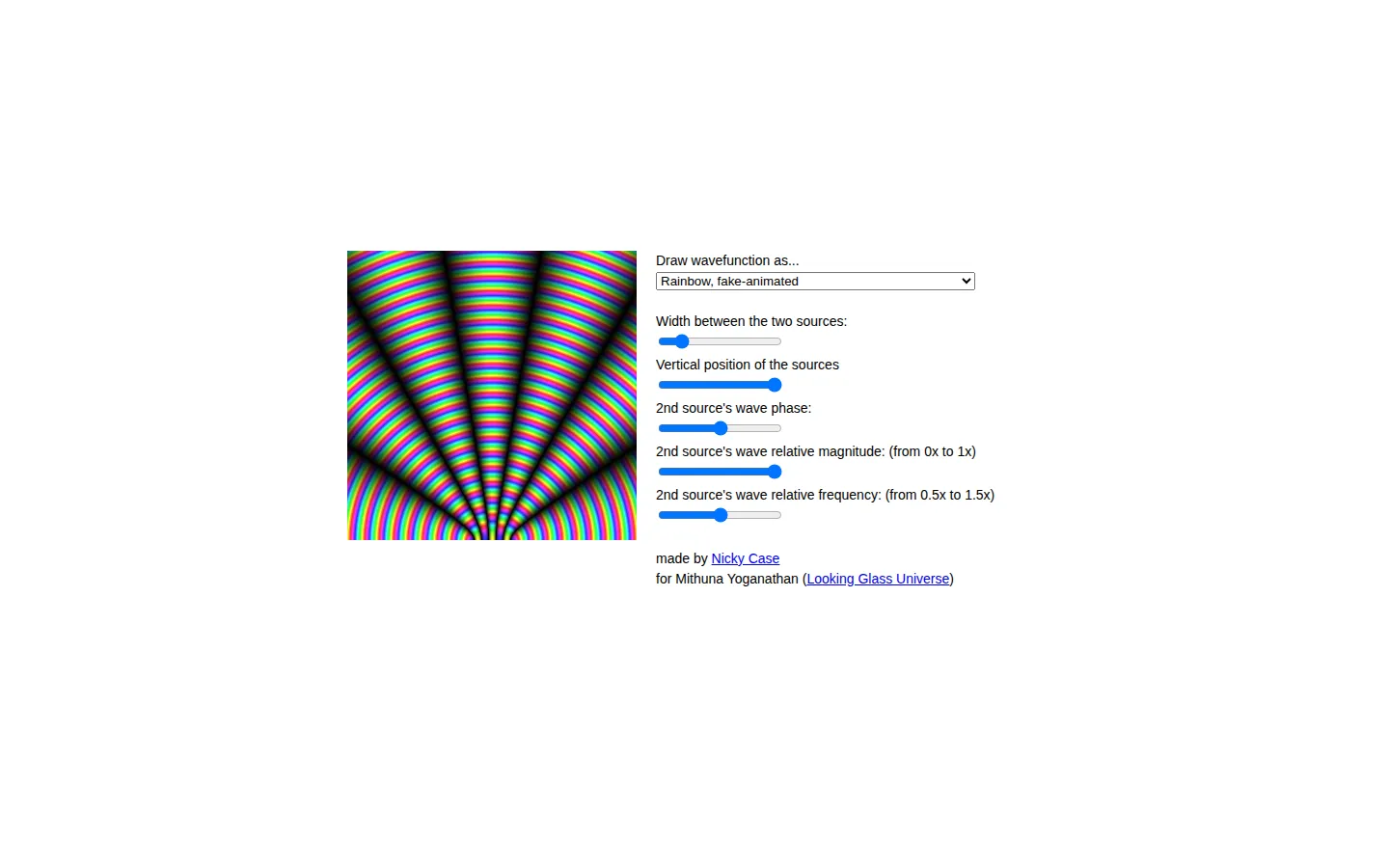
Basic Double-Slit Simulation is a stripped-down wave sandbox from Nicky Case. It gives you direct control over two source positions plus the second source's phase, strength, and frequency, then lets the resulting pattern do most of the explaining. The page is closer to a compact experiment bench than a guided quantum lesson.
What is Basic Double-Slit Simulation?
There is almost no runway here: a drawing selector, a handful of sliders, the visualization, and a short maker credit. Move the sources apart, shift them vertically, or alter the second source until the shared pattern changes character. Phase, relative magnitude, and relative frequency are separated into their own controls, which makes it possible to disturb one relationship at a time instead of throwing every variable into the same physics soup. Despite the double-slit name, the visible interface is framed around two wave sources rather than a barrier, adjustable slit widths, particles, or a detector screen. That narrower scope is the whole charm, provided you arrive ready to experiment rather than be lectured.
What you can do there
- Change the spacing and vertical position of two wave sources
- Adjust the second source's phase, magnitude, and frequency
- Compare wavefunction drawing modes
Why we picked it
It removes nearly everything except the relationship worth watching. The result is quick to approach and unusually good for asking small what-if questions: what changes when one source weakens, slips out of phase, or runs at a different frequency? Those controls make interference feel like a behavior you can perturb, not just a striped diagram in a textbook.
How to get the most from it
Start with the sources at equal strength and frequency, then move only their spacing until the pattern becomes familiar. Next change the second source's phase, followed by magnitude and frequency one at a time. Keeping the early comparisons controlled makes the later oddball combinations much easier to read.
Good to know
This is a tiny, free visual tool rather than a complete double-slit explainer. Its visible controls model two sources and do not expose slit width, barrier geometry, particle emission, or detection. The page does not document units, equations, accuracy, keyboard access, touch behavior, reduced-motion support, or screen-reader cues. Nicky Case broadly permits reuse of their work under a public-domain waiver, though item-level source parity was not established.
Who made it, and when?
Nicky Case is the credited creator or organization.
Creator’s official page Open Basic Double-Slit SimulationMore like this
Stellarium Web

Turn the browser into a planetarium matched to the sky above your location.
The Scale of the Universe 2

Slide from the smallest known scales to the largest structures in the observable universe.
100,000 Stars
Fly from the Sun into a 3D neighborhood of one hundred thousand nearby stars.
WorldWide Telescope

A sky atlas with a time machine tucked into its controls