
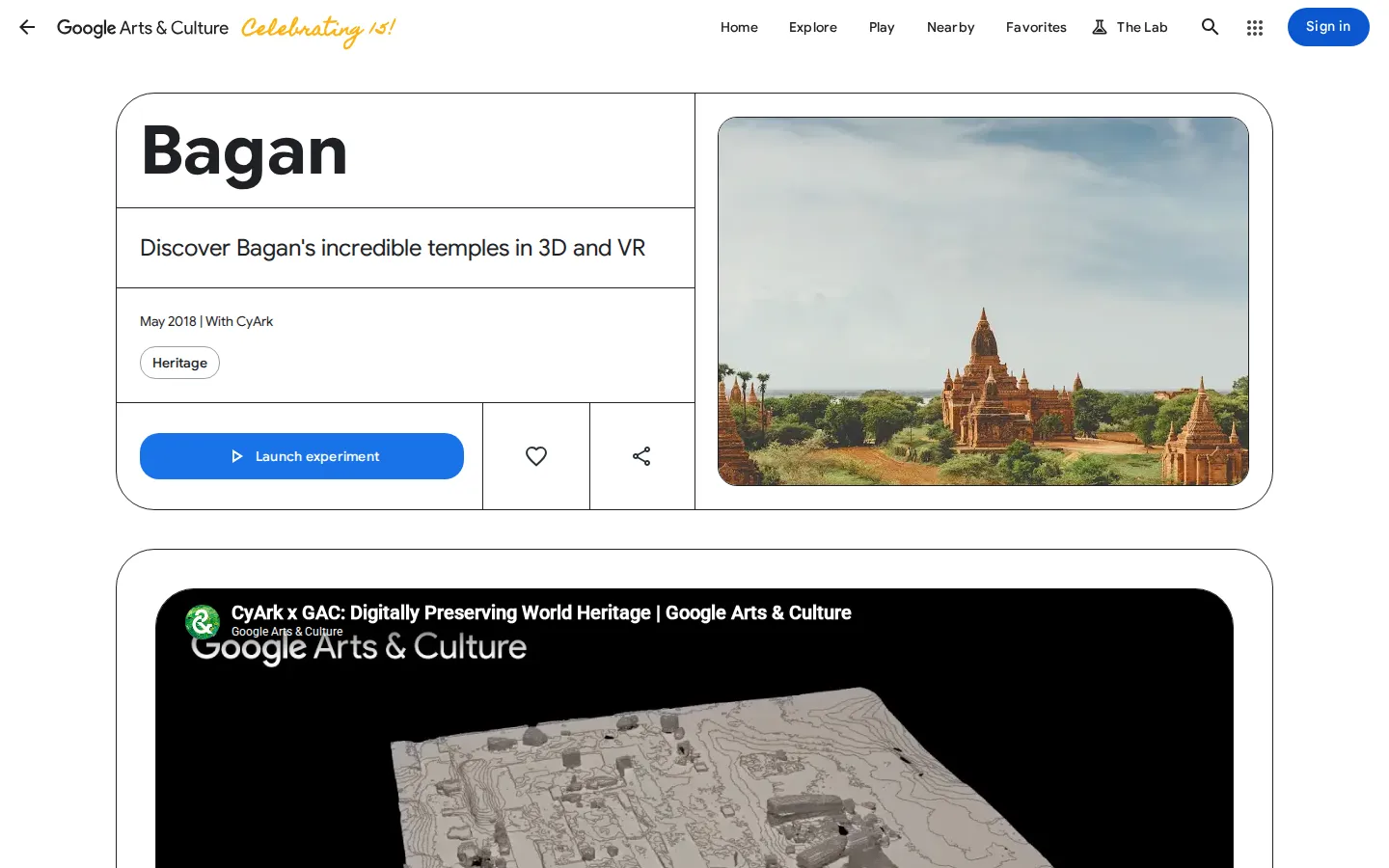
Bagan turns heritage documentation into a guided 3D journey through a small group of Myanmar's Buddhist temples. The spectacle is grounded in conservation: the digital spaces come from survey work used to study earthquake damage and support stabilization planning.
What is Bagan?
The tour moves across Bagan's temple landscape and into decorated interiors, using 3D scanning, photogrammetry, and 360-degree video to build a navigable account of vulnerable places. It is structured as a journey rather than an empty model viewer: a general route carries the story forward, while optional details let you stop for architecture, murals, earthquake damage, and preservation work. That context gives the pixels some weight. CyArk's field records were not collected only for an online attraction; survey-derived drawings helped teams analyze and plan work at Ananda Ok Kyaung after the 2016 earthquake. The public experiment turns part of that technical archive outward, letting a casual visitor see both the monument and the reason careful digital documentation matters.
What you can do there
- Travel through a 3D reconstruction of Bagan
- Enter decorated temple interiors
- Open optional historical and conservation details
- Use a legacy WebVR mode when compatible
Why we picked it
Many virtual tours offer a polished room and little explanation of how it came to exist. Bagan keeps the capture process and conservation purpose close to the surface. The result is a rare double view: an atmospheric trip through intricate spaces and a compact lesson in how laser scans, photographs, drawings, and storytelling can cooperate after disaster.
How to get the most from it
Follow the guided route once before chasing every optional detail. Pause inside the temples for mural and damage notes, then compare the reconstructed spaces with the conservation story. Desktop viewing is the sensible starting point; treat the VR option as a historical extra until your browser and headset prove compatible.
Good to know
The overview still gives WebVR instructions for Chrome 57–79, SteamVR, and HTC Vive, so current headset support is uncertain. The 3D movement may bother motion-sensitive visitors, and present keyboard, touch, captions, and screen-reader behavior remain unverified. This is a focused tour, not a complete catalog of Bagan.
Who made it, and when?
Google Arts & Culture with CyArk is the credited creator or organization. The earliest supported launch date we found is May 2018.
Creator’s official page Open BaganMore like this
OneZoom Tree of Life

Zoom through the evolutionary tree connecting millions of living species.
WindowSwap

Borrow someone else's window for a quiet view of another life and place.
OCEARCH Shark Tracker

A map where each dot has teeth and a travel itinerary
Is it dark outside?

A one-word verdict for a question your window could answer