
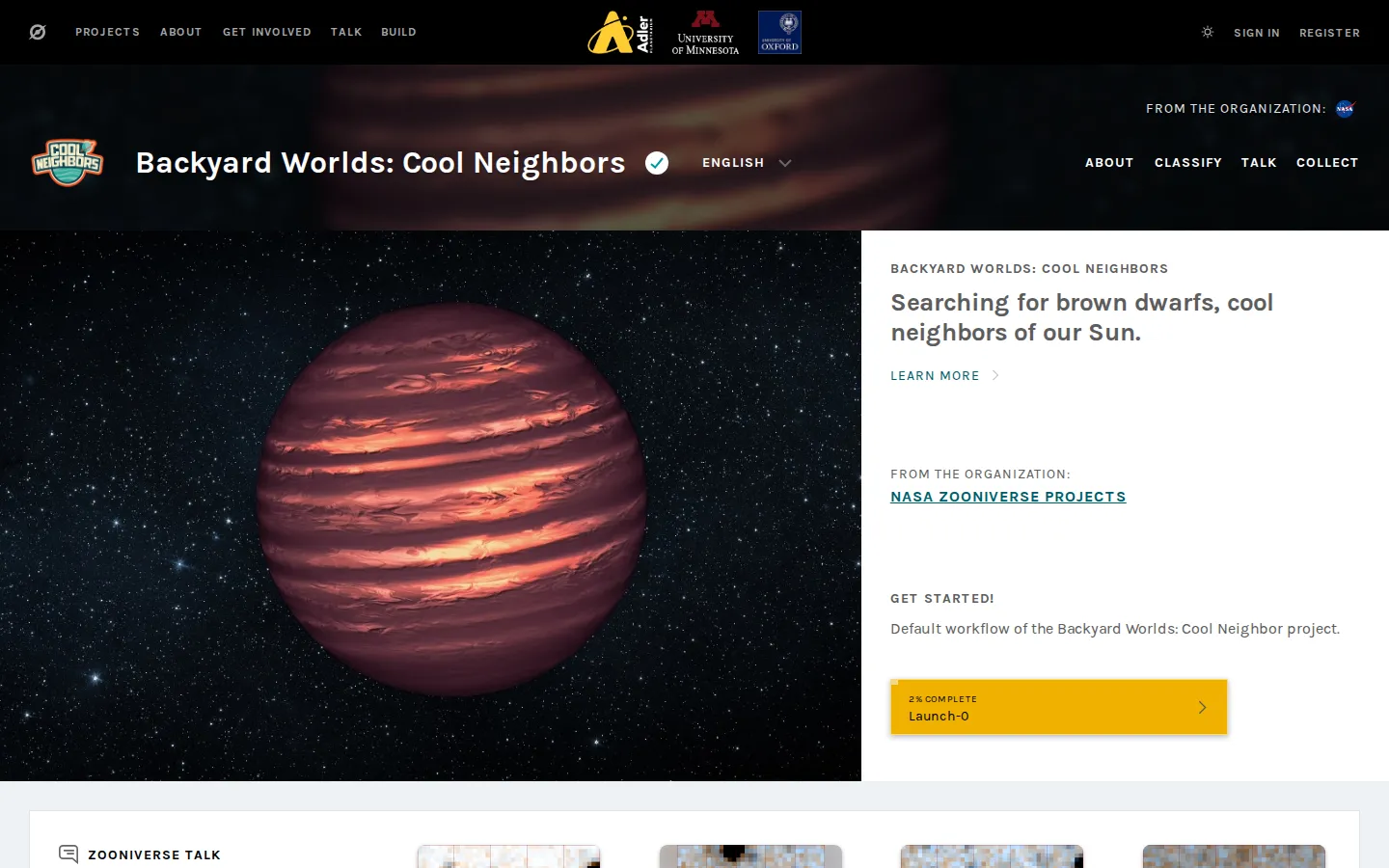
Backyard Worlds: Cool Neighbors turns WISE infrared image sequences into a focused citizen-science search for nearby brown dwarfs. Machine learning picks promising sky patches; people judge whether a faint dot really moves. The research, FAQ, and results pages keep the science readable even when fresh classification subjects are unavailable.
What is Backyard Worlds: Cool Neighbors?
Instead of serving random slices of the sky, Cool Neighbors centers each sequence on a brown-dwarf candidate selected by a neural-network pipeline. The human job is deliberately small and sharp: watch a short flipbook, decide whether a centered source appears to move, and separate genuine motion from detector noise, diffraction spikes, and other astronomical confetti. Zooniverse wraps that task in research notes, a detailed FAQ, Talk discussions, collections, and a results page. That last page says the project has examined roughly 100,000 ultracool-dwarf candidates and links two papers, so this is more than a demo with stars painted on it; volunteer sorting has entered the publication trail.
What you can do there
- Inspect WISE image sequences for faint moving objects
- Mark a likely moving candidate when subjects are available
- Read the project's research, FAQ, results, and Talk material
Why we picked it
Cool Neighbors gives a huge machine-search problem a legible human-sized decision. The candidate-centered flipbooks make the scientific role unusually easy to grasp, while the FAQ explains why false motion can fool an algorithm. It is patient work, but every careful yes or no belongs to a real hunt rather than a decorative quiz.
How to get the most from it
Read the FAQ before opening Classify; it explains the inverted images, the narrow field of view, and the artifacts most likely to masquerade as motion. If a subject is available, watch the full sequence before answering and keep your eye near the center. Use Talk or the linked follow-up form only for candidates that genuinely deserve a second look.
Good to know
A web-connected phone or computer is enough, and NASA budgets about 5–15 minutes for the tutorial. Current availability is murky: the classification route exposed zero subjects during this check while different project views reported conflicting completion figures. The pages and published results remain useful, but do not count on receiving a fresh target immediately. Interactive account behavior, accessibility, sound, ads, and popups were not tested.
Who made it, and when?
The earliest supported launch date we found is June 27, 2023.
Open Backyard Worlds: Cool NeighborsMore like this
Stellarium Web

Turn the browser into a planetarium matched to the sky above your location.
The Scale of the Universe 2

Slide from the smallest known scales to the largest structures in the observable universe.
100,000 Stars
Fly from the Sun into a 3D neighborhood of one hundred thousand nearby stars.
WorldWide Telescope

A sky atlas with a time machine tucked into its controls