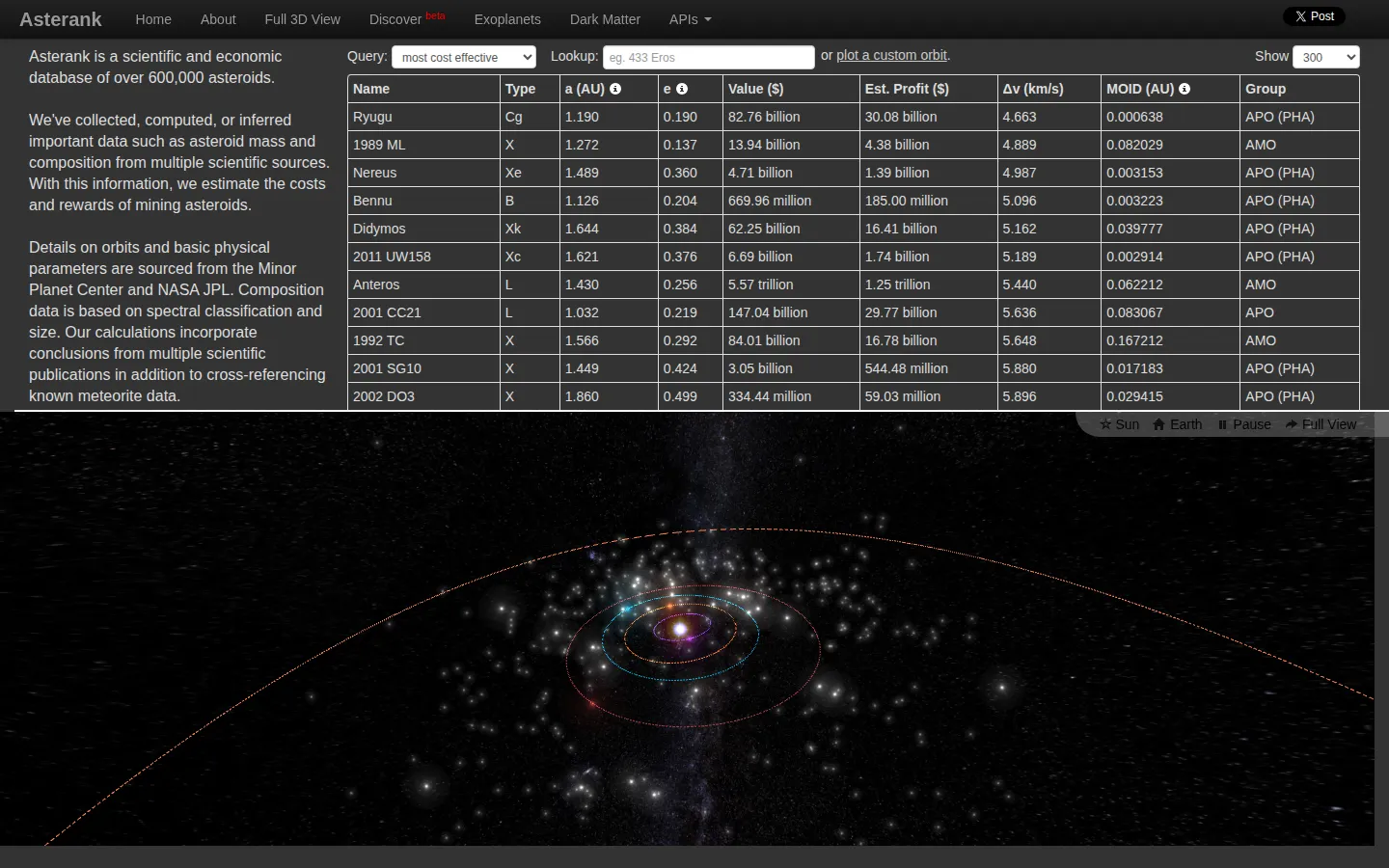
Asterank turns asteroid catalog data into a browsable field of orbital facts, rankings, and speculative resource estimates. It is a place to look up a space rock, compare its characteristics, and let the ridiculous scale of possible mineral wealth do a little harmless work on your imagination.
What is Asterank?
Asterank is what happens when asteroid catalogs meet the part of your brain that enjoys sorting, mapping, and wondering whether a distant rock might contain enough metal to make a terrestrial spreadsheet blush. The site gathers small-body information with orbital data, mass information, and its own calculations, then presents ways to browse, rank, and explore the results. The fun is in the tension between hard numbers and wild possibility. Asterank offers views that make near-Earth objects feel less like anonymous points in a science textbook and more like a crowd of individual candidates with different paths, properties, and hypothetical prospects. You can approach it as a data playground, a solar-system map, or a gentle reminder that there are many, many pieces of space moving above our ordinary concerns. The site is also refreshingly frank about its limits. Most asteroids do not have complete composition data, so the eye-catching value and mining figures are estimates built from incomplete knowledge rather than promises hidden in the sky. That honesty makes the exploration more interesting. Asterank is not asking you to plan a mission; it is inviting you to trace the assumptions behind a fantastically large idea and see how astronomy, orbital mechanics, and market math get stitched together.
What you can do there
- Browse asteroid rankings
- Explore the 3D view
- Look up asteroid data
Why we picked it
Asterank gives a complicated scientific and economic daydream a concrete interface. It pairs the pleasure of browsing a strange catalog with a useful dose of uncertainty, letting visitors compare objects while seeing why a tidy number can still rest on imperfect information. It is an excellent rabbit hole for anyone who likes data visualizations with actual planets in the background.
How to get the most from it
Start with the rankings or look up an asteroid that already has your attention, then use the available views to compare its orbital and calculated properties with nearby entries. Treat the price and profit figures as prompts for questions rather than answers. The most rewarding visit is one where you follow a number back to the data and assumptions that made it appear.
Good to know
Asterank's economic estimates are necessarily speculative. The project explains that many asteroids lack spectral classifications and other data needed to pin down composition, which means true value and mining cost cannot be fully estimated. Its database combines JPL, Minor Planet Center, published, and project-calculated data, so it is best used for exploration and comparison rather than financial or mission decisions.
Who made it, and when?
Ian Webster is the credited creator or organization.
Open AsterankMore like this
Stellarium Web

Turn the browser into a planetarium matched to the sky above your location.
The Scale of the Universe 2

Slide from the smallest known scales to the largest structures in the observable universe.
100,000 Stars
Fly from the Sun into a 3D neighborhood of one hundred thousand nearby stars.
WorldWide Telescope

A sky atlas with a time machine tucked into its controls