
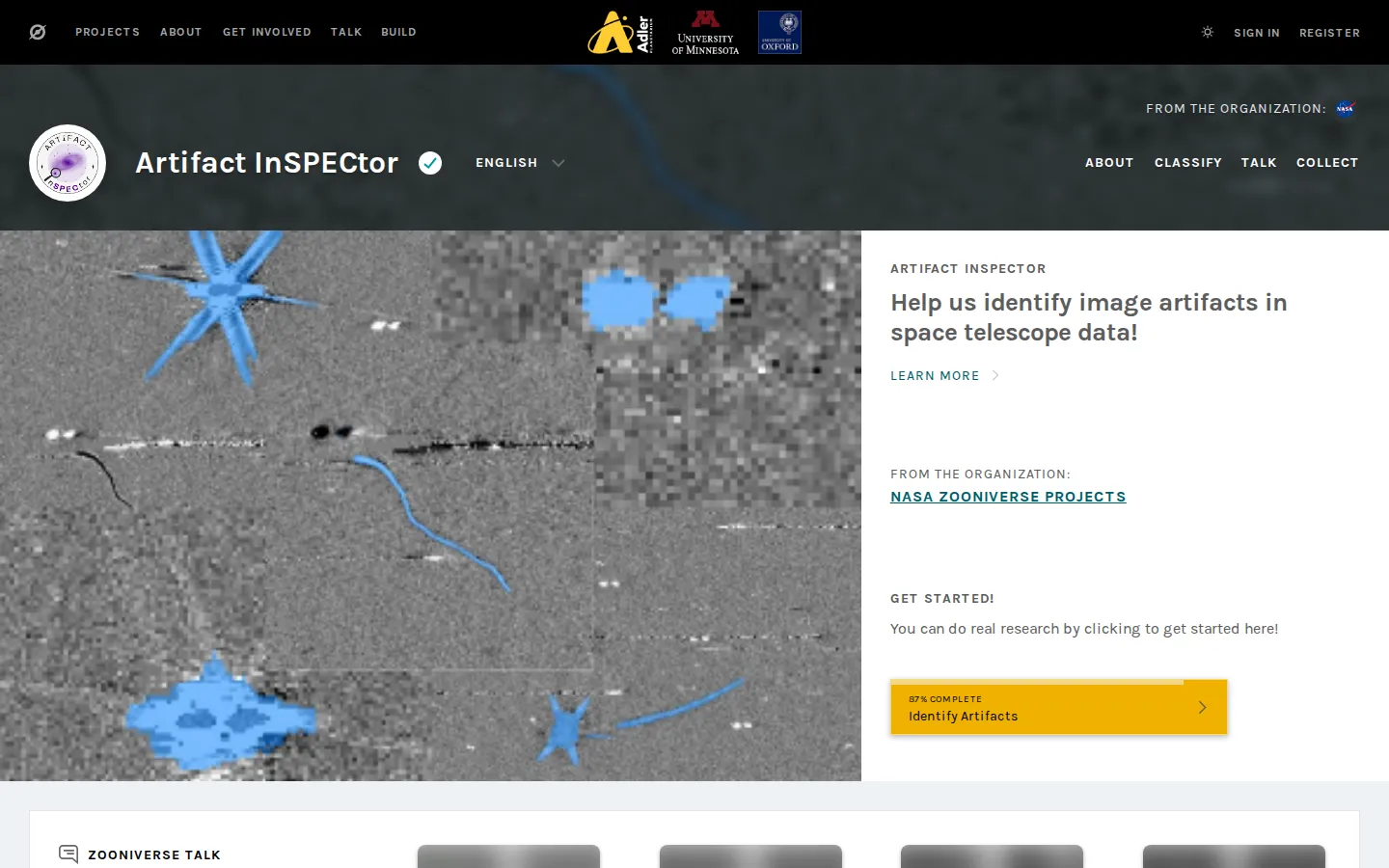
Artifact InSPECtor turns a fussy astronomy problem into a focused citizen-science task: decide whether bright marks in Euclid spectra are useful signals, instrument-made impostors, or a muddle of both. Each careful judgment helps researchers improve the tools that separate scientific data from telescope debris.
What is Artifact InSPECtor?
The project works with slitless-spectroscopy data, where many galaxies leave streaks and small emission-line blobs across the same frame. That makes the pictures less postcard and more cosmic receipt paper. Volunteers compare views from before and after continuum subtraction, label the highlighted feature, and check whether a blue segmentation mask hugs the right pixels. The distinctions matter: a compact blob might be a real emission line, while an infinity-shaped mark can be an optical artifact from the grism. Aggregated answers are meant to sharpen artifact masking for future analysis, including work connected to the Nancy Grace Roman Space Telescope.
What you can do there
- Classify possible artifacts in Euclid telescope spectra
- Judge whether an automated segmentation mask fits the highlighted feature
- Consult the research guide and discuss subjects with the community
Why we picked it
The task has an unusually crisp connection between a tiny visual decision and a large scientific pipeline. Its research and FAQ pages also explain the tricky edge cases instead of pretending every mark has an obvious answer. It is a satisfying fit for people who like finding the one suspicious pixel cluster in a field of nearly identical streaks.
How to get the most from it
Read the short research guide before classifying, then compare the before- and after-subtraction views rather than judging one image in isolation. Pay special attention to the highlighted box and the blue mask. If a spectrum and artifact overlap, use the combined label; if nothing convincing sits in the box, choose the no-obvious-subject option.
Good to know
This is active research, not a passive image gallery, and the available subjects and completion figures can change quickly. The classification flow, account behavior, sound, ads, popups, mobile layout, and accessibility controls were not directly exercised during this check. The destination also blocks third-party framing, so open it as a normal page rather than expecting it inside Site Stumble's embedded viewer.
Who made it, and when?
Artifact InSPECtor research team is the credited creator or organization. The earliest supported launch date we found is September 1, 2026.
Creator’s official page Open Artifact InSPECtorMore like this
Stellarium Web

Turn the browser into a planetarium matched to the sky above your location.
The Scale of the Universe 2

Slide from the smallest known scales to the largest structures in the observable universe.
100,000 Stars
Fly from the Sun into a 3D neighborhood of one hundred thousand nearby stars.
WorldWide Telescope

A sky atlas with a time machine tucked into its controls