
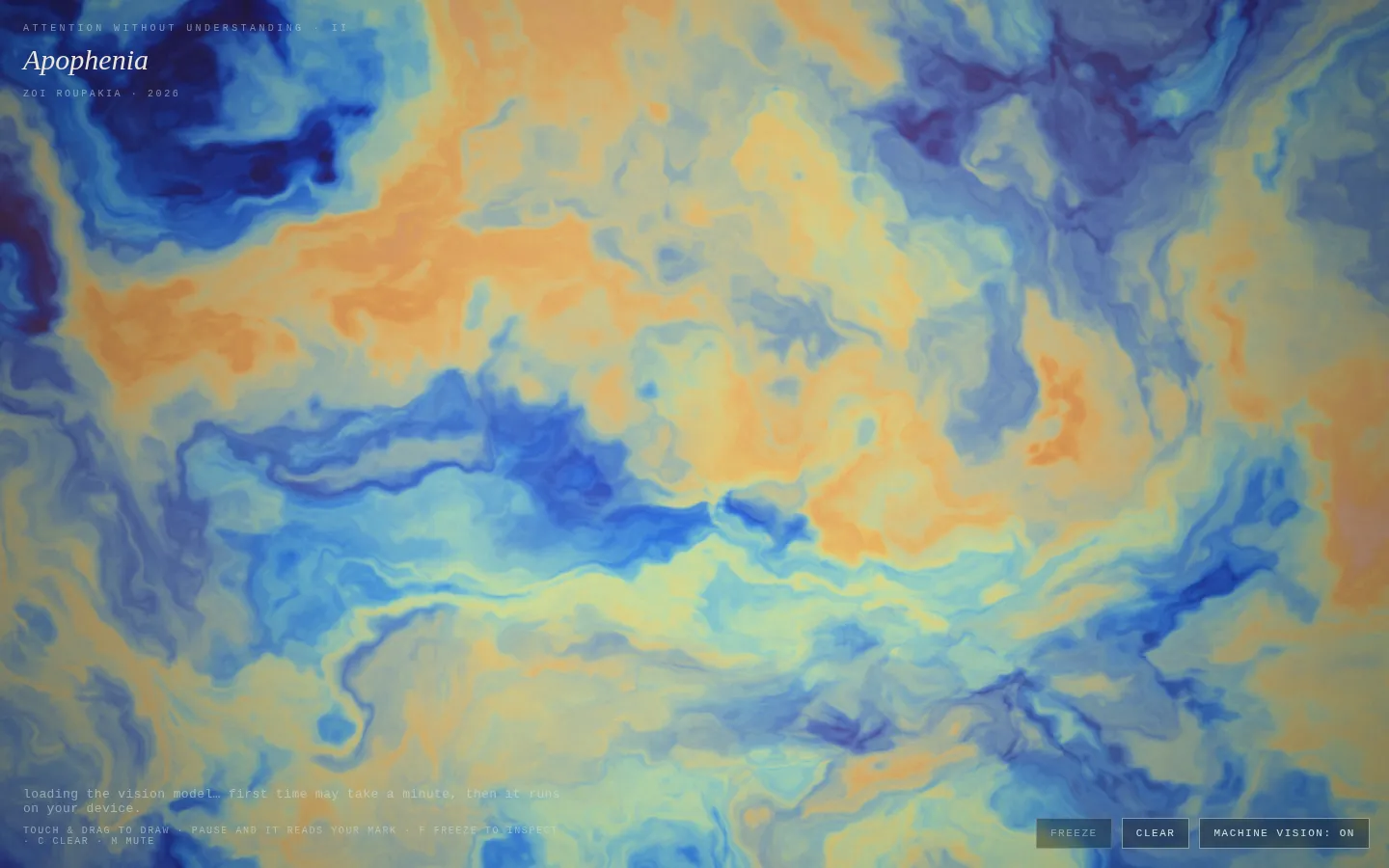
Apophenia turns pareidolia into a duet between human imagination and machine classification. Procedural clouds keep changing, an in-browser vision model names whatever it thinks it finds, and your own marks can be offered to the same cheerful machinery of interpretation.
What is Apophenia?
The canvas behaves like a cloud bank with an overeager museum labeler attached. Shader-generated forms curl and reform while a CLIP vision model samples small regions and proposes faces, animals, figures, and objects that may or may not be there. You can add your own lines to the field, then see how readily the model turns a gesture into a category. The joke is gentle, but the question underneath has teeth: a plausible label can feel like recognition even when it is only statistical pattern matching. Apophenia keeps that gap visible by placing the human urge to imagine beside the machine urge to classify.
What you can do there
- Watch an AI label shapes in procedural clouds
- Draw marks for the vision model to interpret
Why we picked it
The work makes an abstract problem in machine perception immediately legible. You do not need a diagram of zero-shot classification when a changing cloud and one stray line can coax a model into a wonderfully certain guess. Its blend of calm motion, hands-on drawing, and conceptual mischief rewards both a quick visit and a more skeptical stare.
How to get the most from it
Let the generated field run long enough to see several labels, then draw a simple shape and compare the model's reading with your own. Headphones may add atmosphere, but the central idea lives in the changing image, your mark, and the label that follows.
Good to know
The piece uses WebGL and a CLIP-based model through Transformers.js, so startup and performance may vary with the browser and hardware. The artist says inference runs locally without sending image data away, but this was not independently audited. Continuous motion is part of the work.
Who made it, and when?
Zoi Roupakia is the credited creator or organization. The earliest supported launch date we found is 2026.
Creator’s official page Open ApopheniaMore like this
Zoomquilt
An endlessly falling illustrated world nested inside itself.
Thisissand

Pour tiny grains of color into layered landscapes, patterns, and patient accidents.
Click Click Click

A green button that turns browser habits into a tiny surveillance drama.
Beige balls

Twelve colorful-looking spheres, one beige reality, and a tidy lesson in how nearby stripes boss your eyes around.