
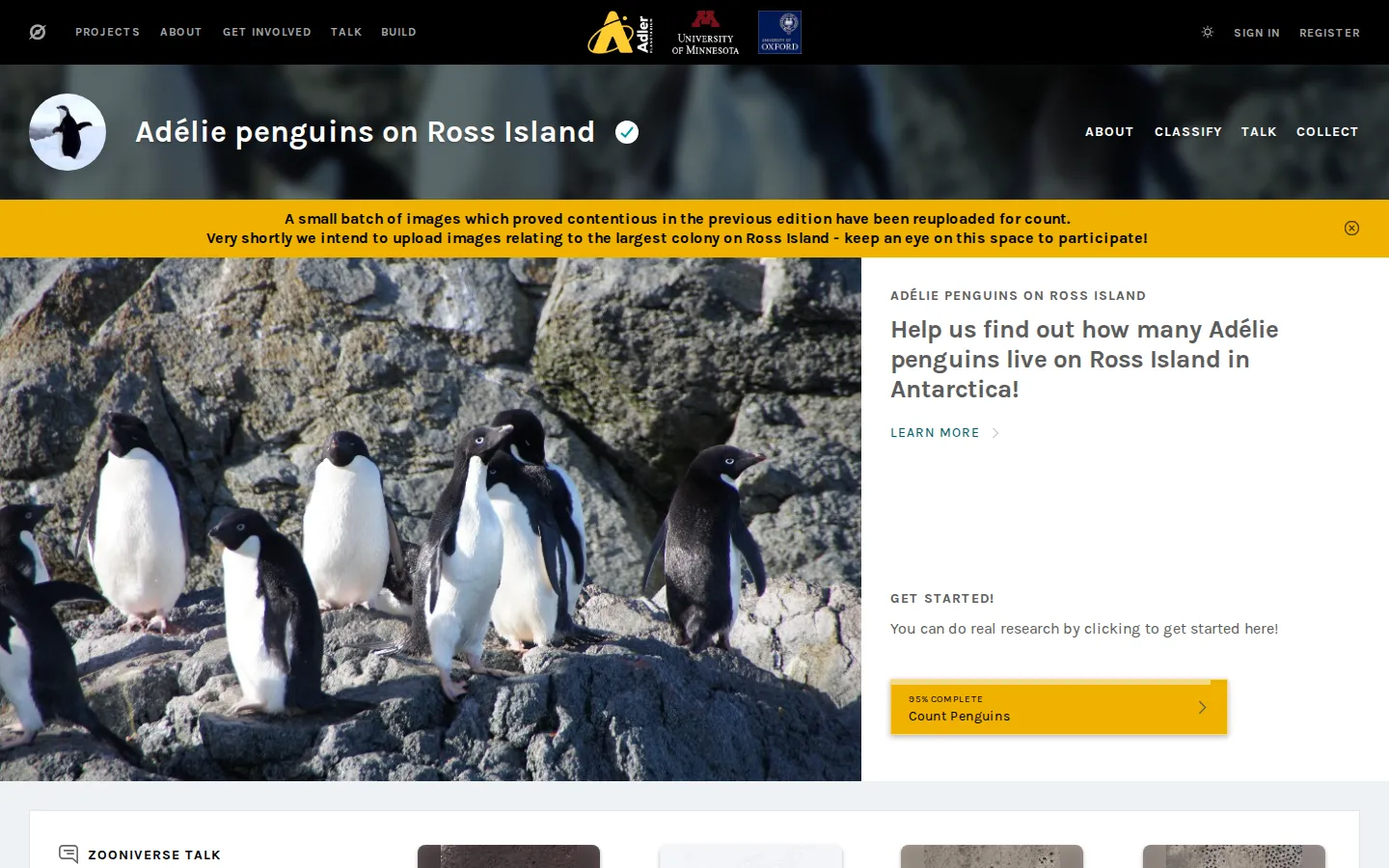
Adélie penguins on Ross Island turns helicopter photographs of enormous breeding colonies into a careful crowd-counting job. The aim is not merely to total birds, but to learn when image angle, rocky ground, mosaics, or human judgment make a wildlife census wobble.
What is Adélie Penguins on Ross Island?
Ross Island's Adélie colonies have been photographed from the air for decades, producing a long census record and a spectacular counting problem. In this project, volunteers inspect pieces of those colony images and count the penguins they can see. The crowd results are then compared with established census methods to find where disagreements appear and what might cause them. A bird can vanish into volcanic rock, a camera angle can compress a cluster, and a mosaic seam can turn an orderly tally into penguin arithmetic. That makes the project useful on two levels: it contributes another population estimate while testing how trustworthy different counting approaches are. Better counts matter because Adélie penguins are monitored as indicators of change in the Ross Sea ecosystem.
What you can do there
- Inspect aerial colony photographs
- Count visible Adélie penguins
- Submit counts for comparison with other census methods
Why we picked it
The premise is instantly understandable, but the research question has a pleasing extra wrinkle. You are not only counting penguins; you are helping measure how counting itself goes wrong. Few web tasks make quality control feel this feathery, and the aerial views turn an abstract population census into something you can inspect one crowded patch at a time.
How to get the most from it
Work methodically across each image instead of chasing the most obvious clusters. Use a consistent left-to-right or grid pattern, zoom when the interface allows it, and watch for birds blending into dark rock or touching one another. If no subjects are available, check the project notice later; batches appear to be released in stages.
Good to know
The project is in English and launched on Zooniverse in December 2025. Its current status is contradictory: the landing page announces more images, while the classifier says all subjects are counted, and the progress panels show 95 percent and 0 percent. Final counts may also be delayed by a two-year data embargo. The counting interface itself was not executed during this review, so keyboard, touch, screen-reader, audio, account, and submission behavior remain untested.
Who made it, and when?
University of Canterbury is the credited creator or organization. The earliest supported launch date we found is December 16, 2025.
Creator’s official page Open Adélie Penguins on Ross IslandMore like this
OneZoom Tree of Life

Zoom through the evolutionary tree connecting millions of living species.
WindowSwap

Borrow someone else's window for a quiet view of another life and place.
OCEARCH Shark Tracker

A map where each dot has teeth and a travel itinerary
Is it dark outside?

A one-word verdict for a question your window could answer