
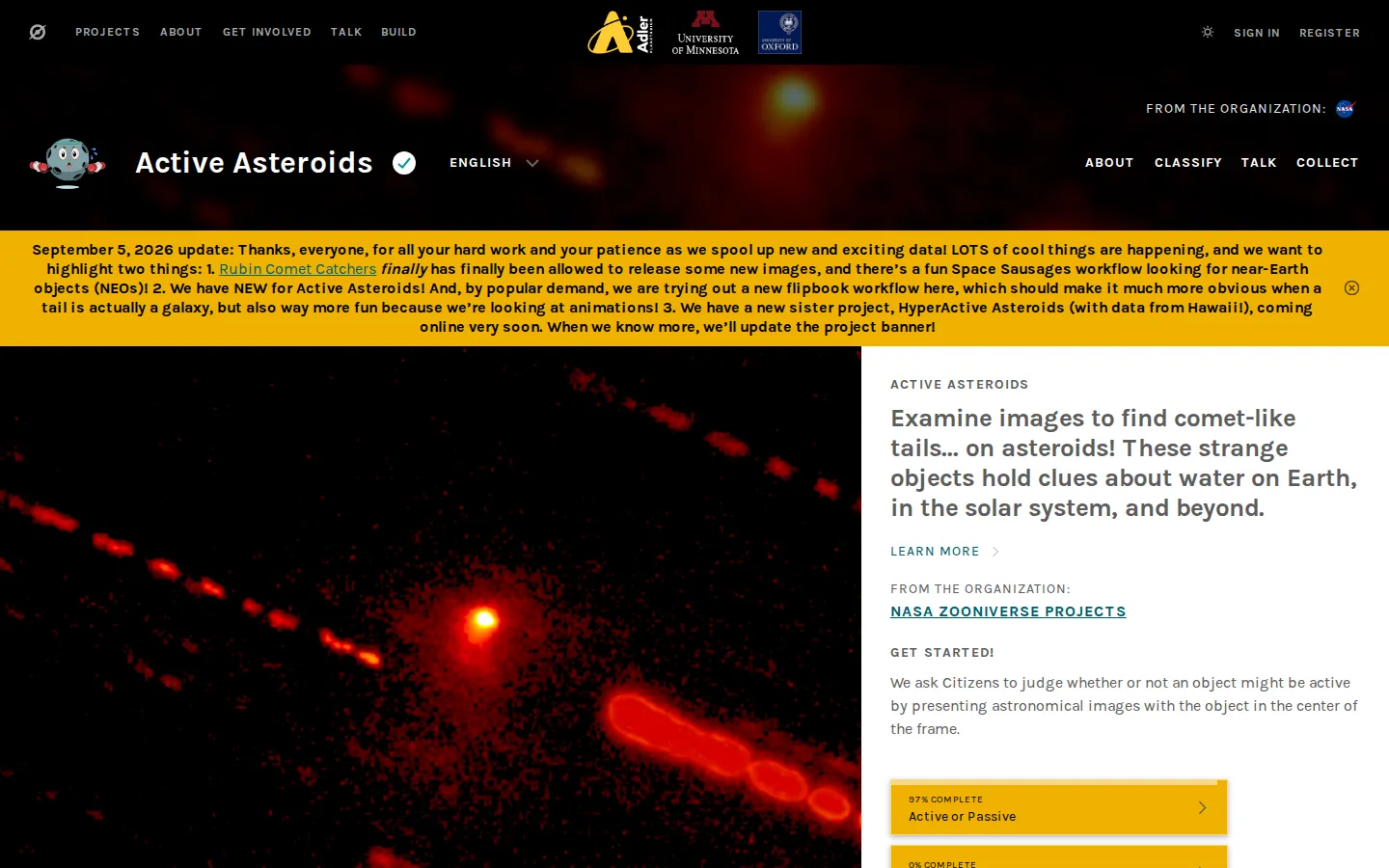
Active Asteroids hands you telescope cutouts of known minor planets and asks a deceptively small question: does this rock look active? The hunt has produced published discoveries, but a volunteer click is only the start of a longer process involving combined votes, expert vetting, archive searches, and follow-up observations.
What is Active Asteroids?
Most frames are exercises in disciplined skepticism. A centered speck may have a genuine comet-like tail or coma, but galaxies, cosmic rays, scattered light, and image trails are talented impostors. The project draws its cutouts from Dark Energy Camera observations made with the Blanco 4-meter telescope in Chile. A fresh September 2026 banner announces new data and a trial flipbook workflow that turns comparison into a tiny astronomical motion study. The static page still reports zero active subjects and 96 percent completion, so the live supply appears to change by batch and should be checked at visit time.
What you can do there
- Inspect telescope cutouts for tails or fuzzy comae
- Compare moving flipbook frames when the current workflow is available
- Discuss promising or confusing subjects in Zooniverse Talk
Why we picked it
The task is wonderfully narrow, yet the payoff is not hypothetical: the project's first major results included sixteen objects previously unknown to be active, and citizen scientists joined the author list. It rewards the useful scientific habit of noticing something odd without immediately deciding what it means.
How to get the most from it
Take the short tutorial, then compare each centered object with its surrounding stars and background fuzz. In the flipbook workflow, watch for a feature that stays attached to the moving object instead of sitting with a galaxy or detector artifact. Flag uncertainty honestly and bring especially peculiar frames to Talk; the research team, not one vote, decides what deserves follow-up.
Good to know
No astronomy background is required, and NASA says a connected phone or computer is enough. The new workflow uses animation, but its motion controls and accessibility were not tested. The live counters showed no active subjects during this check despite the recent new-data notice, so arrive ready for either a batch of rocks or a short wait for the next one.
Who made it, and when?
Colin Orion Chandler is the credited creator or organization. The earliest supported launch date we found is August 31, 2021. A documented update was recorded September 5, 2026.
Creator’s official page Open Active AsteroidsMore like this
Stellarium Web

Turn the browser into a planetarium matched to the sky above your location.
The Scale of the Universe 2

Slide from the smallest known scales to the largest structures in the observable universe.
100,000 Stars
Fly from the Sun into a 3D neighborhood of one hundred thousand nearby stars.
WorldWide Telescope

A sky atlas with a time machine tucked into its controls