
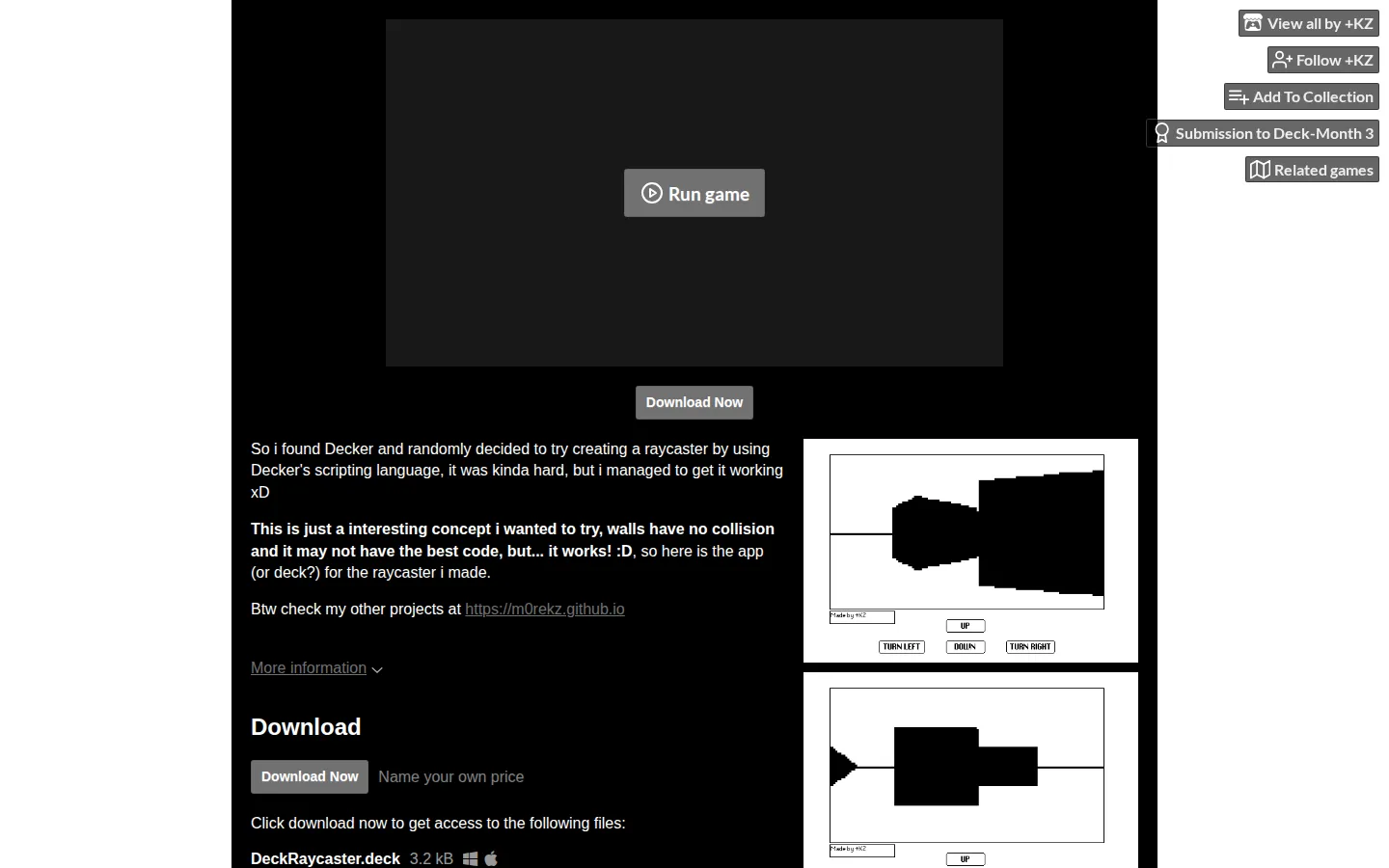
3D Decker is a tiny browser-playable raycasting prototype built inside the Decker multimedia environment. The trick is more compelling than the acreage: it is a compact demonstration of scripting an illusion of depth where you would normally expect cards and widgets.
What is 3D Decker?
The project page puts a Run game button beside a downloadable 3.2 kB deck, an appropriately miniature footprint for an experiment with a large idea. +KZ describes the work plainly: a raycaster assembled with Decker's Lil scripting, offered as a concept rather than a finished game. That constraint is the attraction. Decker is organized around cards, widgets, canvases, and small event-driven scripts, yet this deck bends those ingredients toward a pseudo-3D view. The result belongs in the delightful category of software that asks whether a tool can do something it was never especially designed to do, then answers with a cheerful, slightly wobbly yes.
What you can do there
- Run a small raycasting experiment in the browser
Why we picked it
It turns a modest authoring environment into a stage for a classic graphics technique, and it does so in a file small enough to feel like a magic trick. The rough edges are part of the field note: this is an understandable experiment, not a disguised promise of a full game.
How to get the most from it
Choose Run game on the itch.io page and approach it as a short technical toy. Spend a few minutes noticing how the deck suggests depth, then use the download option if you want the tiny .deck file for closer study in Decker.
Good to know
This is explicitly marked as a prototype. The creator says its walls have no collision, and the jam organizer cautions that Web-Decker can run more slowly than native Decker. Controls, sound, motion intensity, touch support, saving, and accessibility behavior are not documented on the page.
Who made it, and when?
+KZ is the credited creator or organization.
Creator’s official page Open 3D DeckerMore like this
CERN Line Mode Browser

A link list from the Web before it learned to decorate itself
Quenq

An interactive museum for playable internet history.
The Million Dollar Homepage
One million pixels from a gloriously chaotic web experiment.
Windows 93

A fake 1993 desktop where every click may take a glorious wrong turn.