
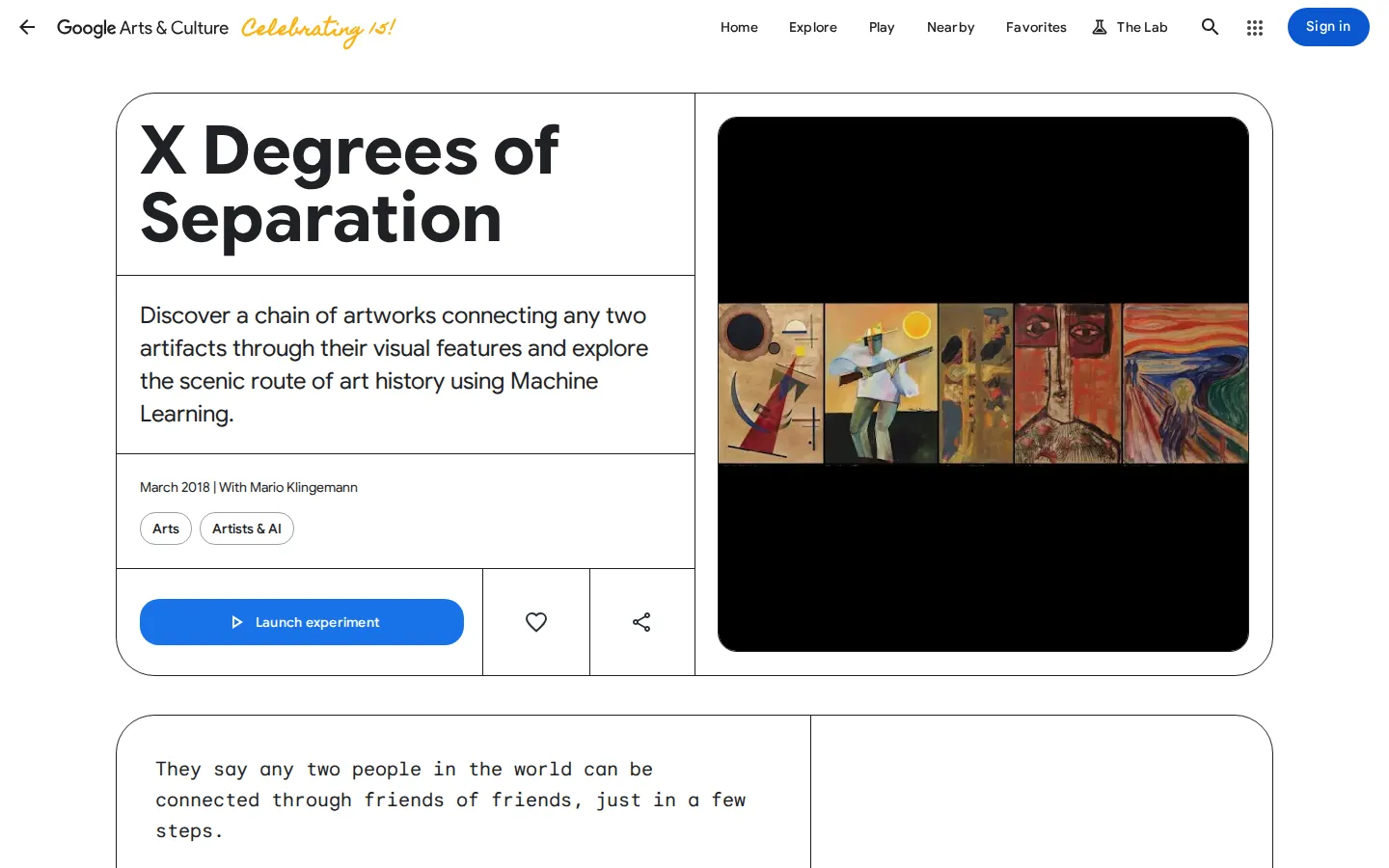
X Degrees of Separation turns an art collection into a visual relay race. Choose two works and it fills the gap with a chain of images that resemble one another, creating detours across periods, media, and reputations. The links are formal rather than historical, which is both the experiment's charm and its important limitation.
What is X Degrees of Separation?
A clay figure and Starry Night do not share a conventional family tree, but this experiment asks whether their shapes, colors, and textures can still lead to one another. Search for two artworks, drag them into place, and the system calculates a route through visually similar objects. Prepared pathways offer a quicker starting point, while fullscreen mode can cycle through random routes. The result behaves like a museum corridor designed by computer vision: famous paintings may hand the baton to an unfamiliar mask, textile, photograph, or humble object simply because their visible features rhyme. That can loosen the grip of artist-name search and surface material that ordinarily stays deep in a large collection. It can also produce shallow or peculiar associations, because resemblance in pixels is not evidence that artists, cultures, or ideas influenced one another. The most rewarding stance is curious but skeptical—enjoy the visual coincidence, then investigate the objects on their own terms.
What you can do there
- Choose two artworks and generate a visual path between them
- Watch random artwork pathways in fullscreen mode
Why we picked it
Most collection search begins with words you already know. This one begins with two images and treats the territory between them as the destination. It makes machine perception legible through small surprises, while quietly exposing how different a computer's idea of likeness can be from an art historian's.
How to get the most from it
Start with two works that seem deliberately mismatched, then inspect each intermediate stop instead of racing to the endpoint. Try the same starting work against several destinations to see which visual traits keep steering the route, and use a prepared pathway when you want an immediate example.
Good to know
These are visual-similarity routes, not claims of historical influence, cultural connection, or shared meaning. Search, drag-and-drop, fullscreen playback, mobile behavior, accessibility, motion, audio, and performance were not exercised in this check. Google's original launch article is dated November 2016, while the current wrapper displays March 2018; that discrepancy remains unresolved.
Who made it, and when?
Mario Klingemann with Google Arts & Culture Lab is the credited creator or organization. The earliest supported launch date we found is November 15, 2016.
Creator’s official page Open X Degrees of SeparationMore like this
The Pudding

Visual essays that use code, data, and interaction to explain culture unusually well.
Earth Nullschool

A living globe of wind, weather, ocean currents, and atmospheric motion.
The True Size Of…

Drag countries around the map and watch familiar size comparisons fall apart.
MapCrunch

Drop into a random street-level view somewhere in the world and figure out where you landed.