
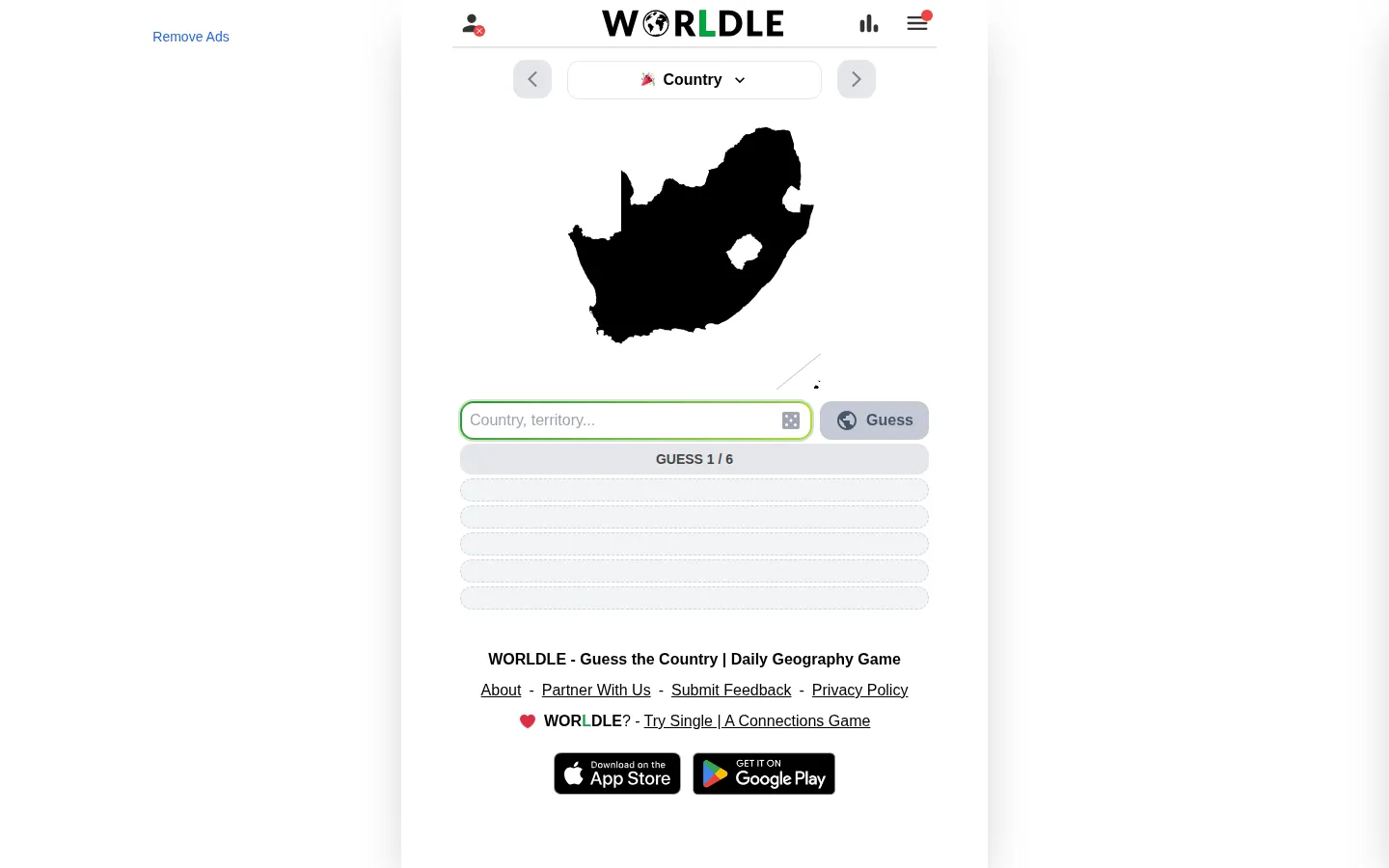
Worldle turns the daily-puzzle ritual toward geography: study an unlabeled country or territory shape, make a guess, and use distance, direction, and proximity clues to steer the next one.
What is Worldle?
Worldle starts with the mildly unnerving sight of a country outline stripped of its label. You type a country or territory name, then the game answers with geography rather than a blunt yes or no: distance, direction, and a proximity score point toward the target. The daily round allows six guesses, which makes a wild first stab useful rather than fatal. The result is part silhouette recognition and part practical map reasoning—an excuse to discover that a remembered border is not quite as memorable as it felt in school. Teuteuf Games credits Antoine Teuf as the creator, while contemporary independent coverage documented the game’s country-shape twist on the daily-puzzle format.
What you can do there
- Identify a country or territory from its silhouette
- Use distance, direction, and proximity clues to refine guesses
Why we picked it
The clues turn a missed silhouette into a navigational problem instead of a dead end. That small design choice gives a quick daily game enough room for hunches, deduction, and the occasional satisfying rescue from a terrible first guess.
How to get the most from it
Start by looking for a distinctive coastline, island pattern, or border shape, then enter a plausible country or territory. Treat the distance and arrow as map evidence, not decoration: use a broad first guess to help locate the next one.
Good to know
The daily puzzle is described as free in the browser, while the archive is described as a premium-account feature. No puzzle or account flow was opened here, so current ads, payments, saved statistics, sharing, accessibility, and mobile behavior need a live check.
Who made it, and when?
Antoine Teuf is the credited creator or organization.
Creator’s official page Open WorldleMore like this
The Pudding

Visual essays that use code, data, and interaction to explain culture unusually well.
Earth Nullschool

A living globe of wind, weather, ocean currents, and atmospheric motion.
The True Size Of…

Drag countries around the map and watch familiar size comparisons fall apart.
MapCrunch

Drop into a random street-level view somewhere in the world and figure out where you landed.