
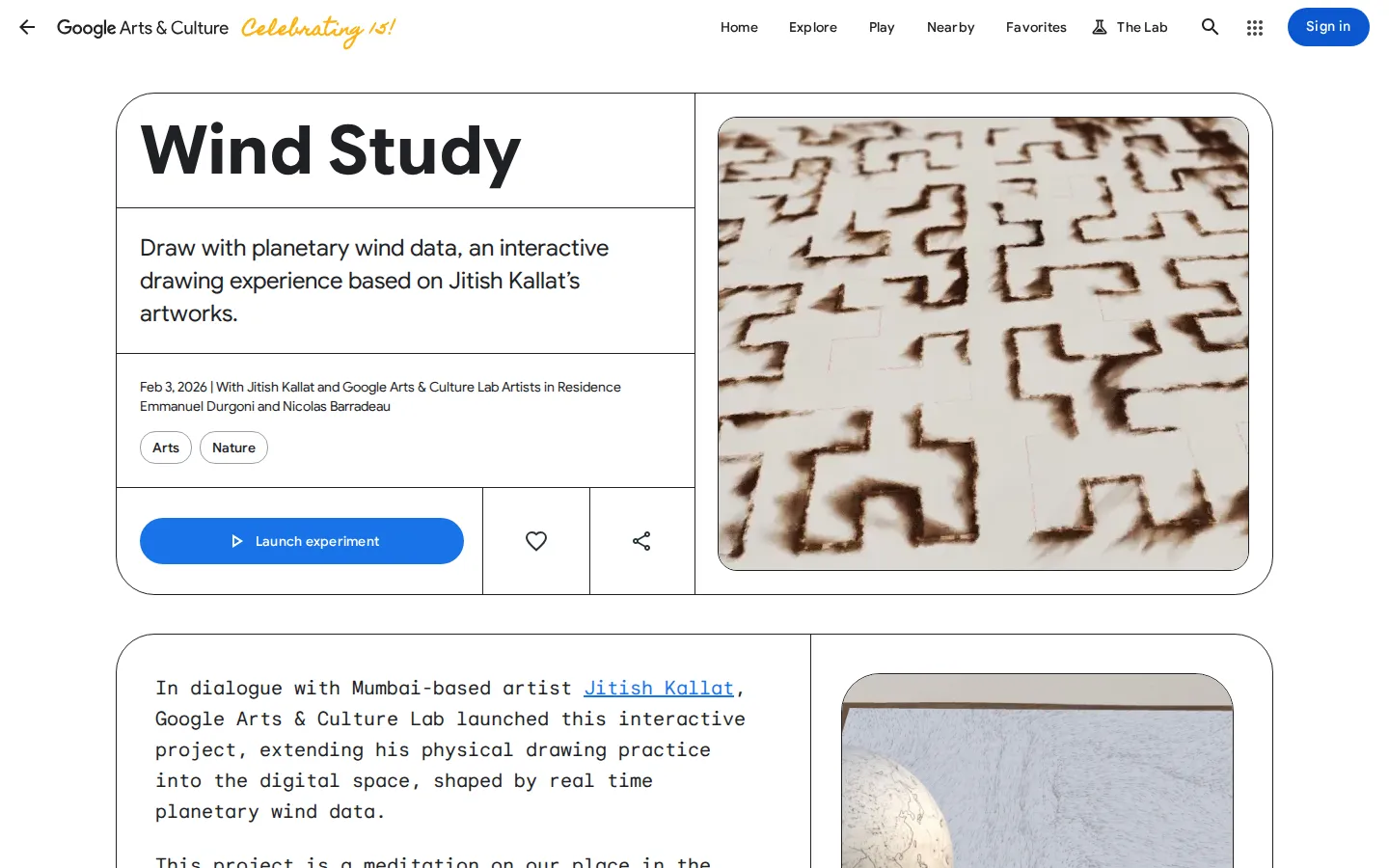
Wind Study makes weather a collaborator in a digital drawing. Built with artist Jitish Kallat, it uses atmospheric data to steer virtual flames across a curling mathematical line. Choose somewhere on the globe and the wind gets a say in the resulting mark.
What is Wind Study?
The starting pattern is a Hilbert curve: a line that folds repeatedly through a square. Google’s experiment connects that geometry to wind conditions from around the planet, so the drawing has both a strict template and an unruly partner. The documented sequence moves from picking a location to lighting the pattern with a digital match, then saving the wind-shaped result. Kallat’s physical Wind Study drawings use actual burning to record the air’s movement. This browser version translates the idea into simulated fire rather than asking visitors to handle a flame. It offers an unusual way to think about weather: as something that can leave a picture behind, rather than just a number beside a cloud icon.
What you can do there
- Choose a planetary location
- Ignite a digital curve
- Save a wind-shaped drawing
Why we picked it
Weather maps normally help you decide whether to bring a coat. Here, the same broad subject becomes a drawing material. The connection to Kallat’s physical practice gives the wind-driven marks a clear artistic reason to exist.
How to get the most from it
Begin with a place you know, follow the digital ignition sequence and let the result develop. Then choose a distant location and compare the marks. Use the saving option to keep an example; treat the comparison as an art exercise rather than a weather measurement.
Good to know
The experiment uses WebGL graphics and simulated flames. Google identifies NOAA/NCEP atmospheric data as its input and describes a six-hour refresh cycle. The output is an artistic interpretation of that data; it is not a forecast or a guide to lighting physical drawings.
Who made it, and when?
Jitish Kallat with Google Arts & Culture Lab is the credited creator or organization. The earliest supported launch date we found is February 3, 2026.
Creator’s official page Open Wind StudyMore like this
The Pudding

Visual essays that use code, data, and interaction to explain culture unusually well.
Earth Nullschool

A living globe of wind, weather, ocean currents, and atmospheric motion.
The True Size Of…

Drag countries around the map and watch familiar size comparisons fall apart.
MapCrunch

Drop into a random street-level view somewhere in the world and figure out where you landed.