
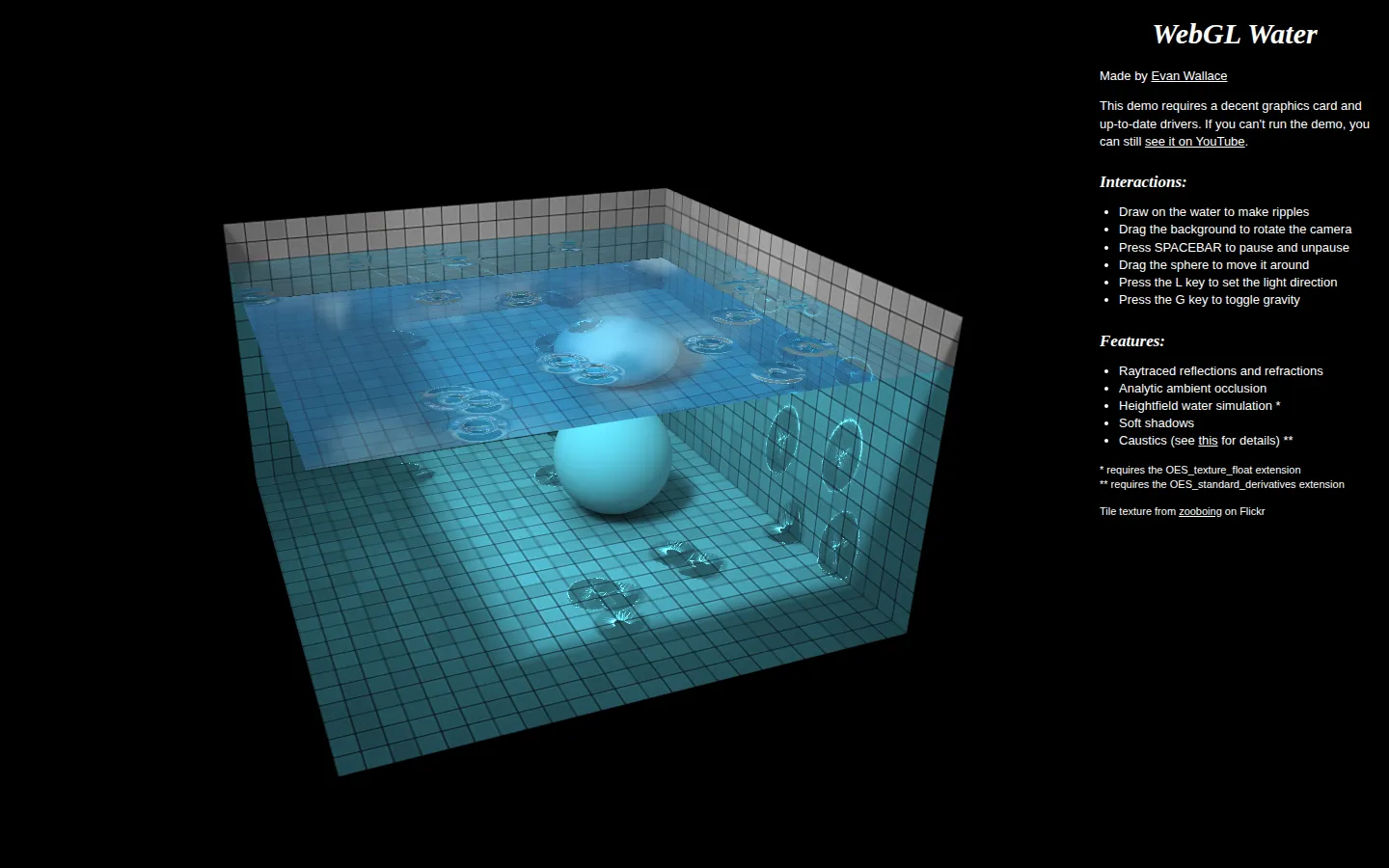
WebGL Water turns a browser tab into a small tiled pool built to show off real-time reflections, refractions, shadows, and caustics. Its control guide invites you to draw ripples, orbit the camera, move the sphere, and meddle with gravity, but the aging demo still depends on compatible graphics hardware.
What is WebGL Water Simulator?
A spare help panel sits beside a full-window canvas and gives the whole premise away: this is less a game than a graphics lab with a very splashable centerpiece. The listed controls let you draw across the surface, tug the sphere through the pool, rotate the camera, pause the simulation, and change either the light or gravity from the keyboard. Evan Wallace describes the work as a rendering experiment rather than a physically faithful water model, which is the right frame for it. The pleasure comes from seeing reflections, refractions, soft shadows, ambient occlusion, and caustics gathered into one compact scene.
What you can do there
- Draw ripples across a simulated pool
- Rotate the camera and move a floating sphere
- Pause the scene or alter its light and gravity
Why we picked it
The idea fits in one screen and makes demanding graphics techniques feel almost toy-like: disturb the water, move a sphere, and watch the scene answer. It also has a sturdy place in browser history, with a Chrome Experiments entry and contemporary coverage from WIRED and TechCrunch.
How to get the most from it
If the canvas loads, begin with one small drag across the water, then rotate the camera and move the sphere. Space pauses or resumes the scene; L changes the light direction and G toggles gravity. The help panel keeps the controls close at hand.
Good to know
Bring a desktop browser with hardware-accelerated WebGL and a capable graphics card. Current compatibility and performance were not verified in a rendered session, and the creator cautions that the water model favors visual technique over physical realism. Core actions rely on pointer dragging.
Who made it, and when?
Evan Wallace is the credited creator or organization.
Creator’s official page Open WebGL Water SimulatorMore like this
Neal.fun

A cabinet of interactive ideas that makes learning feel suspiciously like play.
Quick, Draw!

Doodle against the clock while a neural network tries to guess your subject.
Sandspiel

Paint with sand, water, fire, plants, oil, and other tiny materials that react to one another.
WebGL Fluid Simulation

Push luminous liquid color around the screen and watch digital turbulence behave beautifully.