
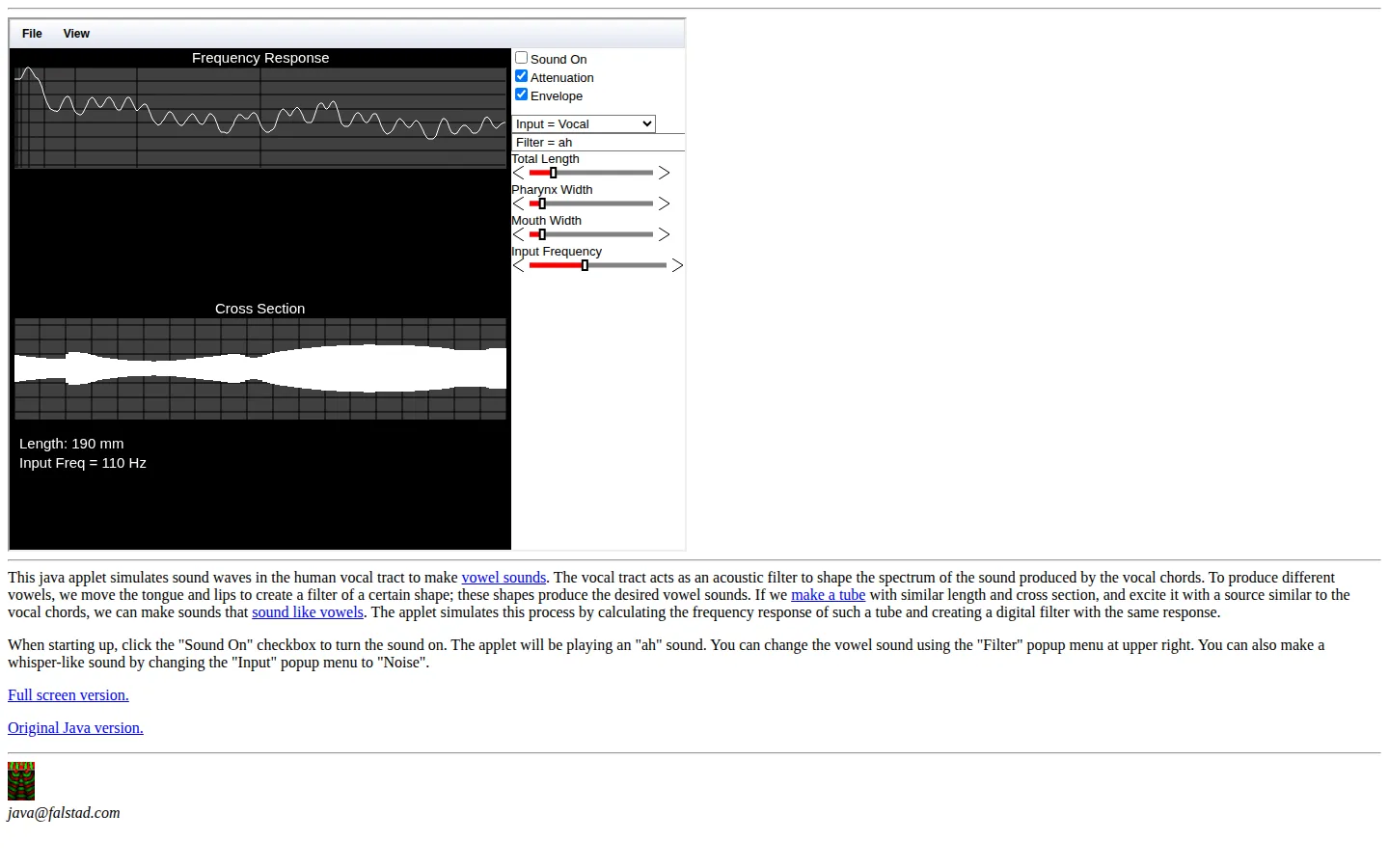
Vowel Resonator treats the vocal tract as a shapeable acoustic filter, then connects that shape to frequency response, spectrum, and vowel-like sound. It is a compact way to hear why the same source can emerge as ah, another vowel, or a whispery cousin.
What is Vowel Resonator?
The model starts with a voice-like source and a simplified tube standing in for the path from larynx to lips. Change the tract shape and the filter's resonances move; those peaks, called formants, amplify some harmonics and suppress others. The page documents preset vowel filters, an initial ah sound, and a Noise input that trades the voiced buzz for a whisper-like result. Independent teaching material also describes cross-section, frequency-response, and power-spectrum views, so the visit can be read with both ears and eyes. It is more illuminating sketchbook than anatomical replica, which is exactly why the basic source-and-filter idea comes through so cleanly.
What you can do there
- Shape a simplified vocal tract and inspect its resonances
- Switch among vowel filters and compare their sound
- Compare voiced and noise-driven whisper-like input
Why we picked it
Few explanations make speech acoustics this tangible. The enjoyable jolt is hearing a neutral source acquire vowel identity while the graphs reveal the resonant peaks doing the work. The Noise option adds a sharp comparison without burying the central lesson under a large interface.
How to get the most from it
Turn sound on at a comfortable volume, compare two vowel presets, and note which frequency-response peaks shift. Then switch the input to Noise and listen for the vowel shape surviving without the voiced buzz. If the live tract control is available, make one small constriction change at a time.
Good to know
Audio is central, so lower your volume before enabling it and skip the visit if sound is inconvenient. This is a simplified educational model rather than a clinical or anatomical tool. Live controls, modern-browser behavior, mobile support, accessibility, acoustic accuracy, and volume handling were not tested, and no screenshot was captured.
Who made it, and when?
Paul Falstad is the credited creator or organization.
Creator’s official page Open Vowel ResonatorMore like this
Radio Garden

Spin the globe and tune into live radio stations almost anywhere on Earth.
Chrome Music Lab

Friendly musical experiments that explain rhythm, melody, sound waves, and harmony by letting you play.
Blob Opera

Conduct four cheerful blobs whose vowel-shaped voices turn almost any gesture into opera.
Patatap

Turn every letter key into a synchronized burst of sound and animation.