
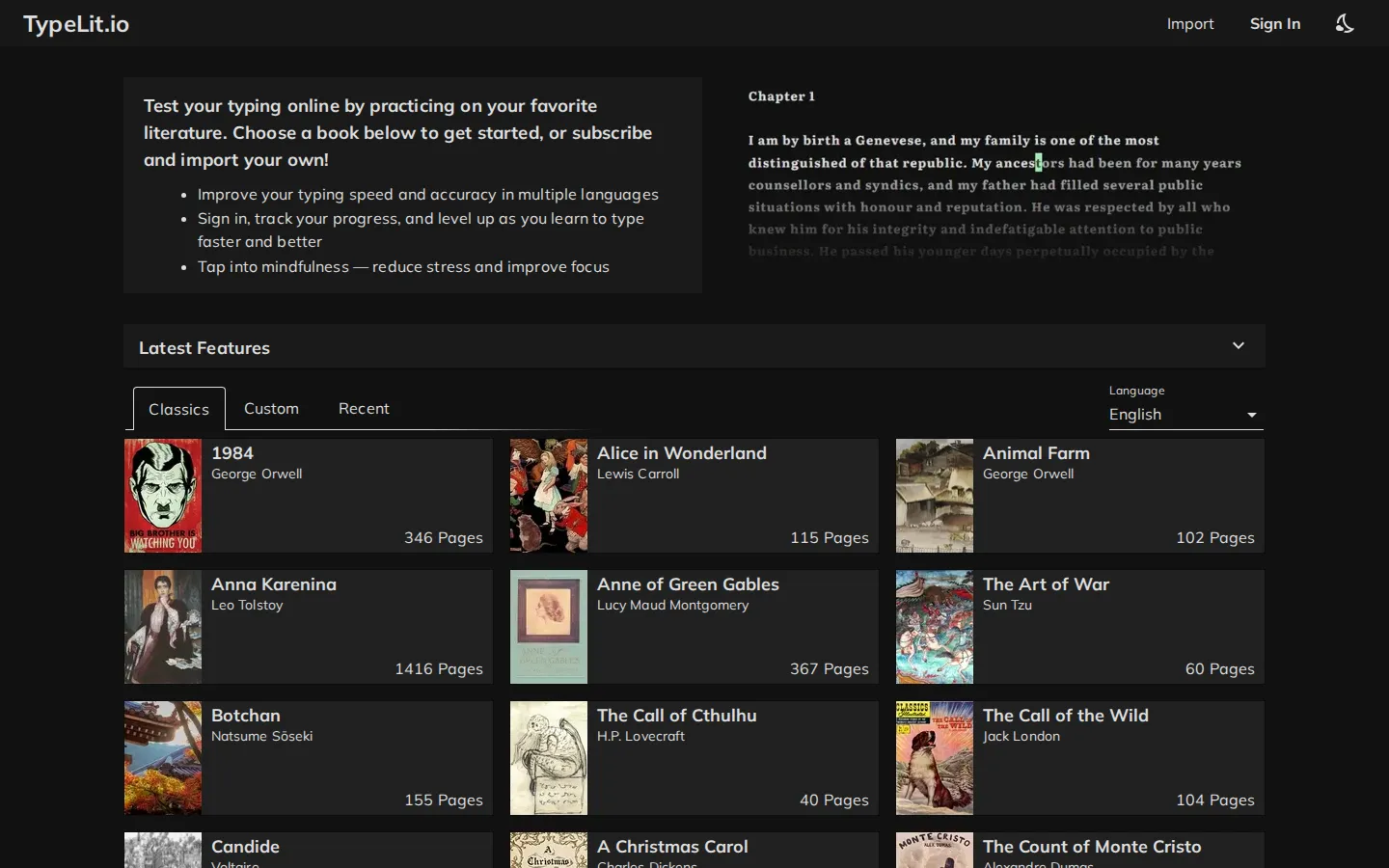
TypeLit turns classic books into long-form typing practice. Choose a title, work through its real sentences and punctuation, and let a chapter become a more substantial alternative to the usual burst of disconnected typing drills.
What is TypeLit?
TypeLit asks a pleasantly unreasonable question: what if typing practice had a plot? Its library is built around public-domain literature, so a session can be a sentence, a page, a chapter, or an ongoing project with actual voices, names, punctuation, and momentum. The opening description names familiar classics such as Alice in Wonderland, 1984, Dracula, and The Art of War, while the FAQ explains that progress can be tracked at the page, chapter, and book level. That makes it less like a typing test and more like a slow reading ritual with your hands involved. Pick something short for a contained challenge or begin a larger book when you want your practice to have a return address.
What you can do there
- choose a book
- type passages
- track progress
- practice accuracy
Why we picked it
TypeLit gives typing practice a reason to keep going beyond the timer. Real prose brings the awkward punctuation, unusual names, and changing sentence rhythms that tiny drills tend to sand away, and a whole book gives those keystrokes somewhere to lead.
How to get the most from it
Open TypeLit, choose a book from the supplied classic library, and type the text in sequence. Use page, chapter, and book progress to set a manageable stopping point. A physical keyboard is the natural fit; start with a short work before adopting a very long novel.
Good to know
The supplied library draws from public-domain literature, and the site says it tracks progress by page, chapter, and book. Its description also mentions importing personal text, but the current import limits and terms were not verified in this research. No live typing session was run.
Open TypeLitMore like this
The Library of Babel

Search an imaginary library that contains every possible page of a fixed length—including this sentence somewhere.
FutureMe

Write an email to yourself and choose a date far enough away to make it meaningful.
Wowfold

A paper-plane hangar stocked with darts, gliders, and expert oddballs
Arcane Intern

A magical publishing internship where coffee runs come with sigils.