
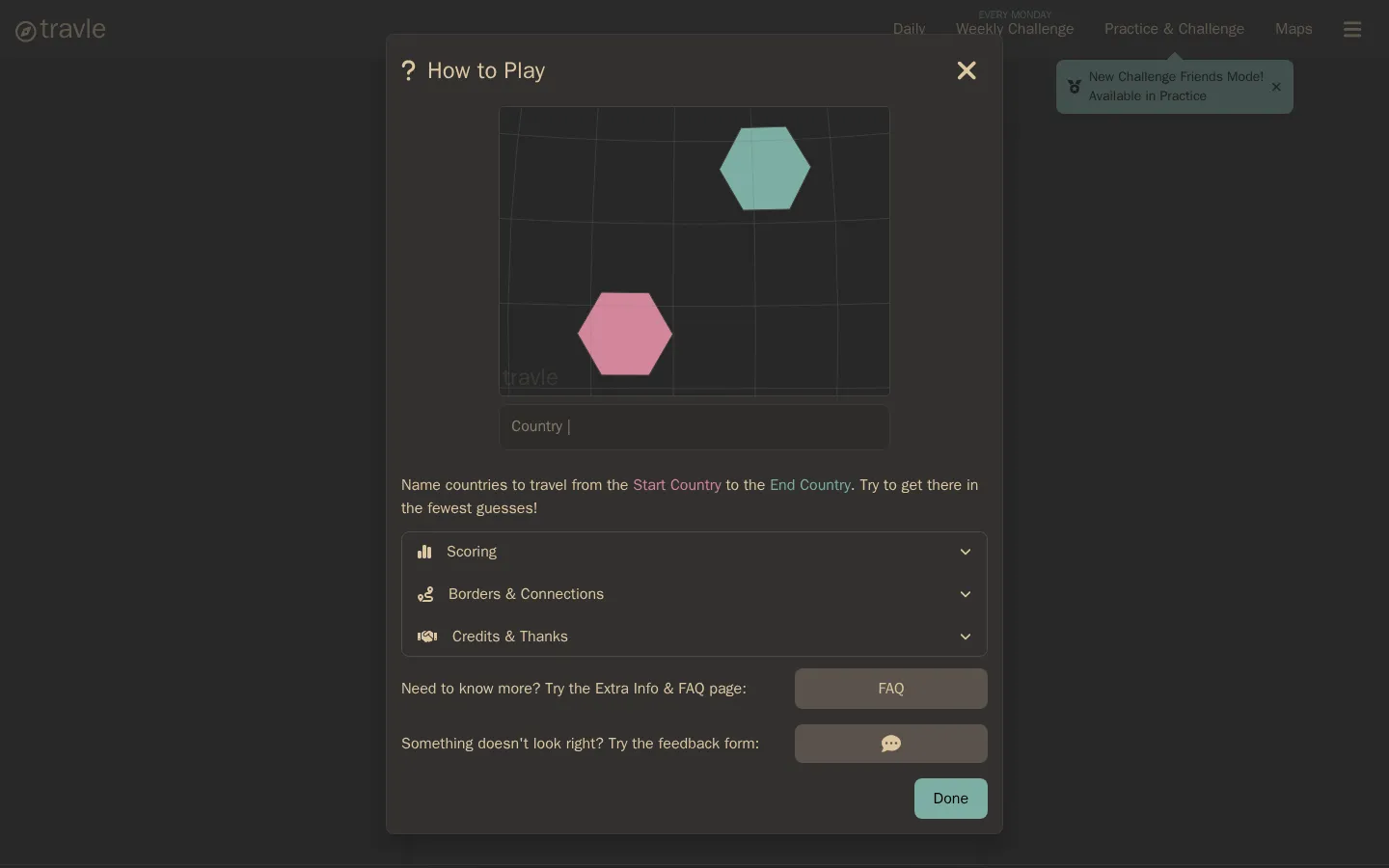
Travle gives you a starting country and a destination, then asks for the leanest chain of places between them. The catch is that it rewards a route through its connection rules, not a realistic itinerary, so borders, bridges, territories, and map trivia become the whole game.
What is Travle?
Travle is a geography puzzle with the pleasingly stern logic of a transit map drawn by a cartographer who enjoys edge cases. Each daily challenge begins with two places and a simple demand: connect them in as few country guesses as possible. The fun arrives when a route that feels obvious in the real world is not the cleanest path through the game's network. Bridges, tunnels, tiny shared boundaries, territories, and a few deliberately documented exceptions can turn a familiar map into a fresh problem. That makes every answer a small hypothesis about how places touch. The game's own notes are unusually helpful about those rules, which is good because the shortest solution is not always a route anyone would actually take. Travle rewards mental-map curiosity more than travel logistics, and it has the satisfying habit of making an obscure border feel important for one very specific minute.
What you can do there
- Name countries between two endpoints
- Find a shortest connection route
- Compare each guess against the route model
Why we picked it
The puzzle uses geography as a connected system rather than a list to memorize. A single country can become a shortcut, a dead end, or the hinge that makes an entire route snap into place, which gives border knowledge a lively tactical role.
How to get the most from it
Read the start and end countries, sketch a possible chain in your head, and enter the places you think connect them. When a result surprises you, check the game's extra information for its connection logic. Save real maps for later if you want the first attempt to stay a puzzle.
Good to know
Travle models a game network, not practical travel. Its connection rules may count bridges, tunnels, territories, corners, and some island crossings in ways that differ from a road trip or border-control reality. Daily, practice, archive, and accessibility behavior can vary by mode and device.
Who made it, and when?
Oisin Carroll is the credited creator or organization.
Creator’s official page Open TravleMore like this
The Pudding

Visual essays that use code, data, and interaction to explain culture unusually well.
Earth Nullschool

A living globe of wind, weather, ocean currents, and atmospheric motion.
The True Size Of…

Drag countries around the map and watch familiar size comparisons fall apart.
MapCrunch

Drop into a random street-level view somewhere in the world and figure out where you landed.