
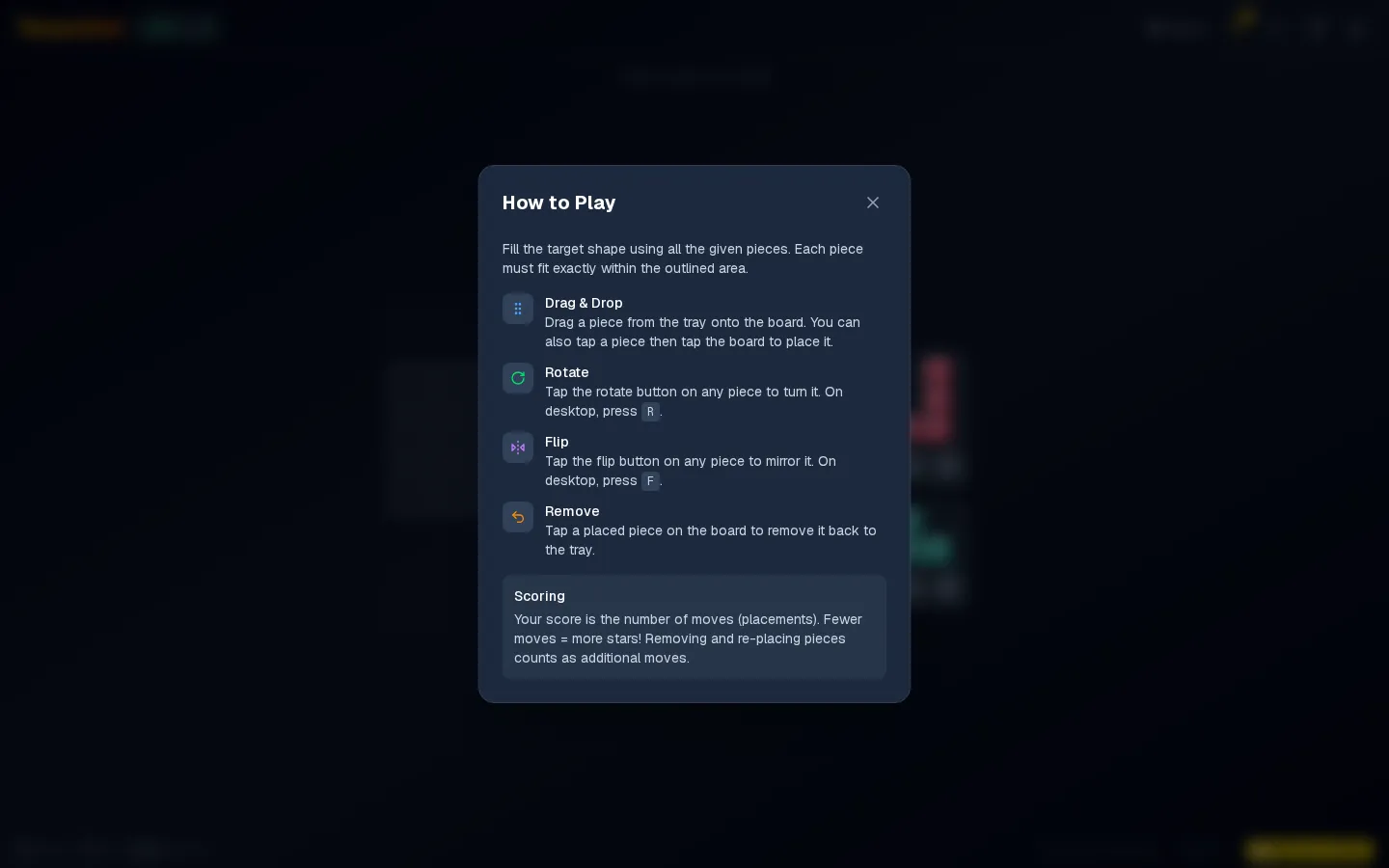
Tessellot serves a fresh spatial puzzle each day: fit every Tetris-like tile inside an outlined shape using drag, rotation, and flip controls. Easy, medium, and hard choices keep the compact ritual from becoming a one-speed chore.
What is Tessellot?
The premise is delightfully tidy. A target silhouette waits for a set of angular pieces, and the whole board becomes a negotiation with empty space: rotate what almost fits, flip what refuses, and keep rearranging until every tile belongs. A daily reset and three difficulty choices give Tessellot more staying power than a one-off packing toy, while streak tracking adds a small reason to return. It is a geometry snack with just enough resistance to make the final fit feel earned.
What you can do there
- Fit every tile into the outlined shape
- Drag, rotate, and flip pieces
Why we picked it
Tessellot turns a familiar polyomino-packing idea into an appealing daily ritual. The outlined target makes the goal immediately legible, while rotation and reflection create the useful sort of friction that can turn one awkward gap into the entire puzzle.
How to get the most from it
Begin with the easy puzzle to learn the piece language, then move upward when the shapes start feeling too polite. Work from corners and unusual notches first, and save flexible pieces for the gaps that remain.
Good to know
The site presents Tessellot as free, ad-free, and playable without sign-up. Keyboard accessibility, audio, browser storage, streak portability, and the exact friend-challenge flow are not clearly documented.
Open TessellotMore like this
The Library of Babel

Search an imaginary library that contains every possible page of a fixed length—including this sentence somewhere.
FutureMe

Write an email to yourself and choose a date far enough away to make it meaningful.
Wowfold

A paper-plane hangar stocked with darts, gliders, and expert oddballs
Arcane Intern

A magical publishing internship where coffee runs come with sigils.