
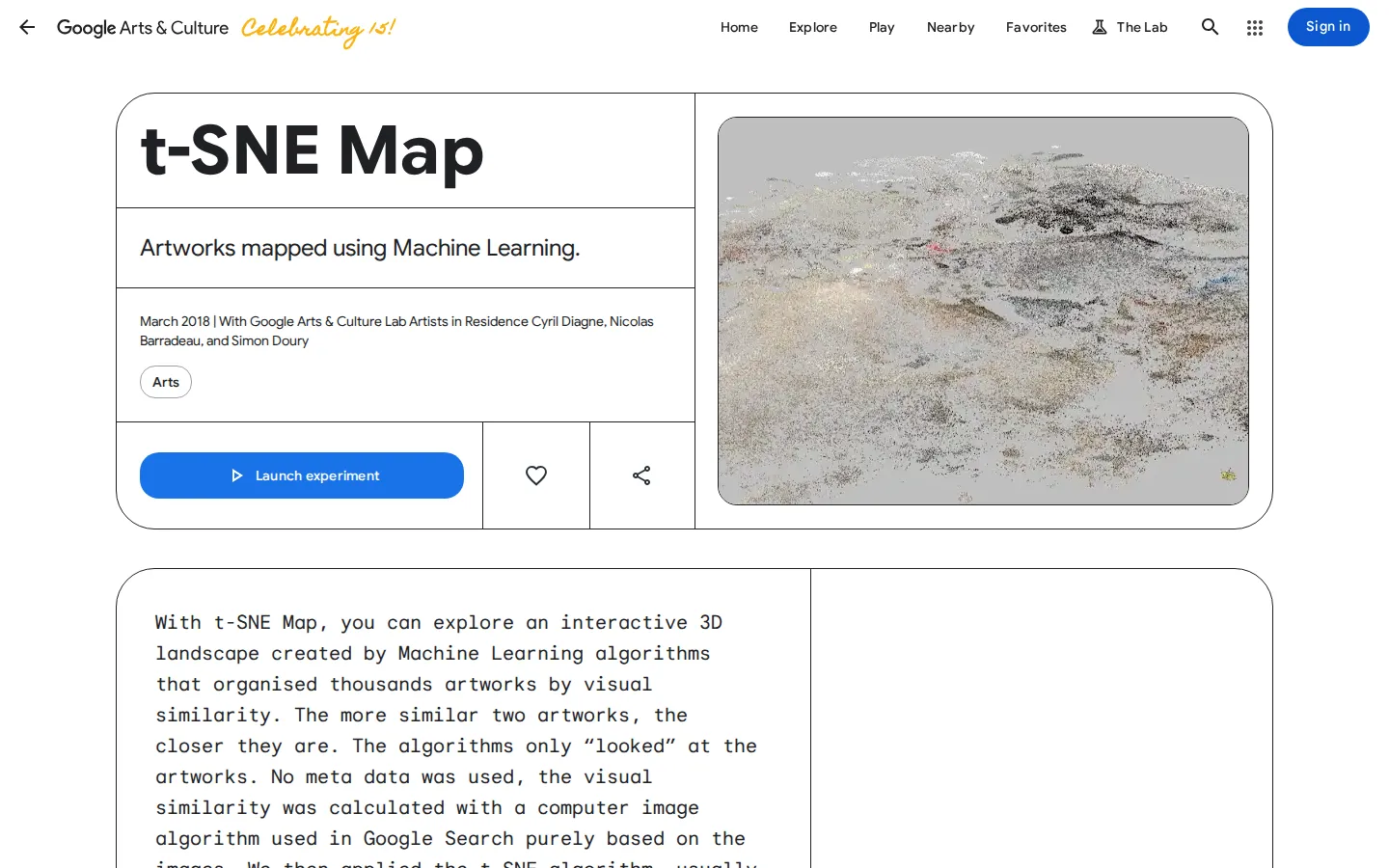
t-SNE Map turns a large art collection into navigable 3D terrain. Works the image system judged visually similar sit near one another, letting you tour strange neighborhoods of armor, woodblocks, portraits, dresses, sketches, and everything between.
What is t-SNE Map?
Instead of lining artworks up by artist, century, museum, or medium, t-SNE Map gives them geography. Drag across the terrain, scroll toward a dense patch, rotate the camera, and click a work for more information or a route into its full Arts & Culture record. A guided tour points toward named regions such as Japanese woodblocks, Impressionists Hill, coins, chairs, graffiti, and a mountain of sketches. The organizing logic comes from image similarity rather than catalog metadata, so the map exposes the computer's visual neighborhoods rather than a conventional art-history syllabus.
What you can do there
- Take a guided tour through artwork clusters
- Navigate, zoom, and rotate the 3D map
- Inspect and open individual artworks
Why we picked it
A collection becomes much more mischievous when it behaves like a continent. The map encourages the eye to notice accidental cousins across periods and institutions: a silhouette, palette, pose, or patch of texture can become the bridge. It is a fine place to get pleasantly lost while remembering that the landscape reflects a machine's pattern matching, not a curator's final word.
How to get the most from it
Begin with the guided tour to learn the camera controls and see a few distinct regions. Then switch to free exploration, zoom toward a cluster that catches your eye, rotate for a better angle, and open one artwork before wandering to its nearest neighbors. The named points of interest are useful landmarks when the full terrain feels enormous.
Good to know
The official page labels this a desktop-only experiment, and the live interface recommends a fast connection. Dragging, scrolling, and Shift-plus-drag are central controls. Distance on the map means visual similarity calculated by the system; it does not prove shared authorship, period, subject, or cultural meaning.
Who made it, and when?
Cyril Diagne, Nicolas Barradeau, and Simon Doury is the credited creator or organization.
Creator’s official page Open t-SNE MapMore like this
The Pudding

Visual essays that use code, data, and interaction to explain culture unusually well.
Earth Nullschool

A living globe of wind, weather, ocean currents, and atmospheric motion.
The True Size Of…

Drag countries around the map and watch familiar size comparisons fall apart.
MapCrunch

Drop into a random street-level view somewhere in the world and figure out where you landed.