
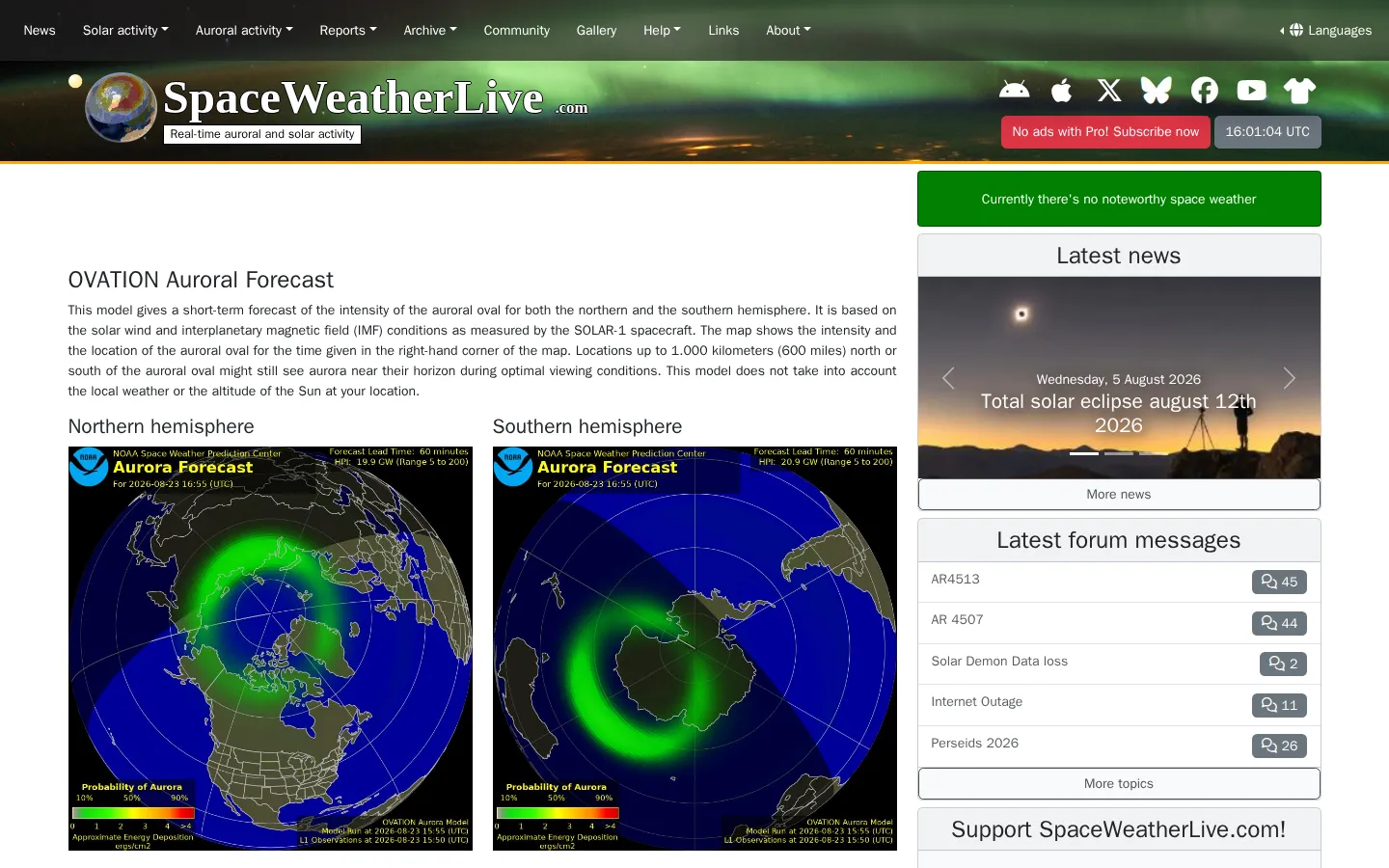
SpaceWeatherLive turns an OVATION auroral forecast into north-and-south polar views, a hemispheric-power readout, and location-by-location overhead odds. It is a useful pulse check, not a local sky forecast: clouds, daylight, horizon conditions, and fast substorms still get the last word.
What is SpaceWeatherLive Auroral Oval?
The Auroral Oval page gathers several useful clues into one weather-map-style stop. It presents the modeled northern and southern ovals, explains hemispheric power in gigawatts, and groups overhead-aurora odds by country and city. That pairing is the charm: the oval supplies the big planetary shape, while the location list answers the more personal question of whether your patch of Earth is even in the conversation. The page also states its own blind spots instead of pretending the magnetosphere can see through clouds.
What you can do there
- Compare northern and southern auroral ovals
- Read hemispheric power and location-level overhead odds
Why we picked it
Few dashboards make a planet-scale forecast feel this glanceable. The two-hemisphere framing gives instant geographic context, while the power guide and city odds keep the display from becoming a pretty green doughnut with no instructions.
How to get the most from it
Choose the hemisphere that matters, check the map's forecast time, then compare the oval with the hemispheric-power explanation and your nearest listed city. If the numbers look promising, verify darkness, cloud cover, and a clear poleward horizon with local tools before grabbing the thermos.
Good to know
This is short-term model guidance, not a guarantee of visible aurora. The page says local weather and the Sun's altitude are outside the model, and independent evaluation notes that fast substorm behavior is difficult to capture. The broader project is supported by advertising, subscriptions, and donations; live ad and popup behavior was not rendered.
Open SpaceWeatherLive Auroral OvalMore like this
The Pudding

Visual essays that use code, data, and interaction to explain culture unusually well.
Earth Nullschool

A living globe of wind, weather, ocean currents, and atmospheric motion.
The True Size Of…

Drag countries around the map and watch familiar size comparisons fall apart.
MapCrunch

Drop into a random street-level view somewhere in the world and figure out where you landed.