
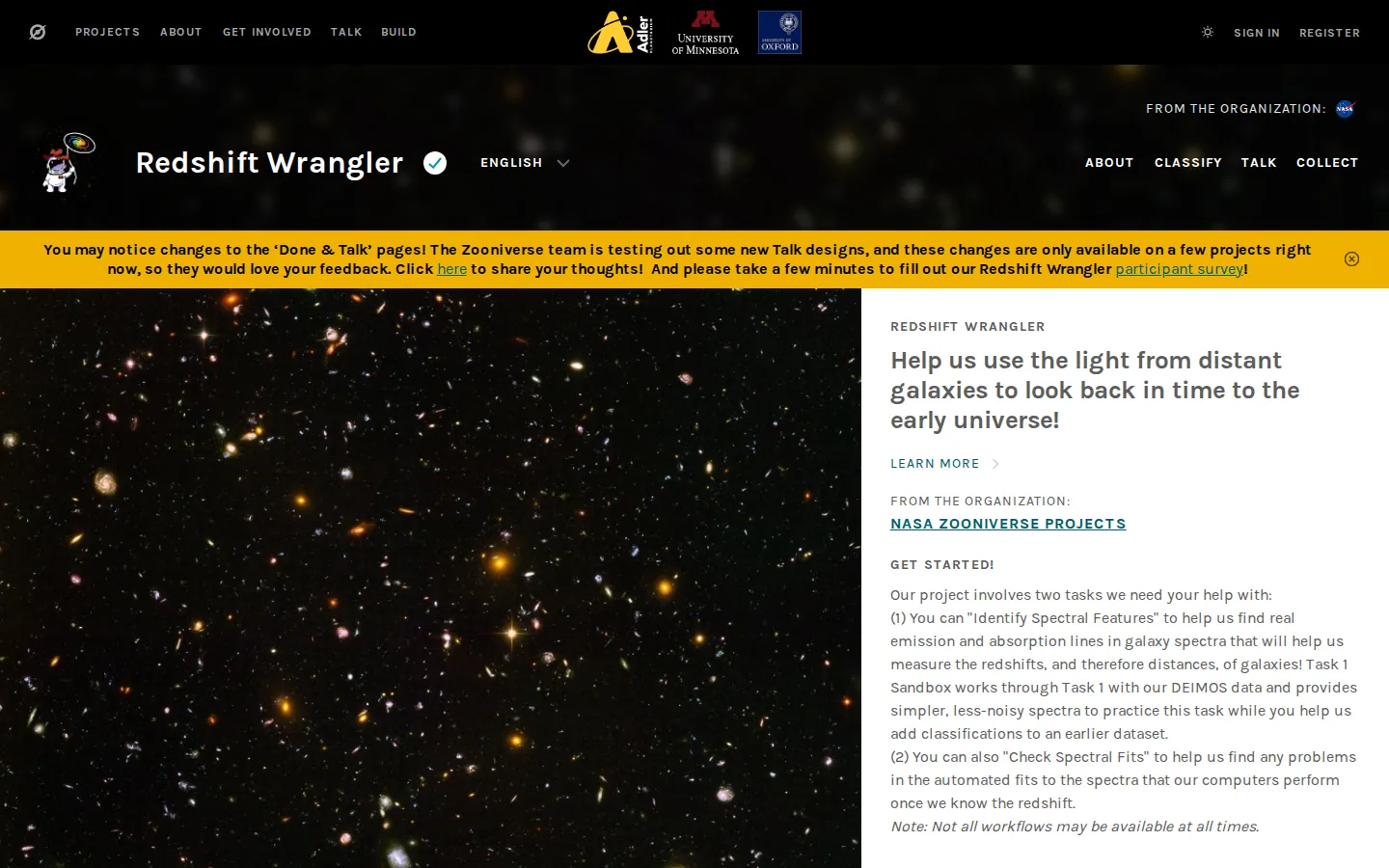
Redshift Wrangler turns distant-galaxy spectra into a pair of careful citizen-science jobs: mark convincing emission or absorption features, or check whether a computer-generated fit actually follows the data. A gentler DEIMOS sandbox gives first-timers a less noisy place to learn the ropes.
What is Redshift Wrangler?
Instead of handing you glamorous telescope portraits, Redshift Wrangler opens the universe's graph paper. One task asks you to compare a plotted spectrum with its two-dimensional strip and box features that look wider and more convincing than a stray pixel. The other asks whether a fitted line behaves like the underlying spectrum or wanders off course. Those small judgments help the Rochester Institute of Technology team calculate galaxy redshifts and study distance, composition, star formation, and black-hole activity. The project already reports encouraging DEIMOS results: for spectra where volunteers found multiple usable lines, more than 92 percent of its measurements closely matched expert catalog values. That result has an important fence around it—it does not cover objects without enough marked lines—but it shows why patient pattern-spotting matters here.
What you can do there
- Mark emission and absorption features in galaxy spectra
- Check automated spectral fits for problems
Why we picked it
This is real research with unusually legible stakes. A bump is not just a bump: when it belongs to a recognizable family of spectral lines, its shifted position helps place a galaxy in distance and cosmic history. The beginner sandbox also softens a genuinely technical task without turning it into make-believe science.
How to get the most from it
Begin with Task 1 Sandbox if it is available, then keep the one-dimensional graph and the two-dimensional spectrum in conversation. Favor features that persist across more than one data point, and use the tutorial and field guide before deciding that noise is a line. If marking peaks feels slippery, switch to the fit-checking task and compare the model line with the overall shape of the data.
Good to know
The project is free, runs online, and says no astronomy background is required; NASA estimates five to fifteen minutes for the tutorial. Workflow availability can change, and the public statistics block currently mixes a 78 percent completion figure with zero visible volunteer, classification, and subject counts. Treat those counters as unreliable until the platform settles them. The classifier itself was not exercised here, so account, device, accessibility, audio, and submission behavior remain unverified.
Who made it, and when?
Jeyhan Kartaltepe and the Redshift Wrangler team is the credited creator or organization. The earliest supported launch date we found is May 30, 2023.
Creator’s official page Open Redshift WranglerMore like this
The Pudding

Visual essays that use code, data, and interaction to explain culture unusually well.
Earth Nullschool

A living globe of wind, weather, ocean currents, and atmospheric motion.
The True Size Of…

Drag countries around the map and watch familiar size comparisons fall apart.
MapCrunch

Drop into a random street-level view somewhere in the world and figure out where you landed.