
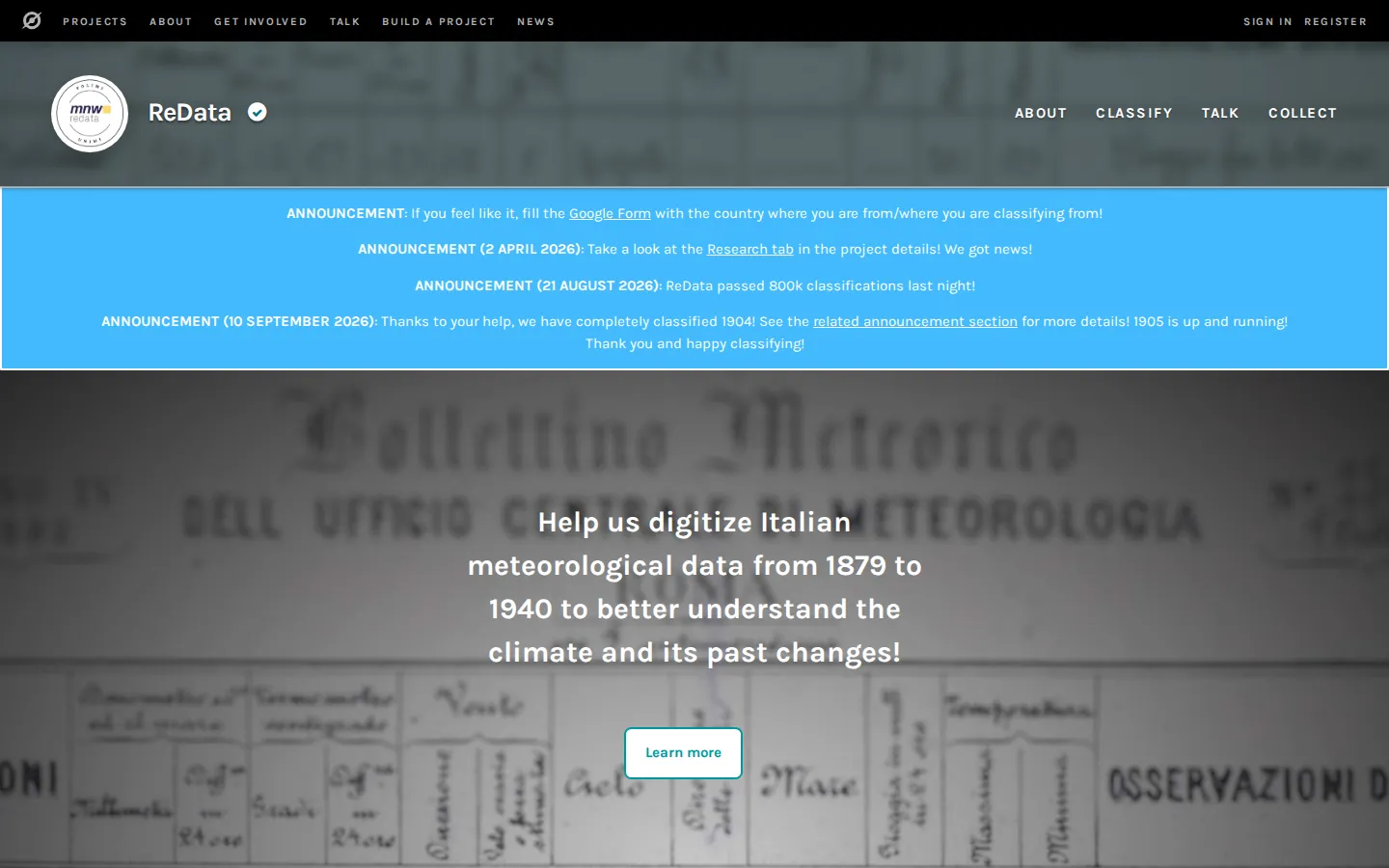
ReData hands volunteers scanned Italian weather bulletins and asks for the sort of patient transcription machines still struggle with. Each finished row rescues pressure, temperature, wind, cloud, sea-state, and rainfall observations from a paper archive spanning 1879 to 1940.
What is ReData?
This is citizen science at its most literal: history arrives as handwriting in a table, and you help move it into data. The Zooniverse workflow is organized by year and station. Volunteers first check that the requested place appears on the scanned page, mark the correct row, then enter pressure, temperature, wind, sky, sea, cloud, rainfall, and daily-extreme values. A tutorial and field guide explain old symbols and formats, while the discussion area gives difficult digits somewhere to go besides the guess pile. The scale is formidable—more than 21,000 bulletins, over 96,000 scans, and an estimated 25 million individual values in the redesigned program. The result is not merely a tidy archive: rescued observations can fill gaps in historical weather maps and help researchers reconstruct events that modern datasets only partly capture.
What you can do there
- Inspect scanned weather bulletins
- Transcribe station observations
- Help build historical climate records
Why we picked it
A single classification is modest, but the cumulative result is a weather memory for an entire country. ReData also makes the hard part visible: old ink, shifting formats, and ambiguous fives and sevens still need careful human eyes, even in an age of automated recognition.
How to get the most from it
Begin with the tutorial and keep the field guide open until the column order feels familiar. Confirm the city before typing, use the pressure and temperature tendency columns to cross-check unclear digits, and move uncertainty into the project discussion instead of quietly turning a smudge into a measurement.
Good to know
The work is repetitive and accuracy matters. Dated project announcements report more than 800,000 classifications and completion through 1903, with 1904 then active, but live counters in indexed output are inconsistent. We did not run the workflow, so account, autosave, accessibility, device support, and submission behavior remain unverified.
Who made it, and when?
MeteoNetwork and University of Milan is the credited creator or organization. The earliest supported launch date we found is November 26, 2024.
Creator’s official page Open ReDataMore like this
The Pudding

Visual essays that use code, data, and interaction to explain culture unusually well.
Earth Nullschool

A living globe of wind, weather, ocean currents, and atmospheric motion.
The True Size Of…

Drag countries around the map and watch familiar size comparisons fall apart.
MapCrunch

Drop into a random street-level view somewhere in the world and figure out where you landed.