
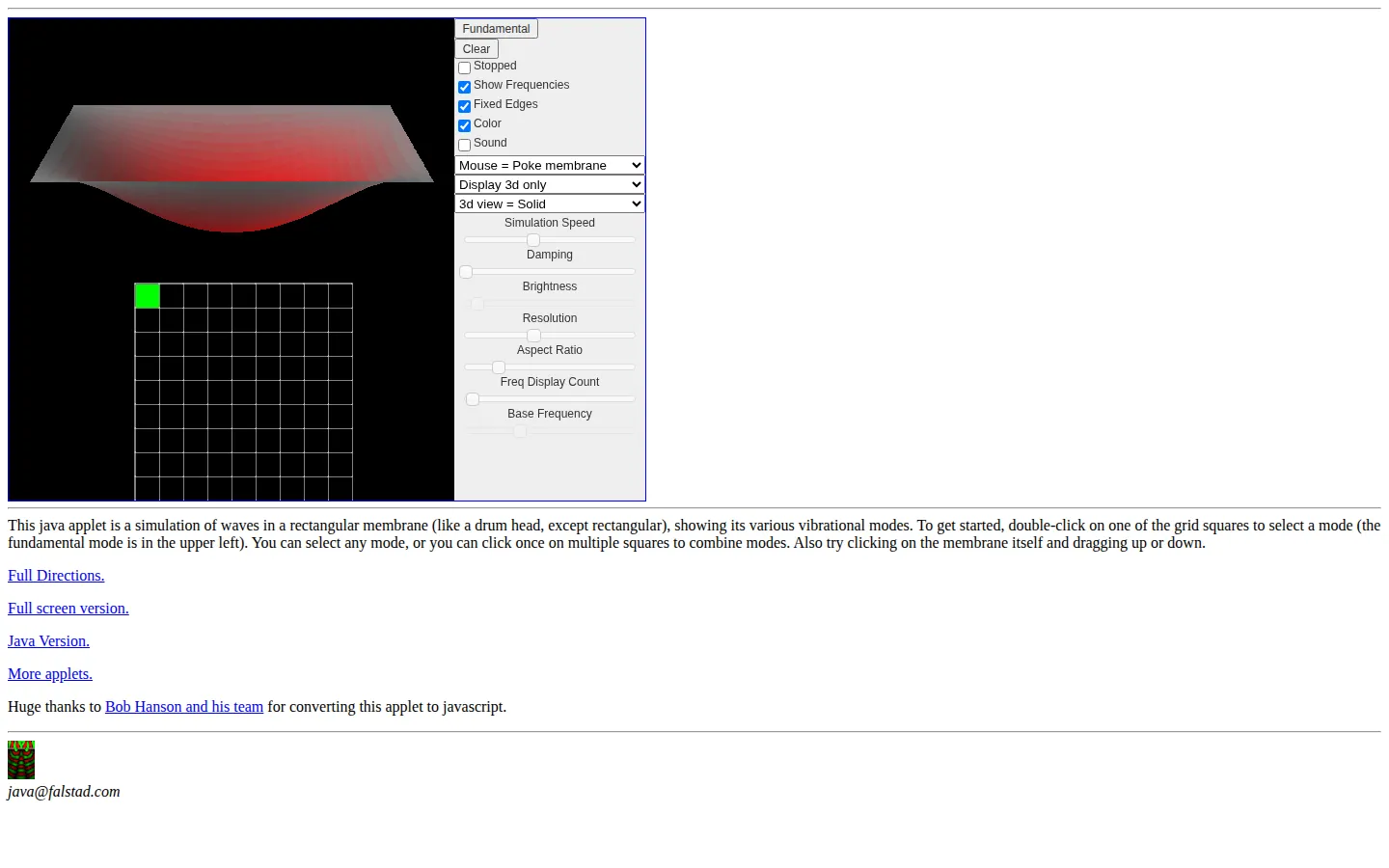
Rectangular Membrane turns normal modes from textbook diagrams into a manipulable surface. Choose a vibration from the grid, blend several together, change the boundary conditions, or disturb the membrane directly and use the surrounding controls to see how the pattern responds.
What is Rectangular Membrane?
The simulation puts a vibrating sheet above a grid of its component modes. That arrangement makes a useful two-way map: click a cell to add a particular pattern, then watch the surface inherit its bumps and nodal lines. Magnitude and phase can be adjusted separately, while fixed or free edges change which families of modes are available. The control panel goes well beyond a single animated drumhead. You can switch between 2-D and 3-D views, alter damping and simulation speed, stretch the aspect ratio, reduce rendering detail, and optionally hear the result. The most revealing experiments come from combining modes or changing a square into a rectangle, where symmetry and degeneracy stop being vocabulary and start becoming visible mischief.
What you can do there
- Select and combine vibrational modes
- Poke or shape a rectangular membrane
- Adjust damping, speed, aspect ratio, phase, and view
- Listen to the simulated membrane when sound is enabled
Why we picked it
It exposes both the whole motion and the ingredients that create it. That makes the page useful for more than watching a wobbly surface: it lets a curious visitor connect spatial patterns, frequencies, phase, and boundary conditions without needing to begin with a page of equations. Independent education records also place it in real high-school, college, and acoustics-teaching contexts.
How to get the most from it
Begin with the fundamental mode in the upper-left cell, then clear the membrane and add one higher mode. Once the nodal lines make sense, combine two cells and adjust one mode's phase. Finish by changing the aspect ratio or edge condition to see which apparent symmetries survive.
Good to know
Sound is optional, and the directions include a color-off control plus both 2-D and 3-D views. The project began as a Java applet and the current page credits a JavaScript conversion, so older teaching references may describe a different runtime. Live mobile, keyboard, accessibility, and browser behavior remain uncertain; the favicon is pending verification.
Who made it, and when?
Paul Falstad is the credited creator or organization.
Creator’s official page Open Rectangular MembraneMore like this
Neal.fun

A cabinet of interactive ideas that makes learning feel suspiciously like play.
Quick, Draw!

Doodle against the clock while a neural network tries to guess your subject.
Sandspiel

Paint with sand, water, fire, plants, oil, and other tiny materials that react to one another.
WebGL Fluid Simulation

Push luminous liquid color around the screen and watch digital turbulence behave beautifully.