
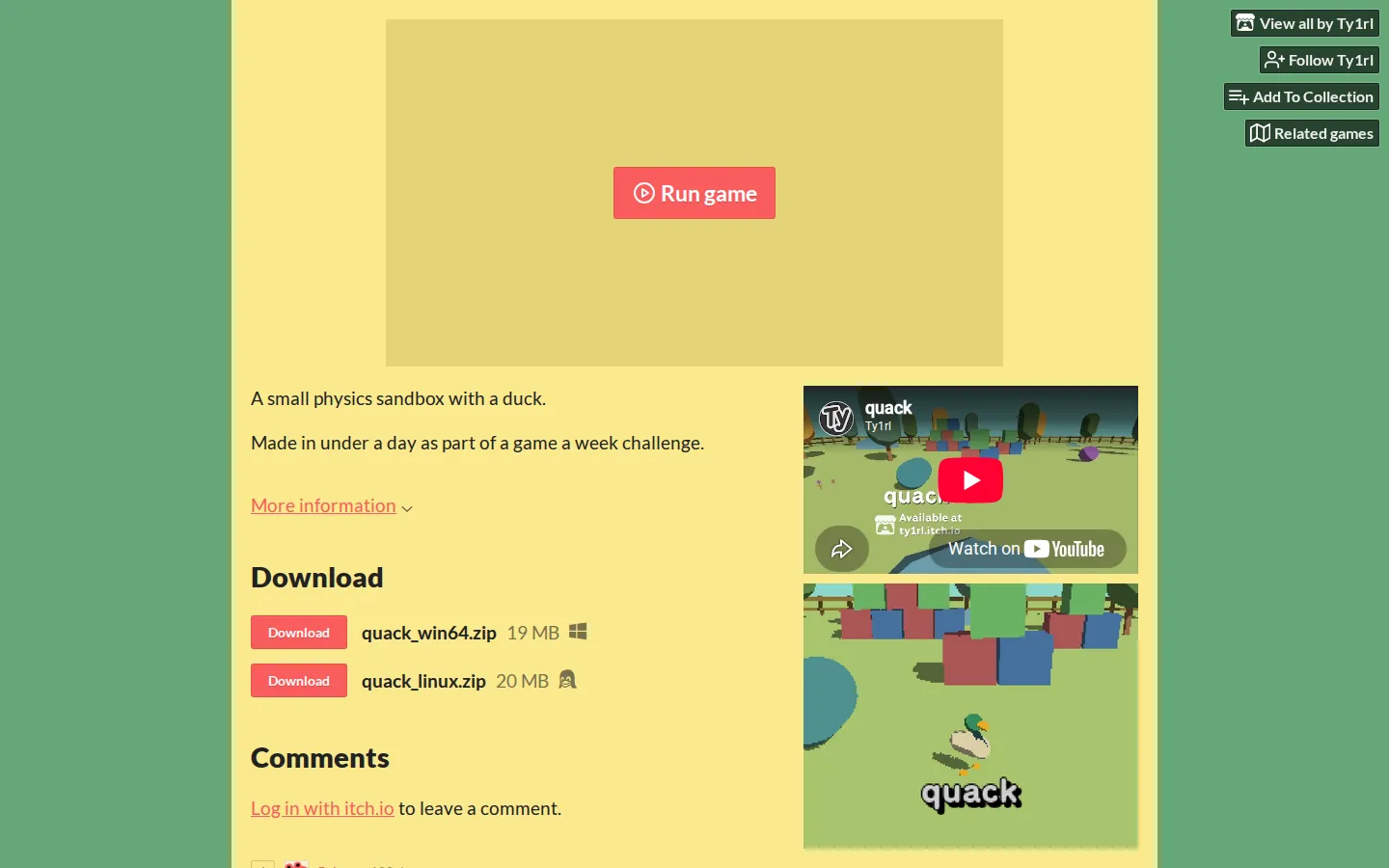
Quack is a tiny browser-playable Godot prototype that turns a duck loose in a 3D physics sandbox. Its store page promises a short, experimental diversion rather than a campaign, with Windows and Linux downloads available beside the browser version.
What is Quack?
The premise is gloriously narrow: put one duck in a compact physics playground and let the movement do the comedy. Quack's chunky, low-resolution look is more than a shortcut; the creator paired toon lighting with a vertex-wobble shader, then gave the duck procedural feet that seek the ground with ray casts. The result is a prototype whose personality lives in how its bird occupies the world, not in menus, lore, or a checklist of objectives.
What you can do there
- Launch the browser prototype
- Experiment inside a duck-centered physics sandbox
Why we picked it
Few one-day experiments communicate their entire appeal this cleanly. A duck, a physics sandbox, and an intentionally wobbly visual treatment are enough to make the project feel like a digital desk toy with feathers. It is specific, quick to understand, and pleasantly unconcerned with becoming a larger game.
How to get the most from it
Choose Run game on the itch.io page and approach it as a toy rather than a level to beat. Give the movement and scenery room to misbehave; if the browser build is inconvenient, the same page offers separate Windows and Linux downloads.
Good to know
Quack is explicitly labeled a prototype. The listing does not explain controls, saving, touch support, audio, or accessibility options, and its frame policy means the experience should be opened directly on itch.io rather than expected to run inside Site Stumble.
Who made it, and when?
Ty1rl is the credited creator or organization.
Creator’s official page Open QuackMore like this
The Library of Babel

Search an imaginary library that contains every possible page of a fixed length—including this sentence somewhere.
FutureMe

Write an email to yourself and choose a date far enough away to make it meaningful.
Wowfold

A paper-plane hangar stocked with darts, gliders, and expert oddballs
Arcane Intern

A magical publishing internship where coffee runs come with sigils.