
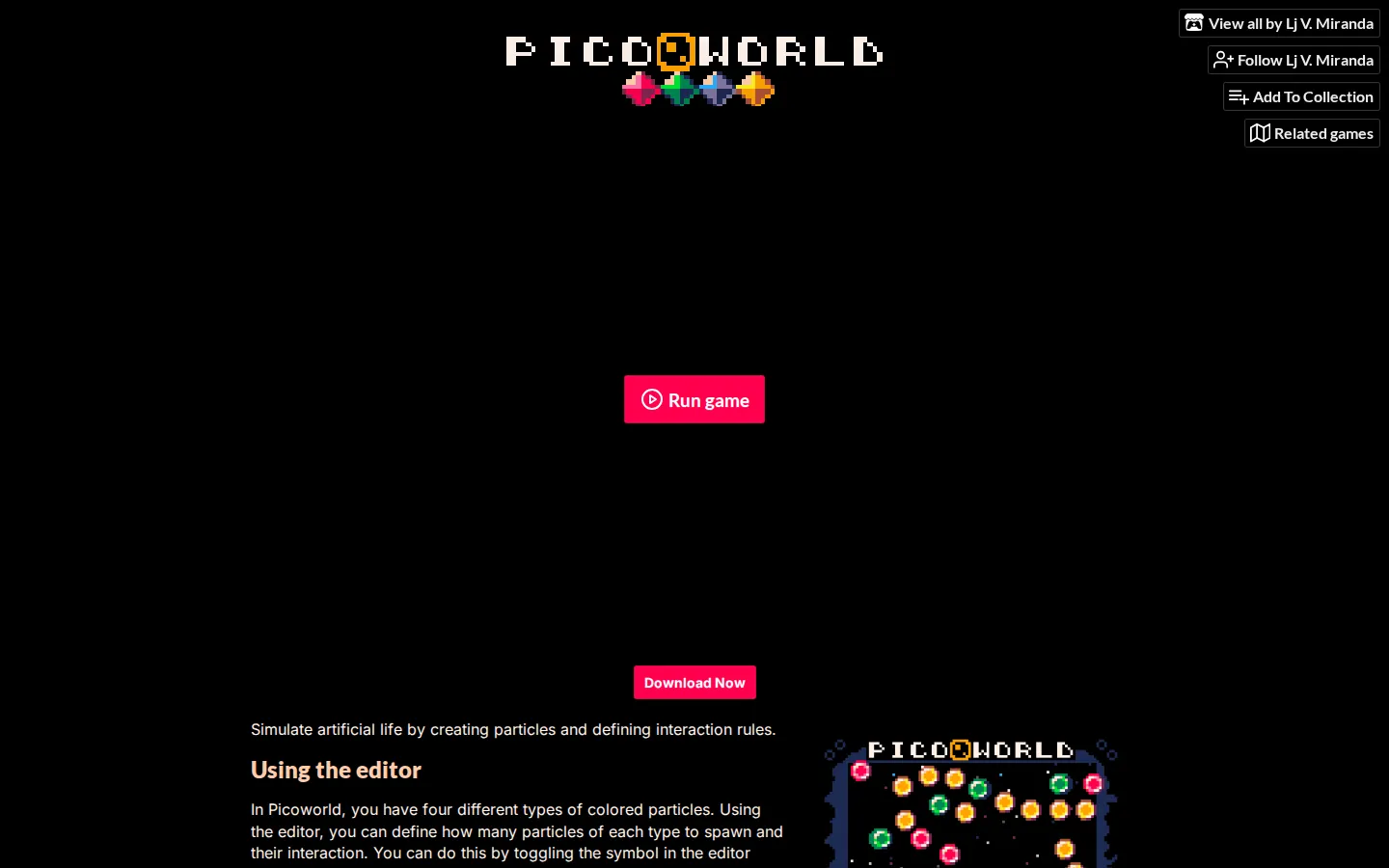
Picoworld is a tiny artificial-life sandbox built for PICO-8. You choose how many particles of four colors should exist, decide which colors attract or repel one another, and then release the whole rule set to see what patterns wriggle into view.
What is Picoworld?
The editor is small enough to understand at a glance but flexible enough to produce lopsided little worlds. A 4-by-4 grid controls directional relationships, so red can chase green without green returning the favor. Population crystals set how crowded each color becomes, while several force strengths let a gentle drift turn into a microscopic traffic dispute. Once the configuration is ready, one button starts the simulation and the rules become motion.
What you can do there
- Set particle populations
- Define directional attraction and repulsion rules
- Run the simulation and watch patterns emerge
Why we picked it
Picoworld turns an abstract idea from artificial-life research into something you can poke without a textbook. The delight comes from changing one relationship, running the same tiny universe again, and spotting how much the pattern shifts. It is compact, legible, and built around genuine experimentation rather than a decorative science theme.
How to get the most from it
Begin with only two particle colors and one attraction or repulsion rule so the cause and effect stay readable. Then add a third color or make one relationship asymmetric. Save a screenshot of any especially strange configuration before changing the grid, because the fun is comparing small rule changes.
Good to know
The page describes an average visit of a few minutes and lists both keyboard and touchscreen input. The downloadable PICO-8 cartridge is offered on name-your-own-price terms, while the official PICO-8 catalog records a CC BY-NC-SA license. Audio and save behavior are not documented.
Who made it, and when?
Lj V. Miranda is the credited creator or organization. The earliest supported launch date we found is September 4, 2022.
Creator’s official page Open PicoworldMore like this
Neal.fun

A cabinet of interactive ideas that makes learning feel suspiciously like play.
Quick, Draw!

Doodle against the clock while a neural network tries to guess your subject.
Sandspiel

Paint with sand, water, fire, plants, oil, and other tiny materials that react to one another.
WebGL Fluid Simulation

Push luminous liquid color around the screen and watch digital turbulence behave beautifully.