
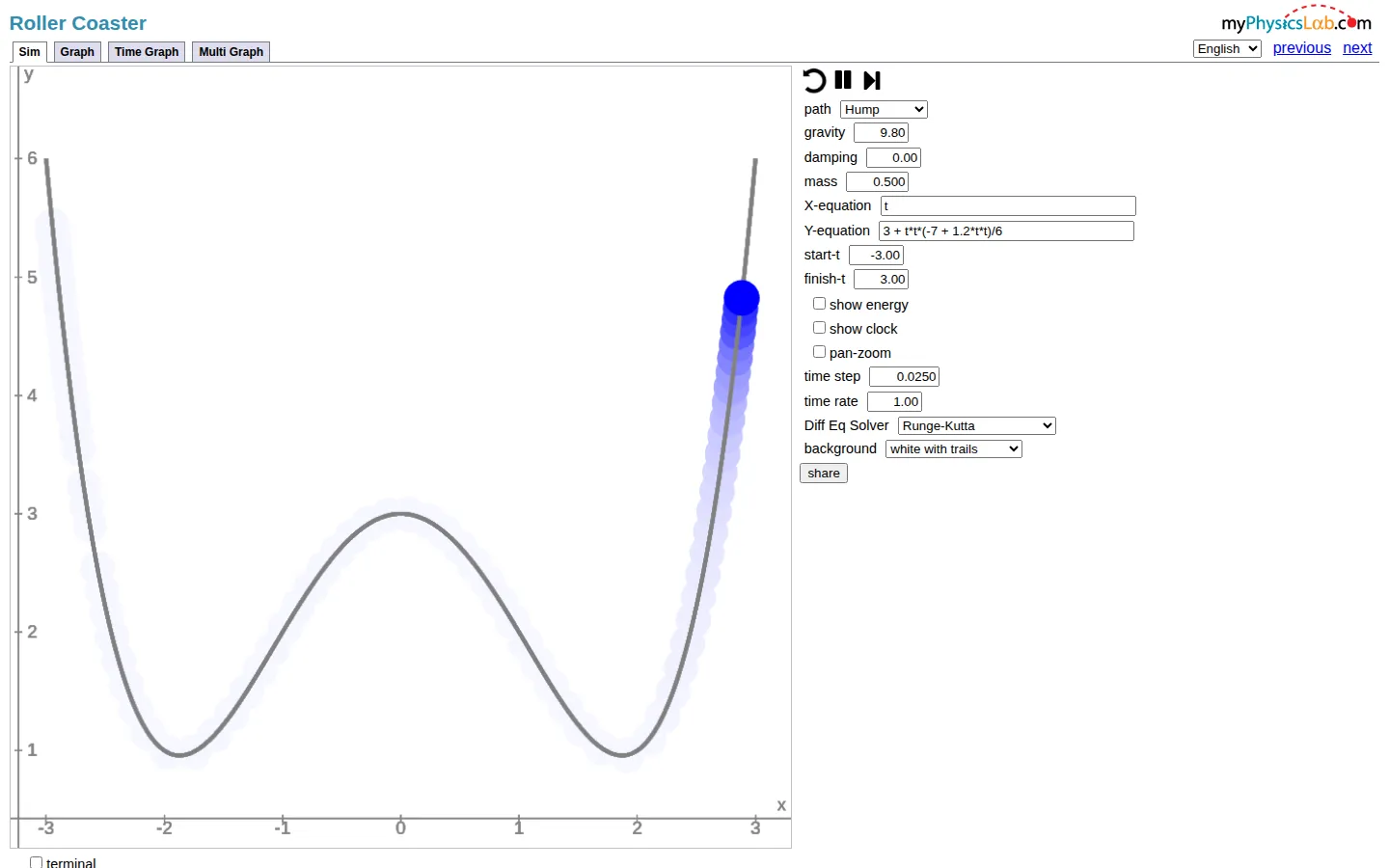
Pick a preset curve or write one with parametric equations, place the ball, and vary gravity or damping while graph views expose the changing motion. It is part playground, part worked notebook: the page derives its equations and even points out where numerical shortcuts make the energy wobble.
What is myPhysicsLab Roller Coaster?
The model is deliberately narrow: one ball moves along a curved track and cannot fly away from it. That constraint creates a surprisingly roomy laboratory. Presets range from a hump and loop-the-loop to a circle, lemniscate, oval, and spiral, while a custom mode accepts JavaScript expressions for X and Y. The page then follows the motion down into the machinery, deriving the force equation, describing its Runge-Kutta solver, and explaining how a table stands in for a difficult curve integral. The most useful twist is its candor. An energy test shows where approximation can make the simulated system drift, turning an apparent flaw into a lesson about numerical modeling.
What you can do there
- Choose a curved track and change the ball's starting position
- Adjust gravity and damping
- Compare simulation and graph views
- Define a custom track with parametric equations
Why we picked it
The simulation does more than make physics wiggle on screen. It connects an adjustable model to the equations underneath and gives visitors a concrete way to probe whether the calculation behaves. That combination of toy, notebook, and self-critique is much more memorable than another frictionless inclined-plane diagram.
How to get the most from it
Start with the hump track and move the ball to a clear starting height. Change only gravity or damping at first, then compare the Sim, Graph, and Time Graph views. For the page's own accuracy test, choose the circle, set damping to zero, release the ball from the apex, and watch whether it returns to nearly the same height. Save the custom equations until the preset behavior makes sense.
Good to know
This is an educational mechanics model, not a coaster game, and the single-ball version assumes the ball stays attached to the track. Its units are dimensionless, so any interpretation must remain internally consistent. The creator also warns that displayed total energy can fluctuate because the curve and slope are approximated; treat that caveat as part of the lesson, not a precision guarantee.
Who made it, and when?
Erik Neumann is the credited creator or organization. The earliest supported launch date we found is April 2002. A documented update was recorded December 19, 2023.
Creator’s official page Open myPhysicsLab Roller CoasterMore like this
Neal.fun

A cabinet of interactive ideas that makes learning feel suspiciously like play.
Quick, Draw!

Doodle against the clock while a neural network tries to guess your subject.
Sandspiel

Paint with sand, water, fire, plants, oil, and other tiny materials that react to one another.
WebGL Fluid Simulation

Push luminous liquid color around the screen and watch digital turbulence behave beautifully.