
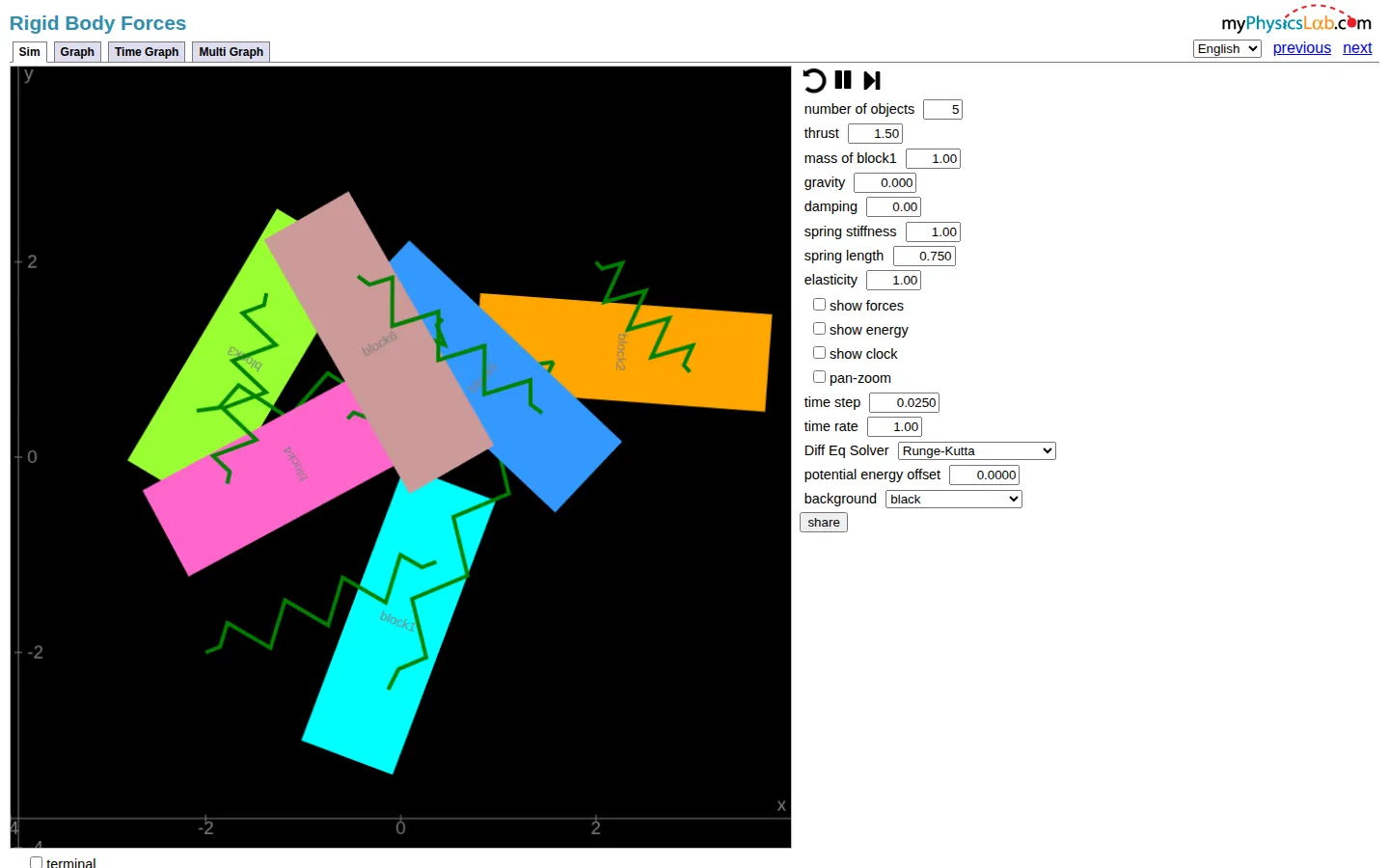
Rigid Body Forces pairs a two-dimensional mechanics sandbox with the mathematics underneath it. Mouse-applied springs, keyboard thrusters, gravity, damping, adjustable mass, and energy views make the motion approachable, while the same page derives the force and torque equations that send each rectangle wobbling away.
What is myPhysicsLab Rigid Body Forces?
Rigid Body Forces puts a small fleet of rectangles in a two-dimensional sandbox where gravity, damping, spring pulls, and keyboard thrusters feed the motion. The clever part sits below the sandbox: the page walks through force, torque, moment of inertia, and the six first-order equations used for each body. Tabs for graphs and an optional energy display turn the toy into a compact mechanics notebook. The page also admits its rough edge—objects can overlap and get stuck—so this is an explanatory model, not a polished collision playground.
What you can do there
- Apply spring forces with the pointer
- Fire keyboard-controlled thrusters
- Adjust gravity, damping, object count, and mass
- Inspect graphs, energy, equations, and momentum
Why we picked it
The handoff from poking a block to understanding its torque is unusually clear. The visible controls give the equations something concrete to explain, and the long-form derivation gives the moving shapes more purpose than a typical digital desk toy. It is a tidy place to connect cause, motion, and math.
How to get the most from it
Begin with one or two objects and change one parameter at a time. Click near a body to apply a spring force, then try the documented thruster keys and compare the motion with the energy graph. If the keyboard does nothing, the page suggests clicking near an object first so the simulation receives the keystrokes.
Good to know
The author warns that bodies can overlap and leave the simulation stuck; reset and try a gentler shove if the sandbox ties itself in a knot. The experience is animated and keyboard-heavy, while current touch, screen-reader, flashing, audio, and reduced-motion behavior remains undocumented here. The equations use dimensionless units, so consistency matters more than a particular choice of meters or seconds.
Who made it, and when?
Erik Neumann is the credited creator or organization. The earliest supported launch date we found is February 2003. A documented update was recorded December 19, 2023.
Creator’s official page Open myPhysicsLab Rigid Body ForcesMore like this
Neal.fun

A cabinet of interactive ideas that makes learning feel suspiciously like play.
Quick, Draw!

Doodle against the clock while a neural network tries to guess your subject.
Sandspiel

Paint with sand, water, fire, plants, oil, and other tiny materials that react to one another.
WebGL Fluid Simulation

Push luminous liquid color around the screen and watch digital turbulence behave beautifully.